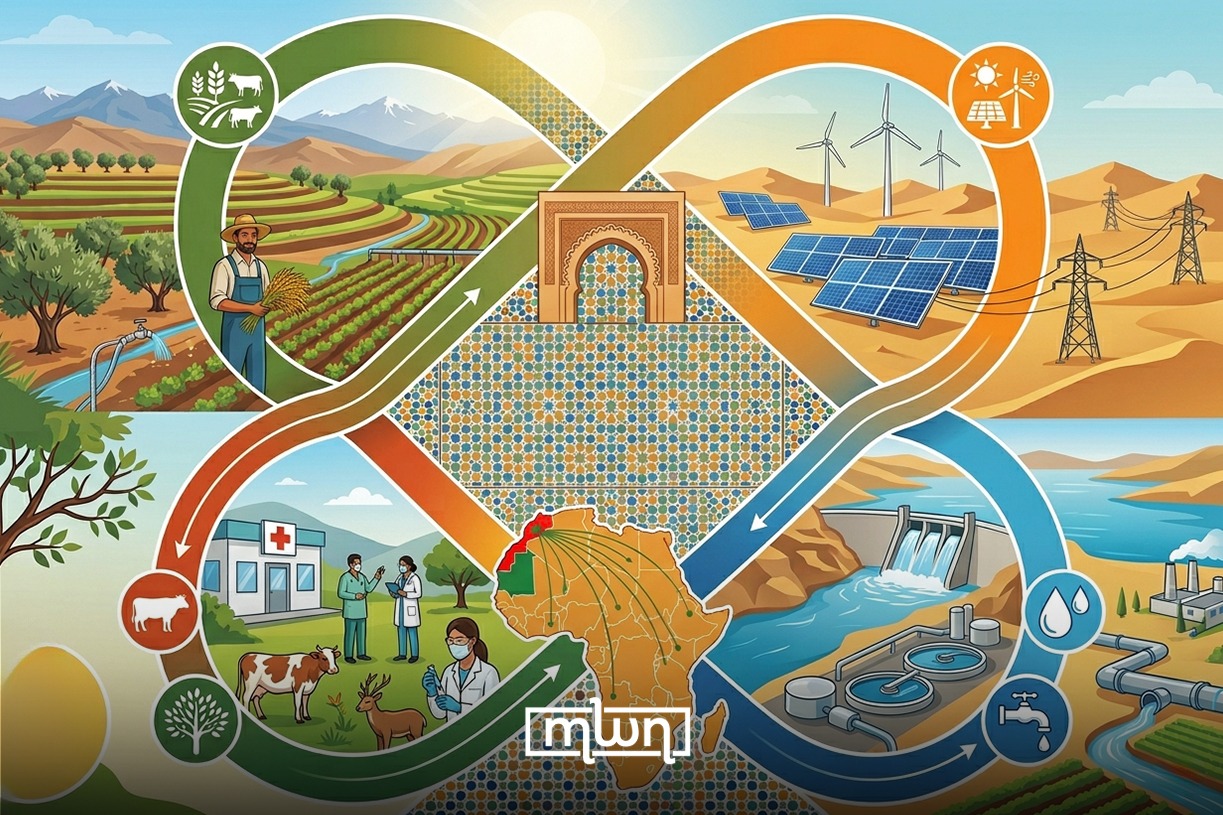
The contemporary resource crisis, the scope of which is evident in the twenty-first century, must be understood through a holistic lens, disregarding the compartmentalized approaches that have been employed in the past. The interrelated challenges of food insecurity, energy vulnerability, water scarcity, and public health risk have converged to render isolated policy responses progressively ineffective. This points to the prominence of the nexus approach in international policy debates, as it acknowledges the interdependence of food systems on water and energy resources, and the multifaceted nature of health outcomes that extend beyond the conventional hospital and pharmaceutical interventions. The nexus approach also recognizes the significance of ecosystems, animal health, sanitation, food safety, and climate resilience in determining health outcomes. According to the World Health Organization (WHO), One Health is defined as an integrated approach that seeks to optimize the health of people, animals, and ecosystems together, rather than considering these elements in isolation.
On a global scale, the mounting pressure is evident. Approximately half of the world’s population endures periods of severe water scarcity on a yearly basis. Agriculture maintains its dominant position as the primary water user, accounting for approximately 72% of global freshwater withdrawals. Concurrently, hunger persists as a systemic challenge. According to the Food and Agriculture Organization (FAO), approximately 673 million individuals experienced hunger in 2024. Africa continues to be the region with the highest prevalence of undernourishment, with more than one-fifth of its population affected. It is imperative to recognize that these figures do not constitute isolated tragedies. Rather, these phenomena are indicative of a systemic imbalance, wherein water scarcity leads to a decline in food production, the costliness or carbon intensity of energy affects the viability of irrigation, desalination, cold chains, and food processing, and the degradation of ecosystems concomitantly increases the risks of disease and livelihood insecurity.
The African continent is particularly cognizant of this interdependence. The continent is confronted with converging pressures from climate volatility, reliance on food imports, disparate energy access, and inadequate infrastructure financing. According to the International Energy Agency (IEA), energy investment in Africa was projected to reach approximately $110 billion in 2024. However, the scale and composition of this investment were deemed inadequate to ensure the sustainable and secure development of many African countries. Consequently, the African policy challenge entails not only the production of food, power, and water in isolation, but also the integration of these systems in a manner that ensures mutual reinforcement. In this regard, the nexus framework transcends its conceptual purview, assuming a more substantial role. This phenomenon, therefore, becomes a governance imperative.
Morocco offers a particularly instructive case study due to its geographical and climatic circumstances, which have compelled the nation to address the nexus problem directly. The country is among the most water-stressed in the world, with water availability estimated by the World Bank at approximately 620 cubic meters per person per year. The urgency of the situation has been accentuated in recent years. Over a five-year period, Morocco experienced four droughts. Additionally, dam reserves used for agricultural purposes have been reduced by half over the last decade. Furthermore, the area irrigated by large-scale systems has declined by 44%, according to a recent World Bank policy note. The same institution has warned that a combination of reduced water availability and climate-related yield losses could result in a 6.5% decrease in Morocco’s GDP over the long term. In a nation where agriculture continues to be of strategic importance from social and economic perspectives, water insecurity emerges as a multifaceted challenge, encompassing not only environmental implications but also significant macroeconomic and social ramifications.
Water in a cross-sector framework
Notably, Morocco has not regarded water scarcity exclusively through a hydraulic lens. The nexus between water policy and these other fields has grown increasingly apparent, with water policy increasingly being intertwined with agricultural modernization, the energy transition, and territorial resilience. The National Program of Water Savings in Irrigation aims to modernize irrigation across approximately 550,000 hectares. Official data on the Green Morocco Plan indicate that drip irrigation expanded to roughly 542,000 hectares, up from 128,000 hectares previously. The Generation Green 2020-2030 strategy has further emphasized a more resilient and eco-efficient agriculture, including the objective of doubling water efficiency. The significance of these policies lies in their role in transitioning the nation from a conventional “supply response” model to a more advanced productivity-based framework. This transformation is predicated on the imperative for every cubic meter of water to engender enhanced food and income value.
The second pillar of the Moroccan experience is the interconnection between water and energy. Morocco’s recent water planning initiatives have incorporated non-conventional water sources, such as desalination and treated wastewater reuse, in addition to pursuing measures aimed at minimizing losses in potable and irrigation networks. This is of paramount importance because conventional water resources alone are no longer adequate in the face of recurring drought conditions. However, desalination is an energy-intensive process, which renders its long-term viability contingent upon access to cleaner and more affordable power sources. In this context, Morocco’s energy transition assumes a strategic importance. According to official Moroccan reporting, the installed renewable energy capacity reached 5.5 gigawatts in 2025, representing 45.5% of the total installed power capacity. By the end of 2024, renewables contributed 27% of national electricity production. Morocco’s long-standing policy target remains to reach 52% of installed electricity capacity from renewable sources by 2030. In terms of nexus, this creates the possibility of powering water security with lower-carbon electricity, while also strengthening industrial and agricultural resilience.
The third pillar is One Health, which is often underappreciated in resource debates. The absence of food safety in food systems invariably undermines their overall security. The absence of adequate sanitation, pollution, and ecosystem degradation can exacerbate the risk of disease transmission through water systems. It is imperative to recognize that the pursuit of agricultural growth is inherently linked to the health and well-being of animals. However, it is equally crucial to acknowledge that this pursuit cannot be considered sustainable if critical considerations, such as zoonotic threats, antimicrobial resistance, and animal health failures, are not incorporated into policy design. Morocco has recently adopted a similar approach through biosecurity and zoonoses-related cooperation that is explicitly grounded in the One Health approach. According to a 2025 report by the Food and Agriculture Organization (FAO), Morocco has been implementing measures to enhance biosecurity measures against zoonoses that have the potential to cause a pandemic. The WHO’s health security platform for Morocco has outlined a series of operational tools that fall under the overarching concept of “One Health,” which emphasize risk assessment, coordination, surveillance, and information sharing. This is of particular importance because a comprehensive nexus strategy must encompass not only the protection of resources, but also the biological systems through which resource insecurity can lead to human vulnerability.
A transitional model of resilience
It must be acknowledged, however, that a romanticized perspective on Morocco is misguided, as the North African country is more aptly characterized as a transitional exemplar than as a consummate specimen. Water reuse continues to encounter regulatory and coordination challenges; the ongoing drought continues to expose structural tensions in agricultural demand; and the energy transition, while substantial, remains incomplete. In essence, Morocco’s significance lies less in its adherence to perfection and more in the design of its policy architecture. The discourse on resilience at the national level has recently begun to incorporate a nexus of factors, including irrigation efficiency, non-conventional water supply, renewable power, and health security. For many African nations, this constitutes the fundamental lesson: the notion that Morocco’s approach is not to be replicated in a mechanical sense, but rather, that the assurance of resource security necessitates a multifaceted, coordinated statecraft.
In this regard, the experience of Morocco merits consideration by the broader African community. The country demonstrates that the food-energy-water-One Health nexus is not merely an abstract academic framework, but a practical foundation for national resilience. In regions where water is a limited resource, the primary challenge is to leverage energy in a manner that facilitates its production and conservation. In contexts where agricultural systems are susceptible to external pressures, technological advancements should prioritize enhancing efficiency over merely expanding extraction practices. In the context of ecosystems under duress, public health must evolve to adopt a preventive, multisectoral, and ecological paradigm. Morocco has not yet resolved all of these challenges; however, it has demonstrated an increasingly coherent approach to addressing them. In a continent where resource insecurity is becoming one of the defining development questions of our time, the model of coherence may be one of the most valuable to consider.
The post The Food-Energy-Water-One Health Nexus in Morocco: A Catalyst for Resource Security and a Model for Africa appeared first on Morocco World News.