San Diego mosque suspects’ writings reveal influence of online extremism, experts say
•The two teenage suspects in this week’s deadly attack on a San Diego mosque appear to have written a 75-page document replete with neo-Nazi ideology, incel rage and racist meme culture drawn from the...
•In an echo of the 2019 massacre at mosques in Christchurch, New Zealand, the suspects appeared to have worn body cameras that livestreamed their assault, video of which has circulated online.
•The suspects — identified by authorities as Caleb Vazquez and Cain Clark, teenagers who are believed to have first met online — killed three people at the Islamic Center of San Diego before taking the...
هذا الخبر من NBC News. خبر يقدم أدوات ذكاء اصطناعي للتلخيص والترجمة والاستماع.
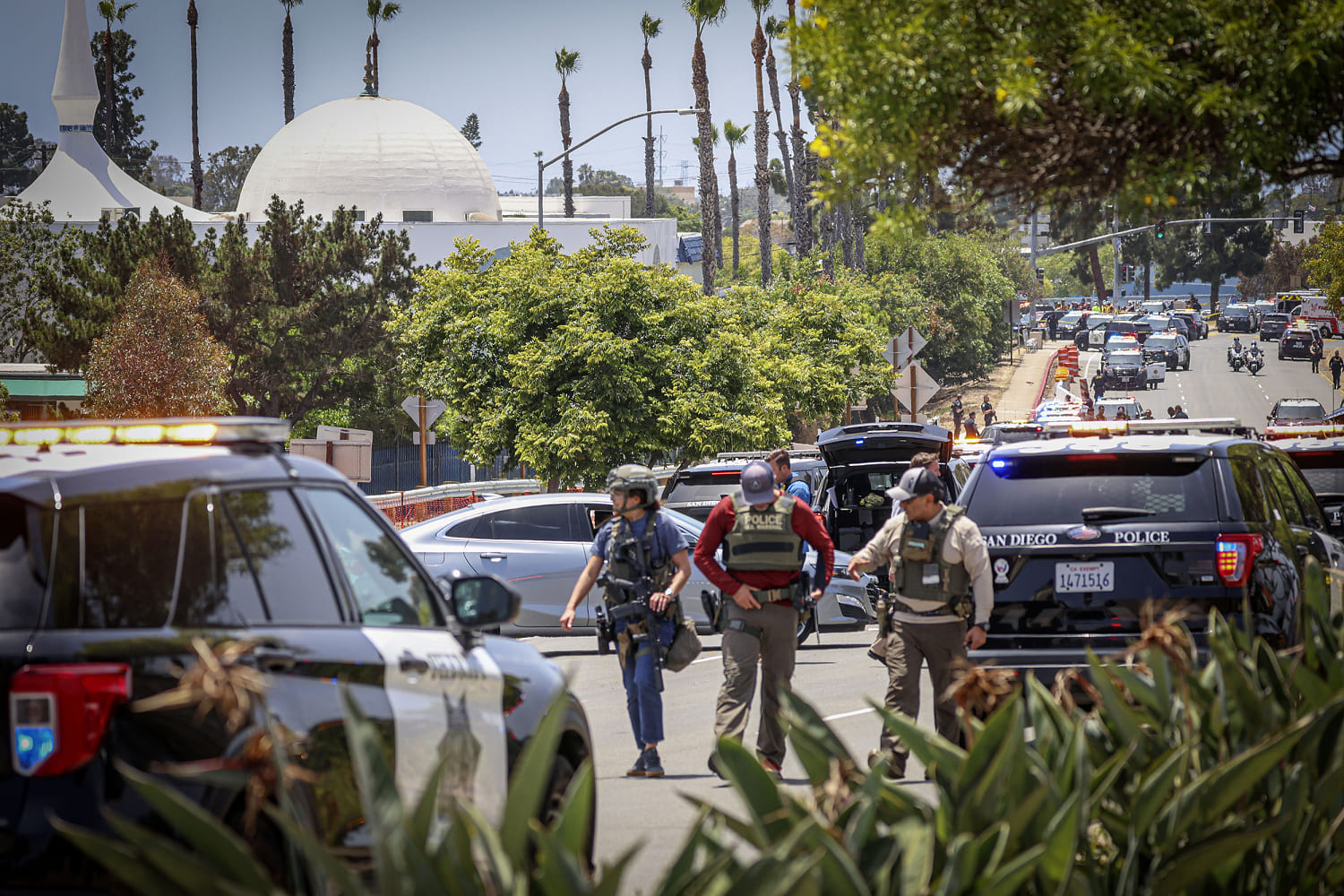
The two teenage suspects in this week’s deadly attack on a San Diego mosque appear to have written a 75-page document replete with neo-Nazi ideology, incel rage and racist meme culture drawn from the darkest corners of the internet. In an echo of the 2019 massacre at mosques in Christchurch, New Zealand, the suspects appeared to have worn body cameras that livestreamed their assault, video of which has circulated online. The suspects — identified by authorities as Caleb Vazquez and Cain Clark, teenagers who are believed to have first met online — killed three people at the Islamic Center of San Diego before taking their own lives on Monday. Authorities looking into the motivation behind the shooting are working to authenticate the lengthy typewritten document, which is filled with vitriol about Muslims, Jewish people, Black people, Latino people, the LGBTQ community, women and various other identity groups. The document features Nazi iconography and explicit references to accelerationism, a white supremacist ideology that encourages acts of violence to hasten the creation of a white “ethnostate.” “They didn’t discriminate on who they hated,” FBI special agent in charge Mark Remer told reporters at a news conference Tuesday. “It covered a wide aspect of races and religions.” The writings also “illustrate general misanthropy and an immersion in online nihilistic violent extremist ecosystems,” according to a review conducted by the Anti-Defamation League’s Center on Extremism, which tracks online and offline activity. The suspects’ purported writings shed light on the harrowing realities of violent extremism in the early 21st century, a time marked in part by an increase in high-profile, ideologically driven shootings and magnified by the chaotic nature of the modern internet. In the years since a gunman massacred worshippers at two mosques in Christchurch, New Zealand — a livestreamed attack that transformed extremist violence into editable digital content— experts say the internet has lowered the barrier for radicalization. “What I’m seeing here is a messy combination of ideological impulses, with accelerationist language that expresses a desire to be a heroic martyr that can inspire the actions of others but also clear white supremacist and antisemitic ideas alongside deeply misogynist and incel references,” said Cynthia Miller-Idriss, an American University professor who studies domestic extremism. “It’s messy and blurry and characteristic of the kind of young man who spends far too much time online incubating in hateful spaces and then follows a choose-your-own-adventure path to assembling what seems to him a coherent rationale for violence as a preferable solution to what he positions as an urgent or existential threat,” Miller-Idriss added. In the document, reviewed by NBC News, the authors express admiration for Adolf Hitler and the Christchurch shooter as well as the perpetrators of high-profile mass shootings in Buffalo, New York; Isla Vista, California; Pittsburgh; Orlando; and Columbine High School in Colorado, where students were massacred in 1999. In recent years, video of the Christchurch massacre has spread across digital platforms where extremists congregate and communicate. Officials investigating this week’s mosque attack are examining a livestream that the suspects appeared to have posted online before they died to determine whether it is authentic, three senior law enforcement officials said. “Each attack functions as a piece of content the community consumes, references, and metabolizes into the next attack,” said Alex Goldenberg, the founder of Silent Index, a national security consultancy. “The kill count operates as a press release; the manifesto and recording, as merchandise that continues to circulate after the attackers’ deaths. “The next attacker reads this material, attaches their own in-group signature, and produces the next entry. The lineage is not held together by an organization,” Goldenberg added. “It is held together by the recurrent production and circulation of violent content as community currency.” Jon Lewis, a researcher at George Washington University’s program on extremism, said he was struck by the fact that the suspects were in their late teens. “They were seemingly 10 and 12 when the Christchurch shooting happened,” Lewis said in a phone interview with NBC News. “They have simultaneously come up in an era” where “everyone in their age group is terminally online, but they’ve been consuming this content, seemingly from a very young age.” Remer, the FBI special agent in charge, told reporters Tuesday that federal law enforcement officials were “still going through” how exactly the suspects became radicalized. “I think that says so much about how low the barrier to entry is,” Lewis said. “I think this is, unfortunately, a really clear instance of how easy it is for this brand of do-it-yourself domestic terrorism to become reality.”المصدر: NBC News | Source: NBC News
ملاحظة تحريرية | Editorial Note: نُشر هذا المقال في الأصل بواسطة NBC News. خبر (Khabr) هي منصة إعلامية أردنية مرخّصة تعمل بالذكاء الاصطناعي. نضيف قيمة تحريرية من خلال: تحليل ذكي للأخبار، ملخصات تلقائية، رواية صوتية بالذكاء الاصطناعي، ترجمة متعددة اللغات، وتدقيق الحقائق. هدفنا جعل الأخبار أكثر وضوحاً وسهولةً للقارئ العربي.
This article was originally published by NBC News. Khabr is a licensed Jordanian AI-powered news platform (Registration #82086). We add editorial value through: AI-powered news analysis, automated summaries, AI audio narration, multi-language translation (Arabic, English, French, Turkish), and AI fact-checking. Our mission is to make news more accessible and understandable for Arabic-speaking audiences worldwide.