[Editor’s Note: This article is part of Khaleej Times’ Schools and Parents, a dedicated section designed to support families in the UAE as they explore educational choices. The section offers explainers, guidance from education leaders, expert advice and insights from parents to help readers make informed decisions about schools, curricula and communities.]
With UAE schools continuing distance learning, the Abu Dhabi Department of Education and Knowledge (ADEK) has introduced a comprehensive framework to maintain consistency, quality, and student wellbeing while campuses remain closed.
The new guidelines are part of a structured response to situations where students must learn from home, whether due to health, environmental, or other emergencies.
The policy makes one message clear: online education is not a compromise.
Stay up to date with the latest news. Follow KT on WhatsApp Channels.
“Distance learning is not a reduced version of schooling. It is schooling delivered by distance. The standard expected of schools — in terms of learning outcomes, student welfare, curriculum coverage, and teacher quality — does not change because the physical location changes.”
For parents navigating this shift, the document offers clarity on what schools must deliver — and what families should expect.
From live teaching requirements to wellbeing check-ins and screen time limits, the framework aims to balance academic continuity with student welfare.
Here’s a guide to help parents and teachers understand the new rules and what they mean for the students.
What do new ADEK rules mean for a child’s learning?
The biggest takeaway is that learning standards remain unchanged, even if classes are online. Schools are required to deliver structured, full-day education — not a reduced timetable or optional activities.
“While the delivery mechanism is different; the obligation to provide high quality education is the same.”
This means a child must continue covering the curriculum, completing assignments, and being assessed, just as they would in a physical classroom.
What is the difference between live (synchronous) and independent (asynchronous) learning?
Distance learning includes two main types:
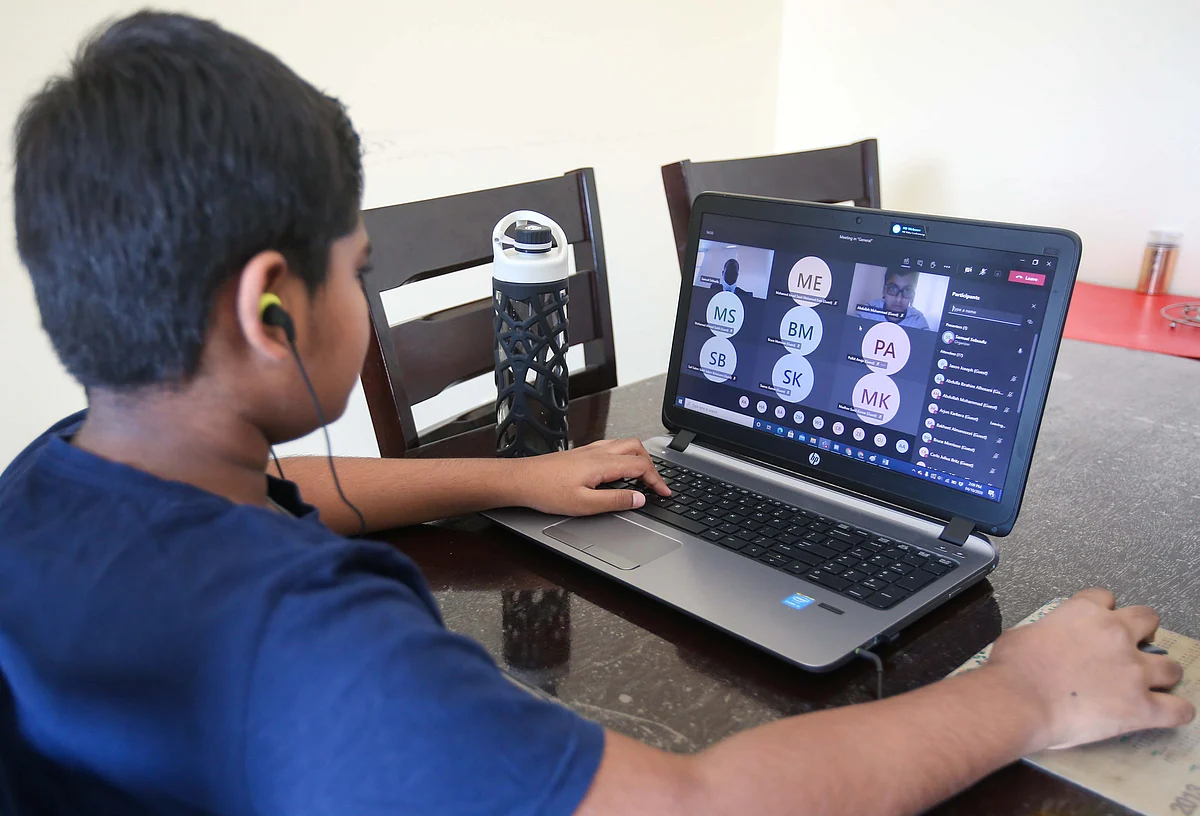
Synchronous learning: Live, real-time lessons where the teacher is on camera, interacting with students
Asynchronous learning: Tasks students complete independently, such as watching recorded lessons or working on projects
Importantly, not everything counts as “teaching time.”
As per ADEK, asynchronous work only counts when it is assigned, tracked, and reviewed by a teacher.
Parents should expect a blend of both, especially for older students, but with clear structure and accountability.
Are schools required to teach live classes every day?
Yes — and with certain conditions, depending on the grade level.
Schools must ensure that:
Teachers are visible on camera during live sessions
Lessons include interaction at least every 20 minutes
Pre-recorded videos cannot replace live teaching
In fact, ADEK is explicit:
“A pre-recorded video watched during a live session slot does not constitute live instruction.”
How will attendance be monitored?
Attendance is taken seriously, even online.
Schools must:
Record attendance for each session
Follow up directly with students if they don’t log in
Report attendance data daily to ADEK
A key point for parents:
Schools — not parents — are responsible for the first follow-up.
“Schools shall not contact parents to check on a student's whereabouts unless the school has first attempted contact with the student.”
Students who miss multiple sessions may be flagged as “at-risk”, triggering additional support.
What support is in place for student wellbeing?
Student welfare is a central part of the framework — not an afterthought.
Schools must:
Conduct at least one welfare check-in per week for every student
Increase check-ins to twice weekly for at-risk students
Appoint a dedicated Student Welfare Lead (SWL)
These check-ins are not academic. They focus purely on:
Emotional wellbeing
Engagement levels
Any signs of distress
This ensures that children who may be struggling silently are identified early.
How much screen time is allowed?
ADEK has introduced clear limits to prevent burnout.
Schools must:
Avoid long continuous screen sessions
Include a mandatory mid-morning break of at least 20 minutes (no tasks or messages allowed)
Ensure homework does not add extra screen time
There is also an emphasis on movement:
At least 45 minutes of PE (Physical Education) per week
Encouragement of 30 minutes of daily physical activity at home
Parents may even be asked during check-ins how their child is staying active.
How and when will schools communicate with parents?
Communication is now more structured — and time-bound.
Schools must:
Share daily timetables in advance (by 8pm the previous day)
Send one structured weekly update per class
Use a single official communication channel
There are also limits on when schools can contact parents:
Only between 3.30pm and 8pm for routine matters
And importantly, ADEK draws a clear boundary on roles:
“Schools shall not transfer responsibility for academic instruction to parents. Parents are responsible for the child's environment; the teacher is responsible for the child's learning.”
How are schools ensuring the quality of teaching during distance learning?
Schools are expected to follow strict monitoring systems to maintain high teaching standards in a remote environment. Principals and senior leaders play a central role in this process by reviewing a minimum of 5 per cent of each teacher’s live session recordings every week. These reviews are formally documented, ensuring transparency and accountability.
If any session does not meet the required standards, the teacher is issued a written improvement notice within two school days, allowing for timely corrective action. In addition, teachers must upload their lesson plans to the school’s Learning Management System (LMS) at least 30 minutes before each live session. Missing a lesson plan is treated as a compliance failure and is recorded in the school’s weekly report.
What can parents do if they feel that the school is not meeting these standards?
The framework is not just guidance — it is enforceable.
Schools that fail to meet mandatory requirements are considered non-compliant and may face action under the education regulator’s monitoring system, which includes:
Daily and weekly reporting
Remote inspections
Data reviews
If need be, as a parent, one must do the following:
First raise concerns with the school (class teacher or leadership)
Escalate through the school’s designated contact (such as the Distance Learning Lead)
Keep records of specific issues (missed live classes, lack of feedback, etc.)
Notably, these are minimum standards, schools are allowed to exceed them — but not fall below them.
What measures are schools taking to support teacher wellbeing during distance learning?
Recognising that distance learning places increased demands on teachers, schools are required to implement clear measures to protect staff wellbeing and prevent burnout. This includes building structured timetables that limit workload, ensure regular breaks, and provide ongoing support.
Each teacher must have at least a 30-minute break during the day, separate from lunch, with no teaching or communication responsibilities. Schools must also ensure that teachers are not scheduled for more than three consecutive hours of live instruction without a break. Weekly wellbeing check-ins are mandatory, and every staff member is assigned a dedicated point of contact for support.
Additionally, schools conduct regular workload reviews to identify teachers who may be under excessive strain and adjust responsibilities accordingly. In more serious cases, teachers can be referred to external support services.