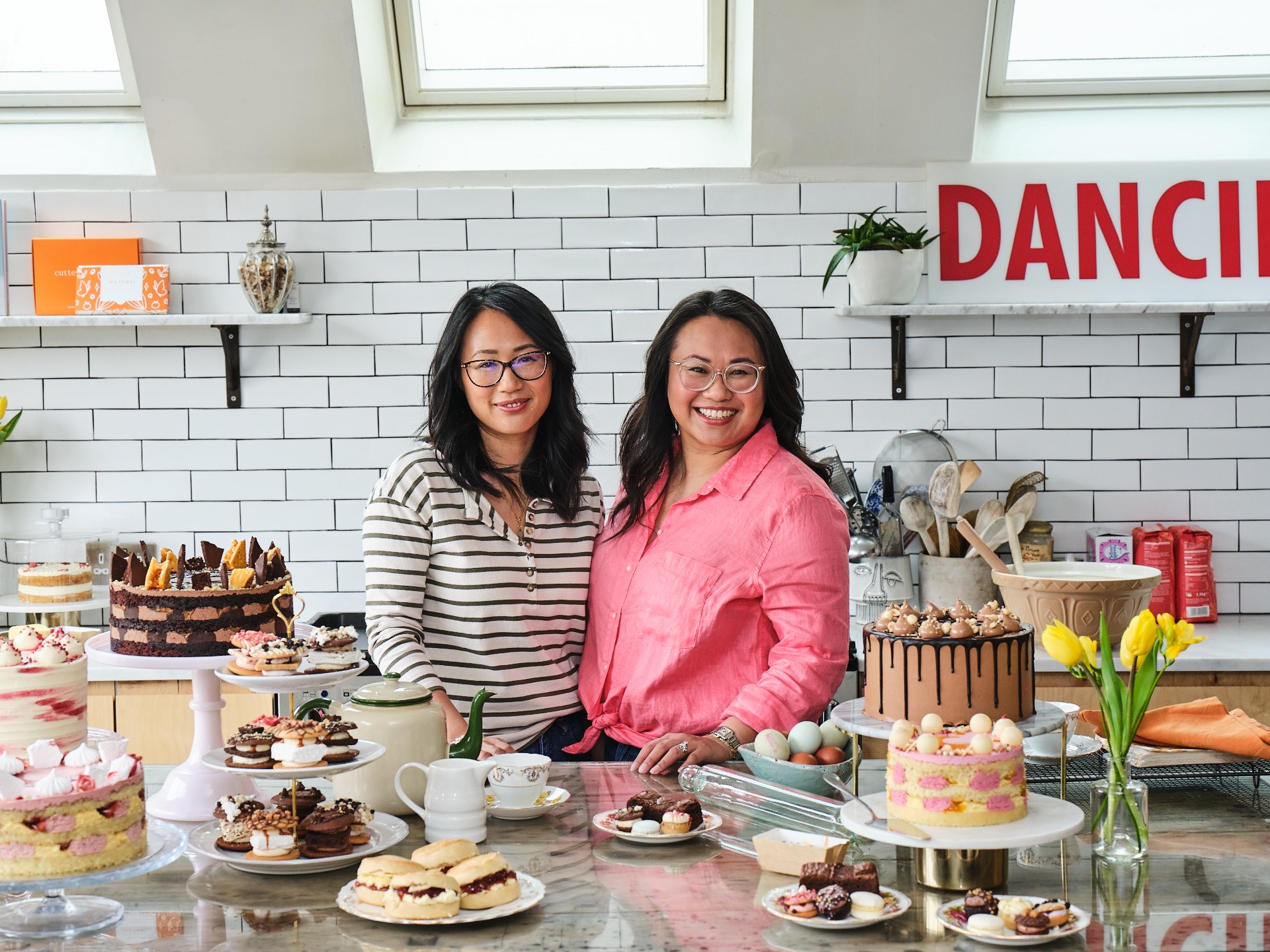
In 2014, Annabel, 40, and Emily Lui, 47, were down to their last £15,000 after a promising start to their bakery side hustle suddenly fell apart. The British sisters had built Cutter & Squidge in 2012 around their signature Biskies and landed accounts with two of London’s biggest department stores, but just as they hired a small team, rented production space and bought a van to support the business, both retailers pulled back. Harrods decided cupcakes were selling better, while Selfridges pulled the plug on Cutter & Squidge’s pop-up, wiping out almost all of the sisters’ income.
“There were a lot of tears,” Annabel told Fortune, recalling that they sat on the sofa for what turned into a 15-hour conversation about what to do with their remaining savings, knowing there was no more money coming. The sisters had built high-powered white-collar careers in finance and law, but Annabel had already walked away from hers in 2013 while Emily was still working as a lawyer. “Do we just take the £15,000?” Annabel remembered asking. “Or do we give it one shot?”
That one shot was a pop-up of their own in London’s vibrant Soho neighborhood. Their father disapproved of the plan, but he still rolled up his sleeves to help sand the floors and build the counter, on the condition that his daughters paid for the materials. They borrowed a battered coffee machine; Annabel painted and cleaned the space while Emily kept working at the law firm.
Their pop-up eventually became the foundation for a business that has grown to nearly £8 million in revenue as of last year. Cutter & Squidge now employs around 50 people—and a dozen more during peak periods—and has served more than 1 million customers. The entirely bootstrapped company expects revenue to grow another 12% this year and is aiming to cross £10 million by the end of 2027.
For Annabel, the CEO of Cutter & Squidge, and Emily, the COO, the challenge now is scaling a business shaped by their Chinese immigrant parents without losing the family identity behind it.
The restaurant kids
Long before they were running Cutter & Squidge, Annabel and Emily were working for their Chinese immigrant parents, who ran an English-French restaurant in London for more than 20 years. By age 11, Annabel was working in the kitchen while Emily worked front of house. Christmas and Easter weren’t days off — they were some of the busiest days of the year.
“When other people are off, our parents were like, ‘That’s when we make our money. That’s when we work,’” Emily said.
When Annabel told her father at 13 that she wanted to become a pastry chef, he said “over my dead body.” He wanted her to go to university and establish a career first, and she duly attended the London School of Economics before joining KPMG’s mergers and acquisitions team. Emily became a real-estate lawyer and eventually became the youngest partner at her firm.
But 25-year-old Annabel was miserable. One Chinese New Year, a deal in New York kept her from going home for one of her family’s biggest celebrations. “If I’m going to be working 24 hours a day,” Annabel remembers thinking, “I should be working for myself.”
She began what was supposed to be a one-year sabbatical from corporate finance to give Cutter & Squidge a shot. Cake was already part of the sisters’ lives. Their family home was where everyone gathered, sometimes 20 or 30 people at a time, and the sisters were expected to bring dessert. “If there was no Lui sisters cake, it’s just a meeting—not a party,” Emily said.
Their Soho pop-up stuck around and grew into a larger flagship on Brewer Street, which still stands. By early 2020, Cutter & Squidge had grown to three stores.
The COVID pivot
Cutter & Squidge was still a largely traditional bakery business when COVID hit. When the pandemic closed all three locations, the sisters were left with no customers coming through the doors and only so much money in the bank. They decided to “fight” for what they’d built, “Annabel said. “We’re Lui sisters.”
Their answer was to find a new way to reach customers. Working with a small core team, they created an afternoon-tea-at-home kit that could be shipped beyond London. Annabel said it became the “hero product” that helped turn Cutter & Squidge into an online gifting bakery, as their online website went from 25% of revenue to almost 100%, Anabbel said, estimating it grew over 1,600% over the next 12 months.
The sisters spent the next two years figuring out packaging, couriers and logistics. A brownie box introduced during that period became Cutter & Squidge’s highest-volume product, and last year the company sold 2 million brownies. “We’re now a totally different business than we were pre-COVID,” Emily said. “How we run the business and how we get our customers is totally different.”
About 80% of Cutter & Squidge’s revenue now comes from direct-to-consumer sales, compared with 7% from its Soho store and 13% from wholesale and corporate customers. Emily estimates up to 95% of customers are buying something to send to somebody else. That gifting has expanded beyond birthdays and Valentine’s Day, with the bakery increasingly creating products around Chinese New Year, Diwali, Eid and Ramadan. Hamper sales jumped 175% between June 2025 and June 2026, the company told Fortune.
Scaling the business
As Cutter & Squidge shifted online, technology became a much bigger part of how the sisters ran the company, even as the products themselves remained handmade.
“At heart, as a business, we are a bakery,” Annabel said. “The product is still made by a person. But everything in between is technology.” Emily explained that the 100% bootstrapped, family-owned company is lean, and so AI makes sense for analytics.
But technology can only solve so much. In the age of inflation and tariffs, the price paid for cocoa and chocolate has increased 175%, while electricity costs have risen 15% and rates are up 25%. Pistachios and matcha have each become about 50% more expensive, and annual increases in labor costs add another 4% to overall costs.” Now a passing mention of bad weather in the Ivory Coast on The Economist’s podcast is enough to make Emily think about what it could mean for their next chocolate order. Even with costs climbing, though, the sisters say cheaper flavorings or substitutes aren’t an option.
Cutter & Squidge expects revenue to grow 12% this year after bringing in close to £8 million in 2025. The sisters are aiming to reach £10 million by the end of 2027 without taking outside investment.
Their father, meanwhile, has come a long way. When they won Online Bakery of the Year at the Baking Industry Awards, he actually said he was proud of what they’d accomplished.
“We’ve got Asian parents,” Emily said, “they don’t really believe in saying ‘well done.’ Oh my God. That’s like the Oscars of the baking world.”
This story was originally featured on Fortune.com