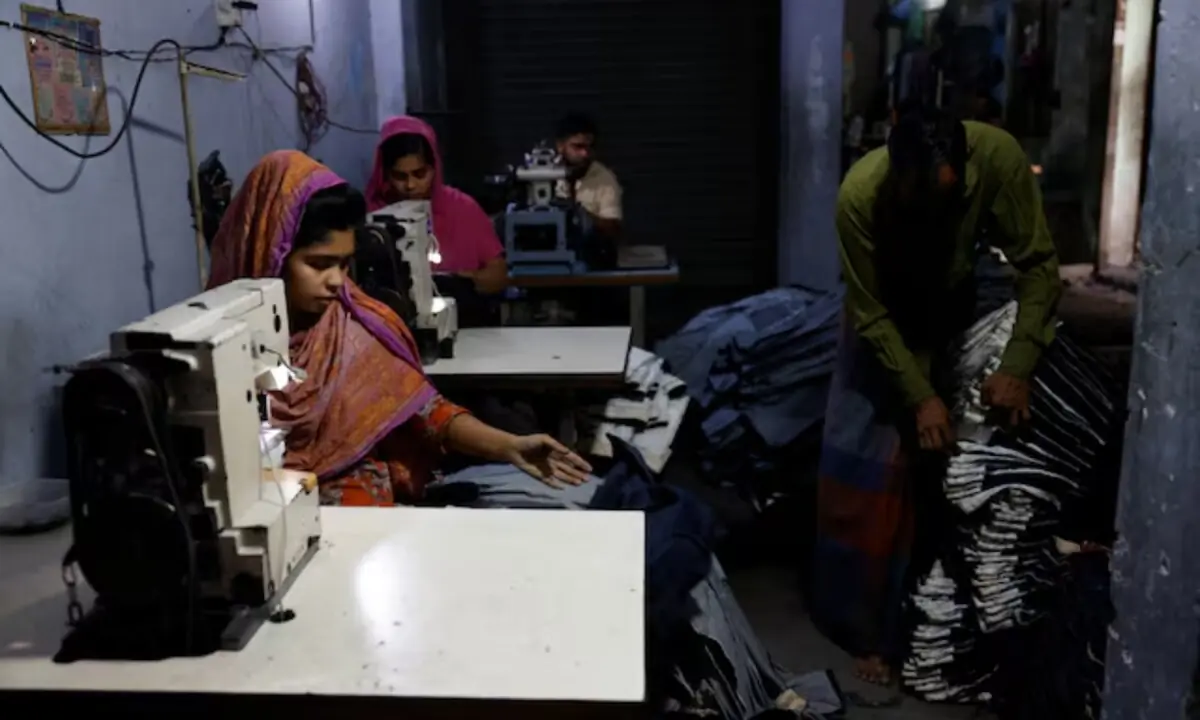
Factories across Bangladesh, the world’s second-largest clothes supplier, have turned off fans and coolers due to energy cuts caused by the Middle East conflict, with workers sweltering and a drop in productivity likely costing billions of dollars.
As Bangladesh enters the hottest time of the year, since late April, the garment industry belt around the capital Dhaka has endured alternating rain and scorching heat.
Temperatures have reached 37 Celsius (98.6 Fahrenheit) with high levels of humidity.
For many smaller garment manufacturers it is too costly to run generators during grid power outages, so they often minimise the use of fans and other cooling equipment, said Zahangir Alam, an independent fashion sector consultant.
“With such distressing heat, many workers are falling sick with profuse sweating, dizziness, nausea, cramps and fainting,” said Kalpona Akter, executive director of the Bangladesh Centre for Worker Solidarity, a workers’ rights organisation.
Bangladesh relies on imports for about 95 per cent of its energy needs. The conflict in the Middle East has led to an energy supply shortage and a sharp rise in the cost of fuel.
“With energy supply disruption, industries are struggling to keep up production, let alone run fans, ventilation and cooling equipment adequately,” said A.K.M. Kamruzzaman, a manager at Matin Spinning Mill in Gazipur, near Dhaka.
A survey by the Bangladesh Institute of Labour Studies published in February said 78pc of the 215 garment workers interviewed had experienced greater summer heat, while about half said soaring temperatures had made them weak and ill.
Some 29 billion potential labour hours were lost in Bangladesh due to heat exposure in 2024, a 92pc rise compared to the 1990-1999 average, said a 2025 data sheet by The Lancet Countdown, an annual report on health and climate change by The Lancet medical journal.
It said the associated income loss amounted to $24bn, equivalent to about 5pc of Bangladesh’s GDP.
A 2023 study by Cornell University’s ILR Global Labour Institute said the failure to reduce heat in factories and flooding around them could cost the apparel industry $65bn in earnings and about one million potential jobs in Bangladesh, Cambodia, Pakistan and Vietnam by 2030.
Efforts to protect workers from heat move slowly
Labour leaders and sector experts said protections for workers during heatwaves remained patchy, with no robust framework covering factory heat risks.
Five major global brands had recognised the importance of adapting to climate impacts, but little funding was available to help workers cope with issues like heat stress, said a February report by Stand.earth, Oxfam and the Bangladesh Center for Worker Solidarity (BCWS).
Some factories do not even provide oral rehydration salts and medical treatment for those who get sick, said Manir Sikder, a worker in Gazipur, to Thomson Reuters Foundation.
“But the situation is yet worse at home where we often get only a few hours of electricity throughout a day,” said Sikder.
Efforts to protect workers and low-income residents from heat have moved slowly.
Dhaka North City Corporation and Dhaka South City Corporation launched climate action plans in 2024 listing a range of measures to protect people, including workers, from the impact of heat such as sending early warnings, strengthening the city’s health care system to tackle heat-related illness, and installing cool roofs in buildings and slums.
But there has not been much progress on those plans, said Md. Jubaer Rashid, Bangladesh country representative of ICLEI, a global network of local governments working on sustainability. ICLEI supported the city corporations in developing the plans.
Dhaka North City Corporation also aimed to develop a heat action plan, with measures like planting trees and raising awareness among low-income residents.
But work on the heat action plan stalled after the political upheaval that led to the overthrow of Sheikh Hasina’s government in 2024, said Bushra Afreen, who previously served as chief heat officer at Dhaka North City Corporation.
Brand’s prioritise decarbonisation over worker adaption
The government has adopted a national adaptation plan for health for 2026-31, while the city’s southern municipality also announced it would plant 300,000 trees over the next five years.
Farzana Misha, an associate professor at BRAC James P Grant School of Public Health, said her team was working with the government to map heat across Dhaka and draft a heat health action plan to include area-specific interventions like creating green zones, building cooling shelters, and local early warning.
Bangladesh has rules for ventilation, drinking water and first aid in factories, but specific heat-stress safeguards like mandatory breaks when temperatures cross specified thresholds and recognition of fatigue and heat stress as workplace health risks are still lacking, said Misha.
Growing heat is also a supply chain issue, but is often ignored in brand compliance systems, said climate experts.
“Heat impacts on workers don’t appear in any supply chain audit framework I have seen,” said Apekshita Varshney, founder of HeatWatch, an international NGO working on heat awareness.
Better cooling systems, clean water, health support at factory level and trade union-led initiatives are key measures to help workers adapt to heat, said the Stand.earth, Oxfam and BCWS report.
Several global brands contacted by the Thomson Reuters Foundation did not respond to requests for comment on heat adaptation.
Varshney said brand sustainability budgets tended to prioritise decarbonisation over worker adaptation, while climate finance pledges under the UN climate process had not reached garment workers on factory floors.
“We need money to support workers’ adaptation to heat stress,” she said.