Experiences of retd senior cop, civil engineer and leader of all-woman tour capture confidence in time of crisis
•Weather ePaper Today’s Paper Journalism of Courage Home ePaper Politics Explained Opinion India Business Premium Cities UPSC Entertainment Sports World Lifestyle Tech Subscribe Sign In TrendingUPSC Of...
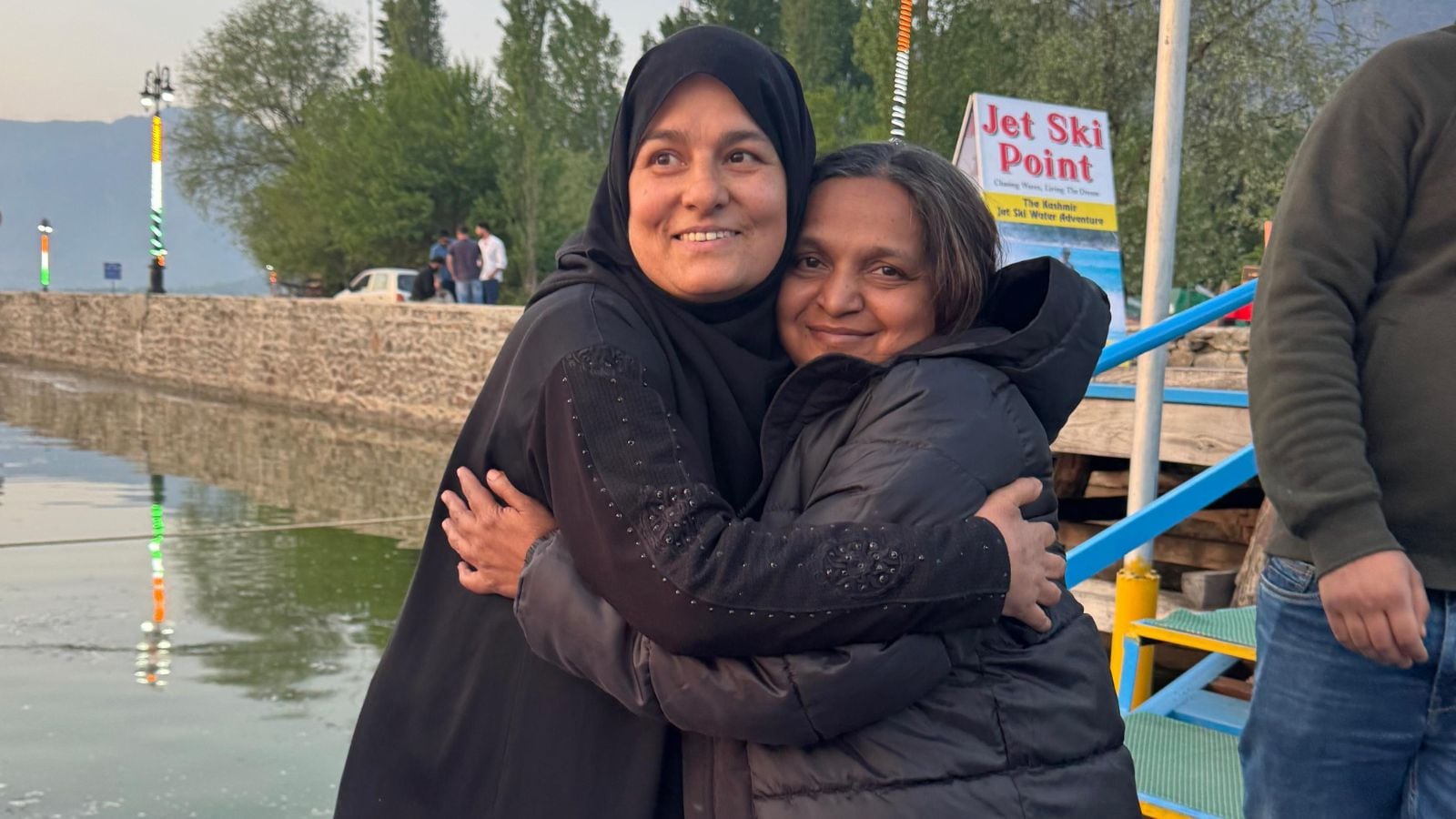
•Written by: Dipanita Nath7 min readPuneUpdated: Apr 21, 2026 09:16 PM IST Surekha Awasare gets a hug from a local woman at Dal Lake after the attack.
•(Express Photo) Make us preferred source on Google Whatsapp twitter Facebook Reddit PRINT The morning after the Pahalgam attack, a video began to circulate that answered an urgent question — What abou...
هذا الخبر من Indian Express. خبر يقدم أدوات ذكاء اصطناعي للتلخيص والترجمة والاستماع.
Weather ePaper Today’s Paper Journalism of Courage Home ePaper Politics Explained Opinion India Business Premium Cities UPSC Entertainment Sports World Lifestyle Tech Subscribe Sign In TrendingUPSC OfferIPL 2026US NewsPuzzles & GamesLegal NewsFresh TakeHealthResearch🎙️ Podcast Advertisement function checkAndLoadWindowSizeScript() { if (window.jQuery) { // jQuery is loaded, include your script jQuery(document).ready(function($) { // Your existing script for checking window width if (window.innerWidth) var page_w = window.innerWidth; else if (document.all) var page_w = document.body.clientWidth; if (page_w > 1024) { $(".add-left, .add-right").show(); } else { $(".add-left, .add-right").hide(); } }); } else { // jQuery is not loaded, check again after 0.2 seconds setTimeout(checkAndLoadWindowSizeScript, 200); } } // Initial call to the function checkAndLoadWindowSizeScript(); NewsCitiesPuneExperiences of retd senior cop, civil engineer and leader of all-woman tour capture confidence in time of crisis Experiences of retd senior cop, civil engineer and leader of all-woman tour capture confidence in time of crisis They wanted to leave the valley but could not. Written by: Dipanita Nath7 min readPuneUpdated: Apr 21, 2026 09:16 PM IST Surekha Awasare gets a hug from a local woman at Dal Lake after the attack. (Express Photo) Make us preferred source on Google Whatsapp twitter Facebook Reddit PRINT The morning after the Pahalgam attack, a video began to circulate that answered an urgent question — What about the stranded tourists? The video, which begins with a shot of the grim facade of a hotel, spans to the grounds where a group of women, men and children of all ages stare grimly in the distance, all joy drained from them. It captured the numbness of tourists in Kashmir who had learned about their narrow escape. They wanted to leave the valley but could not. Shirish Deshmukh, among the group members, addressed the camera and talked about how the group was almost at the attack site and how they were now stuck in Srinagar. The viral video had reached late deputy chief minister Ajit Pawar and Muralidhar Mohol, among others. “They arranged tickets for each of us and we could fly from Srinagar to Mumbai. Tab jaan mein jaan aayi,” said Deshmukh, adding that travel from Srinagar to Jammu was very difficult at the time. A civil engineer from Koregaon Bhima, Deshmukh was in a group of 70 that was travelling by two buses to the Baisaran meadows in Pahalgam when the driver got a call from other local drivers that there had been some shooting at Pahalgam. “One of our buses, which was almost at the location, was diverted by the driver. As it carried mostly women and children, the driver hid them in a local resort. Our bus, which was 3-4 km away, spent agonising hours waiting until all was clear,” said Deshmukh. It was night before the buses could return to Srinagar, where they learned about the full scale of the terror attack. There was another hurdle awaiting them in Srinagar. “We were booked in Pahalgam for that night and had no bookings in Srinagar. There were no hotel rooms available in this peak season,” said Deshmukh. Ultimately, their tour guides accommodated them in two hotels, one of which was being renovated. That Deshmukh and the group got some food and safety is an affirmation of Kashmiri hospitality. A year later, as the anniversary of the horrific day came, Deshmukh said the dust from the hotel room, where building work was set to begin, was the only major problem. “As Indians, we are used to dust and inconveniences,” he said in a lighter vein on Tuesday. The family was together and life was returning to normal when Operation Sindoor was announced. “Patriotism runs in the blood of Indians. After the Pahalgam attack, I began to feel all the more strongly that any fight should be face-to-face rather than cowardly terror attacks,” said Deshmukh. He believes that one should be able to travel freely anywhere in one’s own country and fear should have no place in Kashmir or elsewhere. “After the attack, many tourists returned to the Valley. I am so proud that our tour guide has continued taking groups to Kashmir,” he said. Satish Awasare, retired Asst Commissioner of Police, on the other hand, had continued his stay in Kashmir. “I was confident about the security system. I was feeling secure then, I am feeling secure now,” he said. The driver had just parked the car in Pahalgam when Awasare came across pony riders who said “gadbad hai”. “I thought that tension would mean a communal riot or a terror attack. I asked the driver to get back to the scheduled hotel in Pahalgam. There were police cars rushing and a lot of ambulances,” he said. Awasare said that after an attack, security is stepped up and it had happened this time as well. “Despite the circumstances, we continued our stay in Pahalgam as per our scheduled plan and went ahead with our Kashmir tour. Thereafter, we visited Srinagar, Gulmarg, and Sonamarg, and completed our journey as planned. Throughout the trip, we experienced the resilience of the local people and maintained our confidence in the security arrangements,” he said. His wife, Surekha Awasare recalls that being in Pahalgam that day could have shaken anyone, but she felt a deep sense of safety and reassurance because of the alertness and dedication of our security forces. “Their presence gave me confidence to continue our journey without fear. What touched me even more was the kindness of the local people—one woman, with genuine warmth, welcomed me like family and made me feel protected and cared for. That humanity and courage, both from our forces and the locals, will always stay with me, ” She says. Awasare added that, even today, “my belief remains unwavering. I have complete trust in our country’s security forces and their ability to safeguard citizens and uphold peace”. “With regard to Operation Sindoor, it evokes a deep sense of pride and patriotism in me. It was an emotional moment — one that filled my eyes with tears — reflecting both gratitude and respect for the courage and dedication of those who serve the nation. India stands strong, and as citizens, it is our duty to remain united, resilient, and confident,” he said. Shilpa Sawant Sable, who comes from a large joint family in Pune, was the organiser of the women’s-only family trip to Vaishno Devi and the Valley. Their laughter echoed through the mountains, the music of antakshari flowed in the breeze, the children joined in the play. They were 22 women and did not need anybody else. Pahalgam was to be their final halt. On April 22, everything went wrong. A landslide blocked part of a road, delaying the group, which then had to make up for lost time. Additionally, a sister-in-law left her bag behind at a temple, so Sable and a few others had to rush back to fetch it. Sable gets goosebumps when she recalls a whispered conversation between her car’s driver and a local. “All I heard was the word ‘attack,’” she says, The roads began to fill with army vehicles, with soldiers brandishing heavy machines. Now that it was evident that things were serious, the group turned quiet and even the children became tense. At the border of Pahalgam, the army did not explain. They just ordered the cars to make U-turns “jaldi”. It was with the help of relatives and friends that the group found places to stay at Dal Lake and, the next morning, they left to catch the plane back home. “There were soldiers stationed every foot of the way, the mountains were covered with the army,” said Sable. Throughout the year, Sable has felt a sense of fear but also confidence in the Indian Army. “I will go back to Kashmir, if possible. With the Indian Army, we are safe,” she said. Dipanita Nath is a Senior Assistant Editor at The Indian Express, based in Pune. She is a versatile journalist with a deep interest in the intersection of culture, sustainability, and urban life. Professional Background Experience: Before joining The Indian Express, she worked with other major news organizations including Hindustan Times, The Times of India, and Mint. Core Specializations: She is widely recognized for her coverage of the climate crisis, theatre and performing arts, heritage conservation, and the startup ecosystem (often through her "Pune Inc" series). Storytelling Focus: Her work often unearths "hidden stories" of Pune—focusing on historical institutes, local traditions, and the personal journeys of social innovators. Recent Notable Articles (December 2025) Her recent reporting highlights Pune’s cultural pulse and the environmental challenges facing the city during the winter season: 1. Climate & Environment "Pune shivers on coldest morning of the season; minimum temperature plunges to 6.9°C" (Dec 20, 2025): Reporting on the record-breaking cold wave in Pune and the IMD's forecast for the week. "How a heritage tree-mapping event at Ganeshkhind Garden highlights rising interest in Pune’s green legacy" (Dec 20, 2025): Covering a citizen-led initiative where Gen Z and millennials gathered to document and protect ancient trees at a Biodiversity Heritage Site. "Right to breathe: Landmark NGT order directs PMC to frame norms for pollution from construction sites" (Dec 8, 2025): Reporting on a significant legal victory for residents fighting dust and air pollution in urban neighborhoods like Baner. 2. "Hidden Stories" & Heritage "Inside Pune library that’s nourished minds of entrepreneurs for 17 years" (Dec 21, 2025): A feature on the Venture Center Library, detailing how a collection of 3,500 specialized books helps tech startups navigate the product life cycle. "Before he died, Ram Sutar gave Pune a lasting gift" (Dec 18, 2025): A tribute to the legendary sculptor Ram Sutar (creator of the Statue of Unity), focusing on his local works like the Chhatrapati Shivaji statue at Pune airport. "The Pune institute where MA Jinnah was once chief guest" (Dec 6, 2025): An archival exploration of the College of Agriculture, established in 1907, and its historical role in India's freedom struggle. 3. Arts, Theatre & "Pune Inc" "Satyajit Ray, Ritwik Ghatak were not rivals but close friends, says veteran filmmaker" (Dec 17, 2025): A deep-dive interview ahead of the Pune International Film Festival (PIFF) exploring the camaraderie between legends of Indian cinema. "Meet the Pune entrepreneur helping women build and scale businesses" (Dec 16, 2025): Part of her "Pune Inc" series, profiling Nikita Vora’s efforts to empower female-led startups. "How women drone pilots in rural Maharashtra are cultivating a green habit" (Dec 12, 2025): Exploring how technology is being used by women in agriculture to reduce chemical use and labor. Signature Style Dipanita Nath is known for intellectual curiosity and a narrative-driven approach. Whether she is writing about a 110-year-old eatery or the intricacies of the climate crisis, she focuses on the human element and the historical context. Her columns are often a blend of reportage and cultural commentary, making them a staple for readers interested in the "soul" of Pune. X (Twitter): @dipanitanath ... Read More Click here to join Express Pune WhatsApp channel and get a curated list of our storiesالمصدر: Indian Express | Source: Indian Express
ملاحظة تحريرية | Editorial Note: نُشر هذا المقال في الأصل بواسطة Indian Express. خبر (Khabr) هي منصة إعلامية أردنية مرخّصة تعمل بالذكاء الاصطناعي. نضيف قيمة تحريرية من خلال: تحليل ذكي للأخبار، ملخصات تلقائية، رواية صوتية بالذكاء الاصطناعي، ترجمة متعددة اللغات، وتدقيق الحقائق. هدفنا جعل الأخبار أكثر وضوحاً وسهولةً للقارئ العربي.
This article was originally published by Indian Express. Khabr is a licensed Jordanian AI-powered news platform (Registration #82086). We add editorial value through: AI-powered news analysis, automated summaries, AI audio narration, multi-language translation (Arabic, English, French, Turkish), and AI fact-checking. Our mission is to make news more accessible and understandable for Arabic-speaking audiences worldwide.