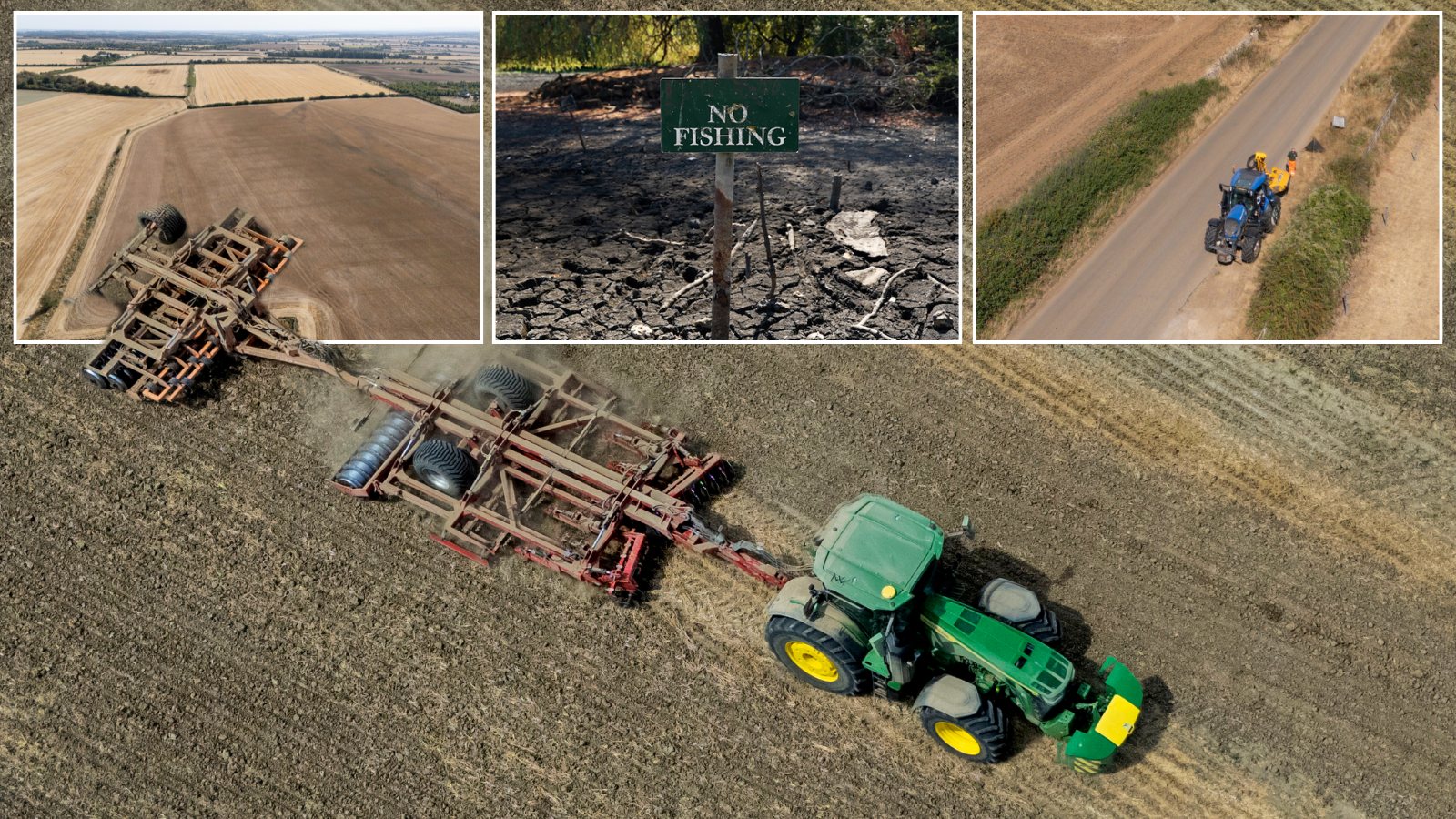
Britain is facing the "worst food security crisis in decades" as the UK is on track for its hottest ever recorded summer.
Analysts issued the warning after it was declared yesterday that almost three-quarters of England has plunged into drought status following a prolonged period of low rainfall and hot weather.
Wheat yield, milk production and vegetable crops have all been impacted by the unusually hot temperatures, investment bank Shore Capital warns.
Reduced yields leave the UK's food supply more dependent on imports from abroad.
Importing food from abroad, particularly purchasing foreign-grown grain could drive up animal feed costs as well.
This will have a knock-on effect on prices at the supermarkets, Shore Capital's Akhil Patel and Clive Black warn.
They said: "The UK has not been so close to a food security challenge for many decades."
Beyond the UK, foreign food production is also suffering due to more extreme weather conditions.

The UN Food and Agriculture Organisation said certain food costs are at their highest in more than three years.
Sugar, cereals and vegetable oils are all more expensive in July than in the month before, it said.
Shore Capital said: "The assumption the UK can import when the agricultural outlook is difficult is severely flawed and based on that assumption there will be availability beyond the UK."
French and Spanish food production has also been impacted by droughts and wildfires, while the ongoing situation with the critical shipping waterway, the Strait of Hormuz, has restricted the supply of fertiliser.
LATEST DEVELOPMENTS:
- UK weather: Met Office issues amber extreme heat warning as parts of Britain to see 38C
- Nearly three-quarters of Britain officially in drought amid record weather conditions
- 'Dust devil' tornado ploughs through London sending terrified Britons fleeing

The stark warning comes as the Met Office announced today this summer is due to be the UK's hottest on record.
Only average conditions for the rest of this month are required to beat the record, which was set last year.
As a possible fifth heatwave for some parts of the nation looms, "extreme heat" warnings have been put in place for some parts of England for Thursday.
Current forecasts predict some locations could hit up to 38C.
Yesterday, it was announced that 71.3 per cent of the country is now in a "flash drought" due to a prolonged period of low rainfall and high temperatures.
The East Midlands, Lincolnshire and Northamptonshire, Kent and East Sussex, and Solent and the South Downs joined other parts of the country (predominantly in the South and Midlands) which already have drought status.
Minimal rainfall and high temperatures have also caused water companies to subject 27 million people to a hosepipe ban.
Alistair Carmichael, the chairman of the environment, food and rural affairs committee, warned shoppers they must prepare for "further food price inflation shocks" later in the year, the BBC reports.
He said: "The problem for farmers today will be the problems for consumers in six or 12 months’ time, because you see massively decreased yields for wheat and barley, and you see increasingly concerned voices coming from vegetable producers as well."
Wheat farmers are experiencing a 14 per cent reduction in their yields this year, while oat supplies are down by nine per cent.
The National Farmers Union said last week if the drought continues, there could be a shortage in the supply of certain food products.
Food inflation could increase to five per cent in the coming months, the investment bank warned, which would be a 3.3 percentage points up from its current figure (1.7 per cent).
The Government should introduce a "25 -year strategy to increase food security", the analysts concluded.
A Department for Environment, Food and Rural Affairs spokesman said: "The UK has a highly resilient food system, drawing on both strong domestic production and international trade, and we do not expect the recent dry weather to have any impact on national food security.
"Alongside this, we are building stronger, more resilient food supply chains to protect Britain from potential disruptions, along with the new Farming Roadmap and our work with the National Drought Group and Farming and Food Partnership Board."
Our Standards: The GB News Editorial Charter