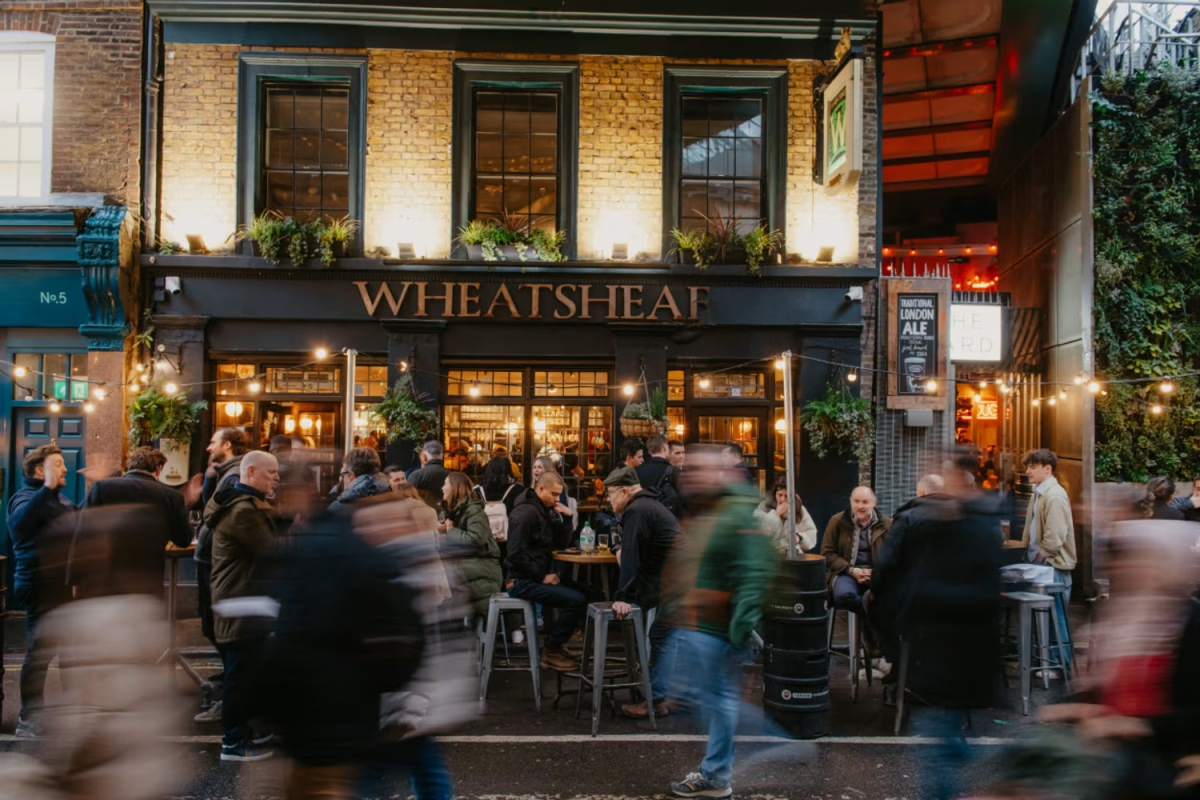
Like many of his Square Mile customers, Young’s boss Simon Dodd knows how to schmooze with booze.
Three years ago, the listed pub chain exec invited rival Clive Watson, the founder of City Pub Group, for lunch at Smiths, the top-notch bar and grill atop Smithfield market, for a steak and a glass of wine.
“We did the usual, how’s your life, a bit of football chat, did you watch the rugby,” Watson said. “But after an hour of this stuff, he suddenly turned and said…Clive I want to buy your business.”
Fast forward a few months, and after a bit of haggling over the price, by March 2024 Young’s had acquired City Pub Group, and its 51 venues, for £162m.
Earlier this year it was the turn of the directors of the upmarket, central London-based Cubitt House group to fall victim to Dodd’s smooth talking. This time he picked The Orange, a posh gastropub in Victoria, one of the firm’s flagships, for a wine-infused chinwag. Cubitt House is now part of Young’s following a £30m takeover.
Dodd isn’t done yet. He has his sights set on hoovering up another 50-70 pubs by the end of the decade. This forms part of a wider vision of re-establishing Young’s as one of Britain’s best-known listed hospitality groups.
Key to that project is the firm’s transition from the junior AIM market to the London Stock Exchange’s main market and, potentially as soon as this month, admittance into the blue-chip FTSE 250 index. That allows the company, Dodd will hope, to attract a host of new institutional investors, as well as get a share bump from inclusion in more tracker funds.
But not everyone is on board with the vision.
Two centuries at the heart of London
Young’s has been a staple of the capital for almost two centuries, beginning its life in 1831 when the Wandsworth-based Ram brewery was bought alongside several dozen pubs by Charles Allen Young and Anthony Fothergill Bainbridge – though the brewery’s roots can be traced as far back as the 1500s.
Young’s closed the Ram brewery in 2006 and transferred its brewing operations into a joint venture with the Charles Wells, before later selling its stake, turning the company into a pureplay pub and hotel business, similar to London-listed rival Fuller’s (Young’s London Original Ale, which remains a top-seller during the winter months, is now made by Marston’s).
The company is one of just a handful that has been continuously publicly listed since the 19th century. The brewer-turned pub operator joined the London Stock Exchange in 1898, before switching to the nascent AIM market in the mid-2000s. After a period of expansion, it’s become one of a growing list to ditch AIM in favour of a move back to Main.
From AIM to Main
The transition is not without its challenges. For a start, switching to the main market brings with it the raft of extra red tape that AIM companies don’t face, though recent rule changes make that step up gentler. In the short term, its shares could also be taking a hit from a sell-off of its stock from AIM-centric portfolios who hold shares in London’s junior market for their inheritance tax advantages.
Fraser Mackersie, fund manager at Unicorn Asset Management, has begun the process of stripping Young’s shares out of its AIM-focused fund.
We don’t like to see good companies leave
“We don’t like to see good companies leave, although there have been quite a few that have made that transition to the main market in recent years,” he told City AM.
“It’s disappointing that we’re not going to be able to hold it in the inheritance tax fund any more – we want to see AIM healthy and thriving and continuing to support good companies grow.
“So we’re kind of on the fence a little bit, a bit disappointed to lose it from AIM…but we can understand the management logic behind that decision.”
Aside from the tax wrangles, there is also the knotty issue of whether Young’s unusual dual-class share structure, with mixed voting and non-voting rights – which derives from the original Young family’s separate class of shares – would leave its stock half-in, half-out of the FTSE 250.
Continued expansion
Shareholders may also query whether, in the context of a hospitality industry under pressure, an aggressive expansion strategy poses risks. After being hammered by pandemic lockdowns, the sector has had to absorb soaring energy prices and steep hikes to national insurance contributions, business rates and minimum wage rates.
As many as two pubs a day are shuttering nationwide, unable to shoulder the cost burden. But Young’s, which has targeted openings in areas with well-heeled punters across the capital and home counties, has seen its venues outperform the wider market.
“Moving listing doesn’t give you a boost in your share price on a standalone basis – it’s got to be supported by strong fundamentals and earnings momentum,“ said Anna Barnfather, leisure equity analyst at Panmure Gordon.
“[But] they’ve timed it to coincide with strong trading, strong confidence, I think they’ve built up a bit of a head of steam to back it up.”
Central London has proved an area of immense success for Young’s. In 2026 the district saw a 16 per cent surge in demand in a single year, while workers in the Square Mile, which has largely returned from its pandemic-era work from home habits, last month helped the chain’s flagship Oyster Shed pub to its best-ever day of takings, with £91,000 turnover in a single day. Investors will expect the firm to pull a similar trick with its Cubitt takeover.
“We’ll keep acquiring. We want to really focus on London if we can, and building our footprint in London because that’s where our huge success stories are,” Dodd told City AM in an interview.
“The focus for us now will be steady growth and steady acquisition – probably five to eight pubs a year, if there’s anything opportunistic over and above that…we’ll look at it.”
But Barnfather points to the group’s shares being “weighed down” by its “suppressed” earnings per share metric, despite higher profits and revenue, as a result of the share dilution to fund the City Pub buyout.
While Young’s footprint has expanded to almost 300 pubs, its shares have lost almost half their value in the past five years.
“I don’t think investors want them to issue equity [to fund further takeovers] – so if it can be self-financed out of cashflows, maintaining their net debt to equity within a reasonable range, then I think people are on board with it.
“It is part of their DNA [to make acquisitions]…I think investors are on board if it moves them up the premium scale into a market that is more resilient to inflationary woes and pressures because [with Cubitt’s] it’s Mayfair, it’s Notting Hill.”
Matthew Grimson, fund manager at NFU Mutual, one of Young’s biggest and longest-serving shareholders, welcomes the transition to Main, and the ambition to grow at pace.
“AIM is more for smaller, more nascent startups, and there is a sense that things should mature and transition from AIM to Main so this is probably the right time for Young’s,” he said.
“I think they’ve got enough power on the balance sheet to fund [further expansion] themselves.
“It’s a well-articulated strategy with lots of guardrails in place in terms of return hurdles and return on capital for the purchases – and up to now, they’ve got a good track record.”
Despite wider industry narratives of declining beer volumes and younger consumers shunning alcohol, Young’s has a different story to tell. The company has pivoted towards premium options and buzzy brands popular with young people, such as peach-flavoured Jubel and Jeremy Clarkson-owned Hawkstone. Last month the firm saw an 8 per cent year-on-year increase in demand for beer, as well as a 16 per cent increase in sales of cocktails.
“Beer is back in fashion…Jubel Peach has gone down extremely well for us, we’ve just launched Jubel Lime, which is going exceptionally well [as is] Hawkstone and Asahi, Dodd said.
“People are still coming to the Great British pub which is lovely to see. When they do come out, they want a premium experience, both in terms of the drinks they choose and the environment that they’re in…and they’re willing to pay a bit more.”