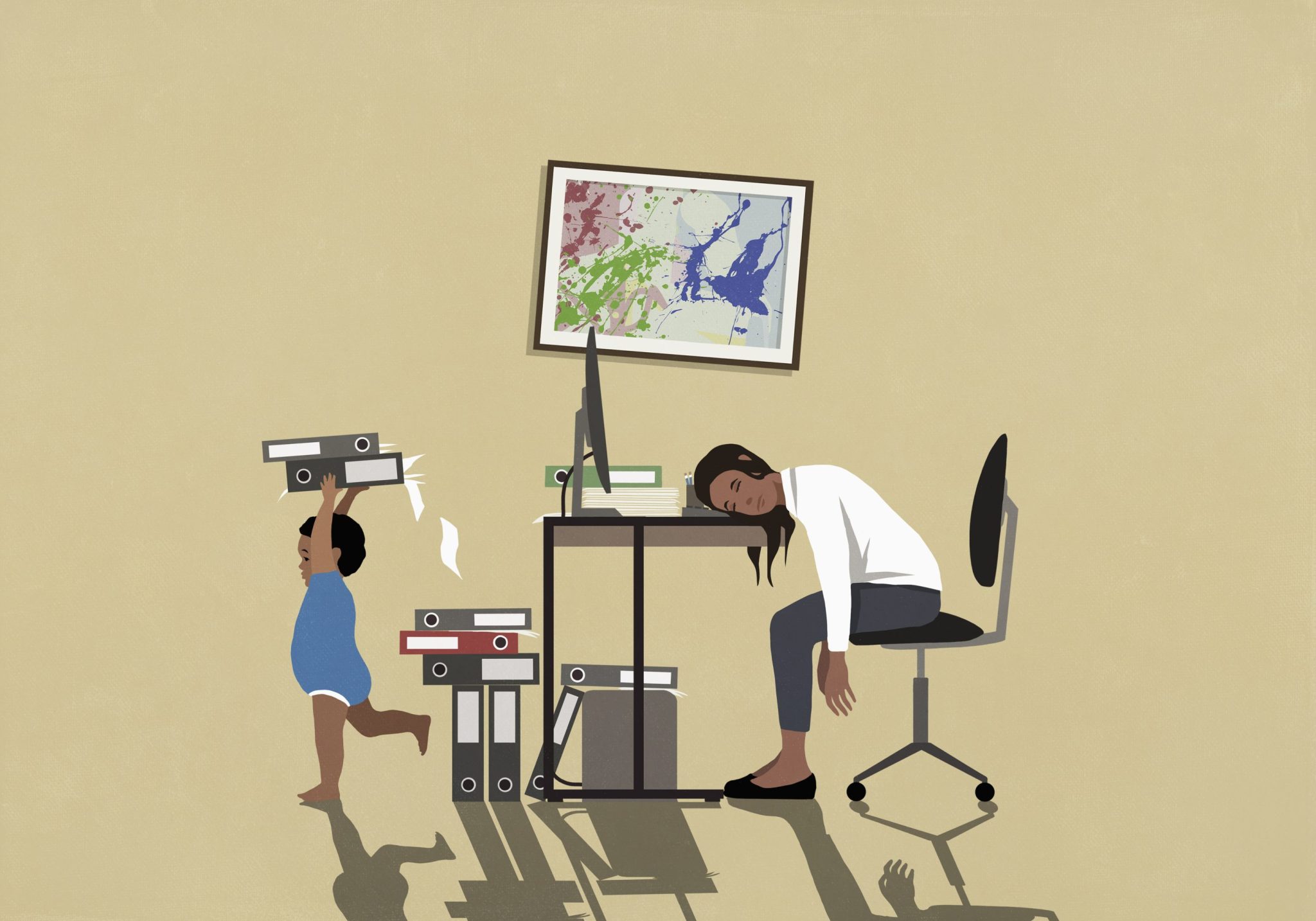
The world’s most powerful economies are increasingly alarmed by their declining birthrates, and there’s no shortage of theories on why. SpaceX founder Elon Musk suggests society is “teaching a fear of pregnancy,” while policymakers in France seem to believe young people are simply forgetting to procreate, and sent reminder letters to 29-year-olds as a result.
Other suggestions are more banal: the cost of raising a child is too high, or would-be parents worry that the world is already running out of resources needed to support population levels.
A working paper by Claudia Goldin, a Nobel prize-winning economic historian at Harvard University, proposes an alternative: Perhaps hardworking, highly educated women are concerned about the autonomy they would sacrifice if their partners don’t share the workload of raising children.
“Women who undertake greater investments in themselves will be more likely to have children if they can reap the financial and personal rewards from their education while raising their children,” Goldin writes. “In the absence of that assurance, they will be more likely either not to have children or not to undertake the initial investment in themselves.”
She adds: “The more that men can credibly signal they will be dependable ‘dads’ and not disappointing ‘duds,’ the more investment in women’s education and careers, and the higher will be the birthrate in the face of greater female agency.”
The theory is neat, and subject to criticism as a result. Some point out that birthrates have continued to fall despite household work being carried out more equitably. In the decade between 2026 and 2016, data from the Bureau of Labor Statistics shows that the hours men spend on household activities have fractionally increased, while the hours carried out by women have slightly decreased. Birthrates have still continued to decline. Other critics suggest the data used in the research is inconsistent, with skeptics also questioning what “dependability” in dads entails.
But Goldin doesn’t claim to have all the solutions to the questions her work raises. “When women did not have any choice, [having children] is what they did,” she tells Fortune. “But now they are given a choice.” So do men, she adds: How to demonstrate whether they are a dud or a dad. But “we don’t really know the answer [to] what sort of commitment mechanisms [men] have,” Goldin says.
Goldin, perhaps attuned to this dynamic because of her research, says she can spot anecdotal indicators among her students: “I can pretty much tell who the good dads are. There’s no question—they are the individuals who are clearly going to share and [are] going to engage in what I would call couple equity.”
“Couple equity doesn’t mean equality—it doesn’t mean you’re doing exactly the same things … but it does mean that each of them has decided that they’re willing to give up a certain amount of income and prestige to raise a child or two, or three together.”
No new phenomenon
While Goldin’s methodology can be debated (and indeed, the historian is open to feedback), the research is nevertheless making waves. On a superficial level, Google searches for Goldin’s name have increased 400% over the past year compared to a year prior. More broadly, the topic of birthrates is ascending the political agenda—President Trump even suggested he’d be known as the “fertilization president” courtesy of policies aimed at supporting birthrates, such as increasing access to IVF.
So why the sudden focus? The trends driving Goldin’s formula are nothing new: Women have been investing in their education in increasing numbers over the past 50 years. The Bureau of Labor Statistics’ (BLS) latest reporting, for the year 2024, found that among recent high school graduates ages 16 to 24, 69.5% of women were enrolled in college, and 55.4% of men had done the same. Meanwhile, Census data from 50 years prior shows that in 1974, 45.87% of 14 to 24-year-olds enrolled in college were women.
In addition to women wanting to build careers for their enjoyment and fulfillment, there’s also been an increasing economic need for them to do so. Brookings found in a 2020 study that without women’s earnings, middle-income households would have seen virtually no income growth between 1979 and 2018.
Myra Strober, a labor economist and Professor Emerita at the School of Education at Stanford University, sees an answer both simpler and broader than the data from the past half-century suggests: The need for children has shifted from the household level to the societal.
“Historically, people had children because they needed them,” Strober tells Fortune. “In an agricultural economy, you needed children to do the work … as agriculture has become a less and less important part of our economy, people don’t need children the way they did before.
“And people had lots of children because the infant mortality rate was high. You couldn’t be assured that the children you had would live to adulthood, and so you better ensure you have plenty of children to help around the farm. Once agriculture declines and the infant mortality rate goes way down … people don’t need children in the way that they did.”
Strober founded the famous Stanford course “Women and Work” (later renamed “Work and Family”), where she met student Abby Davisson, now an entrepreneur and consultant. The pair co-authored their book ‘Money and Love’ in 2023, which is now required course reading at Stanford’s Graduate School of Business.
At the end of the duo’s book, they examine the extent to which public policy trickles down into household decision-making, “yet we have not changed our policies around … work expectation or cultural norms. It’s much easier to change policy than it is to change culture,” Davisson tells Fortune.
“There is a cultural conversation piece that’s tricky here, even if we have the best geopolitical policies and …. everyone holds hands and agrees on that, if the culture—the expectations for parents do not change, if the expense for raising children does not change—I don’t see how we’re going to see different behaviour at the individual level, because it’s not just this one piece of policy.”
“We should be thinking about the economy as a whole and public policy rather than bedroom policy,” Strober echoed.
An economic boon
Whether or not equity in partnerships is the cause of declining birth rates, Goldin, Strober, and Davisson are united in advocating for it—the latter duo even includes checklists to prompt conversations between couples in their book. But that doesn’t mean equity is no longer a significant economic concern.
“If you begin with the thought that you have a distribution among women and men of talent and creativity, why would you not want to use both distributions and take the top of each to run your economy and your society?” Strober poses. “In terms of economic well-being, social well-being, use of resources, you want to look equally among men and women.”
Davisson, mom to two boys, chimes: “I really value the fact that my children see their father in food preparation mode all the time—he’s the family chef—like they’re going to grow up thinking that that is totally normal. The value is both for the workplace and for the citizens in that workplace.”
This story was originally featured on Fortune.com