WNBA player Natasha Cloud had a message for transgender people Sunday night.
The Chicago Sky guard wrote on social media that trans people "belong," that they're loved, seen and "perfect as you are." She added that they would always be "protected" by her.
It came after Cloud confronted Enes Kanter Freedom during the Sky's 113-90 loss to the Indiana Fever at Wintrust Arena on Sunday night. Freedom has spent the past few weeks pushing the WNBA on something that really shouldn't be difficult to answer: Can a male play in a women's professional basketball league?
Cloud answered a question nobody asked.
The fight isn't over who gets through the doors at a WNBA arena. Freedom is asking whether a male is allowed to play in a women's league. Indiana Fever guard Sophie Cunningham has made the same basic point, saying "biological men" shouldn't compete in women's sports.
But there's a reason the conversation keeps getting dragged somewhere else: defending males in women's sports is a much harder argument to make than simply declaring "trans people belong."
And Cloud wasn't the only one doing this over the weekend.
The New York Liberty hosted the Fever at Barclays Center on Saturday, and the scoreboard featured messages specifically welcoming transgender fans.
"Welcome Trans Liberty fans! You are loved and you belong!" one read.
Another said, "Hey trans fans! Glad you're here! Go Liberty!"
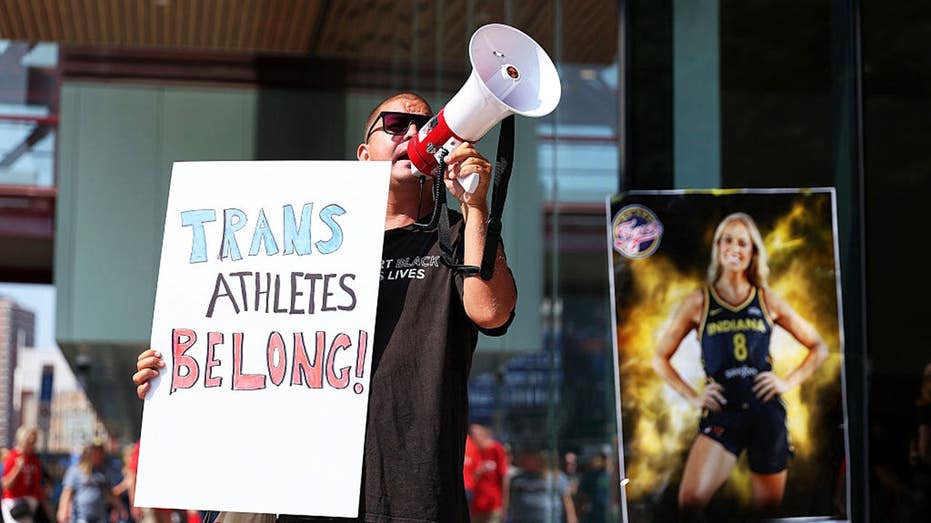
Outside the arena, transgender activists showed up to counter a rally supporting Cunningham and chanted "trans lives matter."
Okay. Sure.
Transgender fans are welcome at basketball games. Treat them like everyone else in the building.
Now, can we talk about the actual issue?
Because the response to Cunningham is a perfect example of what’s been happening in this debate for years.
Back in 2023, USA Today columnist Nancy Armour went after ESPN's Sam Ponder for supporting fairness in women's sports.
Armour called Ponder's position "bigotry" and accused Riley Gaines and others fighting to keep males out of women's sports of promoting hate.
I wrote at the time that Gaines wasn't "anti-trans." She was pro-woman.
Gaines' position has always been that the women's category should be reserved for females. You can disagree with her, but at least disagree with what she's actually saying.
Calling her a bigot or a transphobe is much easier than explaining why she's wrong.
A few months later, I went to Harvard when Riley Gaines spoke on campus. Before she even arrived, a Harvard athletic administrator had described her as an "athlete-turned-anti-trans-activist."
Sound familiar?
Rather than explain why Gaines was wrong about women's sports, the administrator branded her "anti-trans."
Then Martina Navratilova got the same treatment.
Navratilova has been one of the most outspoken female athletes in the country on this issue. She thinks women's sports should be for females.
A tennis reporter called her "transphobic" and accused her of going on an "anti-trans crusade."
So explain why Navratilova is wrong.
Seriously. Explain why a male should be entitled to compete in a female athletic category. That's the hard part, so critics change the subject to hate, safety or claims that children struggling with gender identity need to be "protected."
And now the WNBA is doing its own version of the same thing.
For years, the playbook was simple: call anyone who objected a bigot or a transphobe.
Now the tactic is a little different. Don't defend males in women's sports. Just announce how much you love transgender people.
Minnesota Lynx coach Cheryl Reeve wore a "Trans Kids Belong" shirt after Cunningham's comments started getting attention. Then came the Liberty scoreboard. Then Cloud's post.
But Cunningham wasn't talking about whether some kid somewhere feels like he or she "belongs."
"Trans Kids Belong" is a slogan, not an argument. And slogans become pretty useful when the logic isn't on your side. It still doesn't answer whether a male is eligible to play in the WNBA.
Freedom has forced the WNBA to confront that question.
He has publicly said he intends to enter the 2027 WNBA Draft. Former NBA player Royce White has said the same. Obviously, they're making a point, and it's a useful one because the WNBA's own publicly cited eligibility language says only players who are women can play, but the league has not publicly defined the term.
So define "woman," WNBA. That shouldn't take multiple meetings over "weeks and months." The WNBA exists for female basketball players, which should mean a male isn't eligible.
Period.
And every time the question comes up, the WNBA drags the discussion back to hate, inclusion and protecting transgender people. Pretty soon we're miles away from the reason anyone started talking about this in the first place.
A trans fan can go to a Liberty game, buy a jersey and spend the night yelling at the refs like everyone else. Nobody's debating whether that person gets to sit in the stands.
We're talking about who gets to be on the court.
Women's sports exist because sex matters in athletic competition. That's why female athletes have their own leagues, divisions and championships in the first place.
So protect that category.
Keeping males out of women's sports isn't a statement about how anyone should be treated outside of sports.
Cloud can post whatever message she wants, and the Liberty can welcome trans fans on the scoreboard. Fine.
But the WNBA still hasn't answered the question that started this whole debate.
Should a male be allowed to compete in women's sports?
No.
Maybe someday the people calling everyone else hateful will explain why they think the answer should be yes.