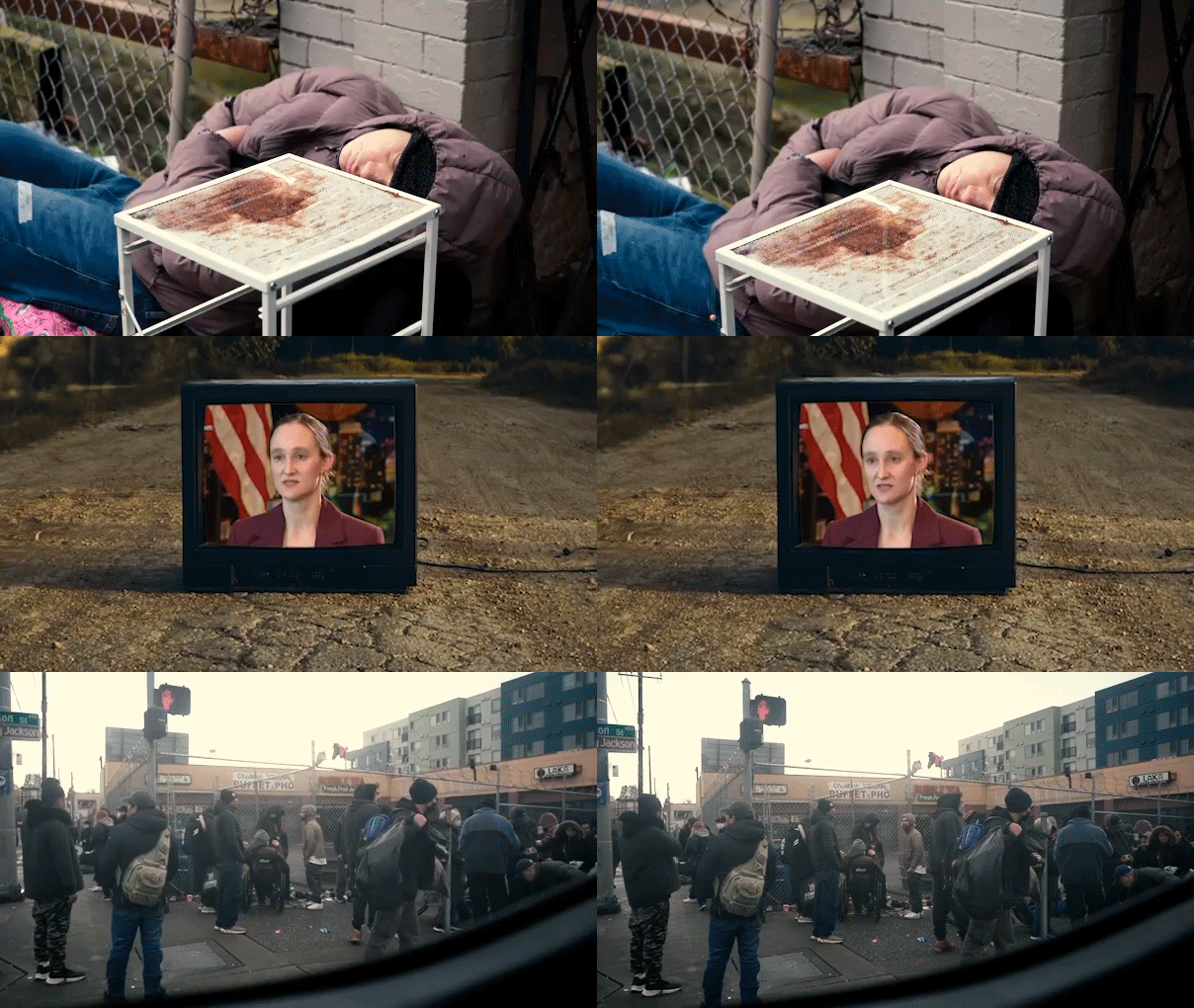
SEATTLE — City advocates say they are struggling to find solutions as homelessness and open-air drug use spread across Seattle’s streets, amid growing concerns about the direction of socialist Mayor Katie Wilson’s new administration.
"You can just see the foil is like blowing down the sidewalks like autumn leaves," Andrea Suarez, founder and executive director of We Heart Seattle, told Fox News Digital in an interview.
"Very common to see property damage of our parks and shared spaces. You can see Narcan is used to reverse an overdose, so you'll see cartridges. But at least we're remodeling the bathroom to be gender-neutral. I'm not [kidding] you, that's where our priorities are."
Suarez, who founded We Heart Seattle in the fall of 2020 to clean up her city, public spaces, and offer resources to people in need, says her city has been overtaken by homelessness and open-air drug use, and she said it isn’t getting any better.
"In this park alone, which is Dr. Jose Rizal Park, Lewis Park, and Sturgus Park, there's three connected parks here. In one afternoon, we picked up several hundred pieces of foil in the off-leash dog park, near the children's playgrounds, and the memorials, and the pagoda that's over here as well."
"You can just see every one of these foils was a pill. It could have been a potential overdose," Suarez said. "So pretty jarring when you think about this being in our parks, at our bus stops, you can see the straws. You can see there's needles as well. And oftentimes we'll find that the drugs are still rolled up in the foil, and they get dropped. And we've had several hundred cases of overdoses and poisoning of infants and dogs."
Suarez said that King County Behavioral Health in downtown Seattle now provides information on how to reverse an overdose in dogs.
"That's how bad it is," Suarez said. "It's how prevalent this is in our shared spaces."
She said area stores will sell a "bubble," also called an oil burner, pizzo, or pilo, a type of glass pipe used to smoke substances including fentanyl for $6, and that King County gives them out for free "in the name of harm reduction."
King County also offers "harm reduction vending machines" which give free naloxone, fentanyl test strips, as well as condoms, Plan B, and "safer sex kits."
Suarez said that addicts will spend anywhere from $100 up to $300 a day on drugs "if you have it."
"And if you don't, you might get a little sick, but if you can use more, you will," Suarez said. "And so, everything from retail theft, boosting, fencing, prostitution, men and women, huh? Yeah, men, and women. People don't hear that very often that men are preyed on, frankly, by perverts. And they will do anything to not get sick."
Local conservative radio host Ari Hoffman told Fox News Digital in an interview that he believes the city is making its problems worse.
"Seattle and Washington and King County have spent a ton of money on what I call Homeless, Inc., which is fueling this problem," Hoffman said. So, they don't actually get you into treatment. They say, ‘Here, let's give you foil, let us give you a pipe, let's give you a spoon, let's give you whatever drug paraphernalia you want and maybe a pair of socks and some condoms also on top of that.’"
PORTLAND DA CRACKS DOWN ON DRUG CRIMES AS SEATTLE PULLS BACK ON ENFORCEMENT
"And because they are constantly fueling the people who are running Homeless, Inc. and these nonprofit organizations are making an excess of six-figure salaries, these massive huge salaries, there's no incentive for it to end," Hoffman added.
According to Seattle.gov, in 2024, the city of Seattle spent $153.8 million on homelessness services through its Human Services Department.
Compounding the drug crisis is homelessness, which Suarez said has worsened under current policies.
"What I say in Seattle is we've actually removed rock bottom by services, by free housing for life, tiny houses, hotels, allowing tenting in parks," Suarez said.
According to local reporting, homelessness in Washington state is increasing.
WHEN EVEN OBAMA CALLS YOUR HOMELESS SITUATION AN ‘ATROCITY,’ IT’S TIME FOR NEW SOLUTIONS
The Washington State Standard reported in August that the total number of individuals counted as homeless is a 4.4% increase from 2024 and a 25% increase overall from 2022. Additionally, the year-over-year increase was approximately consistent with the 4.07% rise from 2023 to 2024, but below the 14.8% jump between 2022 and 2023.
On her campaign website, Wilson said she wants to end "unsheltered homelessness."
"We can’t afford four more years of inaction, with empty tiny homes sitting in storage lots," Wilson said on her campaign website. "We can end unsheltered homelessness. We can reduce public disorder and misery by providing the care that people need, in dignified settings — not leaving people in the streets or moving them around endlessly. We know what works. What’s lacking is the political will to bring solutions to scale."
Local outlet KOMO News reported April 8 that Wilson spoke with members of the Shelter Expansion Community Action Team about opening 1,000 new shelter units and emergency housing this year.
The Seattle City Council on Tuesday unanimously passed two ordinances related to Wilson’s campaign promise to increase the number of shelters in the city. The council approved $5 million in funding and expanded Wilson's authority to scale up the number of "tiny homes" in existing city-run villages. The funding is tied to Wilson's larger $17.5 million plan to create 500 new tiny homes by June. She hopes to double that number by the end of 2026.
"We have to aspire to something higher than pushing an encampment around the corner so it’s a problem for a different block," Wilson said.
According to Suarez, results may be far from ideal if housing does not come with conditions.
"The permanent supportive housing that we fund in Seattle, since there's no requirement to get clean, you're essentially housing somebody with a permanent drug addict's neighbor and likely their dealer," Suarez said.
"And you'll read in my Seattle Times article, how are you supposed to get better when the fox is guarding the hen house," she asked. "I mean, that's just like, ‘Oh, I just need them to get stabilized, and then they can think about moving on with their life and getting help and reaching self-sufficiency.’ Meanwhile, the entire house is using. So there's absolutely no free, clean and sober housing in Seattle. There's like, you can't find it."
In a new interview on "On Point with Meghna Chakrabarti," Wilson was asked about the services Seattle provides to fix the homelessness problem. She acknowledged there was a problem with the way they were dispensed.
"Seattle provides a lot of services, not enough, but I think part of the problem is not just the amount, but also the way that those services are provided. And for example, mobile treatment vans that are going around trying to provide drug treatment to like people living in encampments," she said.
"Then you lose track of that person, and they're still living unsheltered, nothing against mobile treatment vans, actually. They have a very important place in the ecosystem. But the point I'm trying to make is that we create this system of dead ends where you're starting to provide a service, but then you don't have all of the pieces that are needed to make that really successful."
In the same interview, Wilson discussed her "socialist" label, saying "we need a really fundamental restructuring of our society and our economy."
Seattle's Low Income Housing Institute (LIHI) is a low-barrier housing provider, meaning that they are made for individuals who are homeless who may not be accepted into traditional, high-barrier shelters.
In March, Suarez posted a video on X showing a resident of the Interbay Village Tiny Home Community in Seattle, which is part of LIHI, showing Suarez around the property, and an empty tiny home with a few chairs inside.
SEATTLE MAYOR PUSHES LOCAL POLICE TO TRACK, INVESTIGATE ICE AGENTS' ENFORCEMENT ACTIVITIES
In the video, the resident told Suarez that the space is used by others to take drugs, including fentanyl.
But Suarez said there is no clear plan for people who refuse to use housing options provided by the city.
"We're asking our leadership, what is your plan for people who will never take a tiny house, who will never even take an apartment because they don't even want to ever have to get ID," Suarez said. "These are people that want to be off the grid, do their drugs, be left alone, and they're doing it in plain sight on a sidewalk."
However, state Rep. Shaun Scott of Seattle, a member of the Seattle Democratic Socialists of America, said he believes state-provided services and "compassion" are the answer.
"Understand that somebody who's struggling with either addiction or with houselessness or the overlap between the two, we need to have a compassionate response," Scott said.
FATAL DRUG COMBINATION SPARKS ALERT AS 'RHINO TRANQ’ SPREADS ACROSS US
"And so I believe that we are successful to the extent that we go in that direction. And I'm not asking you to believe me on this question," he added. "I'm asking you to actually believe the Chamber of Commerce-funded study that indicated in 2018 that in order for the King County area to effectively address houselessness in our state and in our county, we would have to spend something like $400 million annually for about a decade. That is the business community's own response to how it is that we would make our state, make our county in King County, make the city of Seattle, one that's a lot more friendly to people who are experiencing houselessness. And I believe that that is true. I believe we need to go in the direction of fully funding those kinds of services, housing services, social services, we would see a dramatic reduction."
Scott also criticized encampment sweeps, suggesting that "criminalizing" homelessness has done little to reduce the number of encampments and the levels of open-air drug use in the city.
On Wednesday, an encampment at the Rotary Viewpoint Park in West Seattle was swept — a move that critics and advocates say contradicts Wilson's previously proposed strategies.
Leading up to her election, Wilson signaled that the city should prioritize long-term housing solutions instead of displacing the homeless.
"I think this is the opposite of an out of sight, out of mind approach, right? Like we're really doing this work intentionally so that we don't have to just sweep people into other neighborhoods," Wilson previously stated, regarding her approach to homelessness.
Hector, an addict who We Heart Seattle has offered treatment to many times, told Fox News Digital that he has been having a "hard time."
The number one drug people are using in the area is "Fetty," according to Hector. He cautioned young people to stay away from it.
"The younger people, don't waste their lives on drugs," Hector said. "It's a waste of time, waste of money, waste of life."
Tanya Woo, a former appointed City Council member whose family immigrated to Seattle in 1887, told Fox News Digital she is concerned for the future of her city.
"I grew up in this community, I'm a fifth-generation Seattleite, and I've seen a lot of changes in the last couple of years, recent changes that kind of have made me really sad about this neighborhood. It used to be a vibrant community where people from all over the state would come and go shopping and eat and visit," Woo said. "And now it's really empty, and it's tough because a lot of the people who come here are afraid, because we do have a negative public safety reputation in this area."
While some, like Scott, say compassion is the goal, Suarez said the approach is falling short.
"Anybody that is in recovery and has been clean and sober for at least a year or years will tell you, ‘You know, I had to go to jail and sweat it out. I had to be on parole. I had to [urinate] in a cup once a week. I had to show up somewhere to someone. My peer support specialist, my AA sponsor, my parole officer,’" Suarez said. "Without accountability, we are prolonging human suffering, and there's nothing compassionate about trapping a person in their cycle of addiction."
A spokesperson for public health in Seattle and King County told Fox News Digital in a statement that, "King County has invested in a wide variety of actions to address opioid overdoses, including increasing access to treatment, providing medications, distributing overdose reversal drugs, and establishing places to go for care – you can read more in this blog post. We’ve seen promising results — over the past two years, fatal overdoses in King County have decreased 32%."
The spokesperson added, "We’re not distributing flyers about how to reverse an overdose in a dog. If clients ask our staff for this information, we have a flyer from an outside organization that we offer. We don’t collect data on overdoses in dogs, but we don’t have any indication it’s an issue locally."
Fox News Digital has reached out to Wilson for comment.