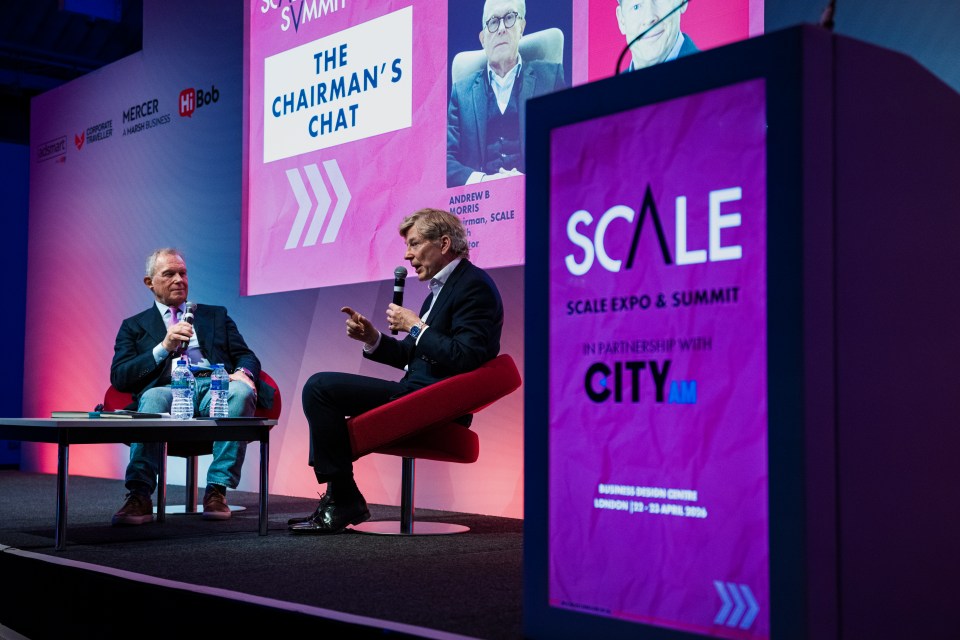
At SCALE SUMMIT on 23 April, HomeServe founder Sir Richard Harpin joined SCALE Chairman Andrew B Morris for a Chairman’s Chat on the decisions, mistakes and principles behind one of Britain’s most remarkable entrepreneurial journeys.
Richard Harpin built HomeServe from nothing into a £4.1 billion business sold to Brookfield in 2023. Over 30 years, he navigated three different types of backer, expanded into seven countries, hired and fired his own replacements, and eventually chaired the company through new ownership before stepping back.
He’s now distilled what he learned into a book, ‘How to Make a Billion in Nine Steps’, and a community for founders called Business Leader.
On stage at London’s Business Design Centre, Richard shared the lessons that shaped both in a fireside chat with Andrew B Morris, Chairman of SCALE.
Choose your backer as carefully as you’d choose a co-founder
Richard Harpin has worked with three types of investor across his career: a trade backer, public institutional shareholders, and private equity. Each brought different advantages, but what matters most is timing.
“Don’t go and raise when you’re desperate and you’ve run out of money,” he said, “because that’s not the best time to do it and the investor will know that you’re desperate.” In HomeServe’s early days, that desperation led him to sell half the company for half a million pounds. For Richard, it worked out (the backer brought credibility, software, and a call centre operation that helped the model take shape) but it could have gone very differently, and the lesson stayed with him.
His advice for founders who have more time on their side: try to retain control, take your time on due diligence, and look beyond the money itself. “Finding the right partner is more than just getting the money into the business.”
Once you have investors, you have to manage them, particularly in a public company. Richard’s rules for this are simple:
- Under-promise and over-deliver.
- Always keep something in reserve.
- Never talk about ideas externally until you’ve tested them, because “they will hold you to account.”
Lesson for Founders: Raise before you have to.
The best investor conversations happen when you can afford to walk away.
Hire your replacement before you think you need one
Eight years into building HomeServe, Richard realised that he was, in his own words, “a rubbish chief exec.” Too many ideas, not enough focus on running the day-to-day. His solution was to bring in an MD to run HomeServe UK, which freed him to do what he was actually good at: thinking about where the business could go next.
Richard argues that this move is one an entrepreneur should make sooner than feels comfortable.
The role for the entrepreneur is to get the business up and running, prove the model, start scaling the business. Then ideally bring in somebody that has scaled a business before.
He frames this using Jim Collins’ fox and hedgehog distinction from Good to Great. The entrepreneur is the fox. They come up with a new idea a day, they are restless, expansive. The hedgehog is the person who “puts up the prickles, ignores that idea and keeps moving in a methodical direction, just delivering a simple plan.” The two need each other. Richard points to Apple as the definitive example: Steve Jobs was the fox; Tim Cook was the hedgehog who went on to grow Apple from a $350 billion valuation to $4 trillion without a single revolution.
Apple would not have been successful without Steve,” Richard explains, “but then he had Tim Cook as his COO who ultimately took over as the CEO.”
Lesson for founders: Find your hedgehog
It might be your existing COO, a tough finance director, or a new CEO who comes in and replaces you day-to-day. Bring them in before you think you’re ready.
When you go international, don’t change the model
When Richard hired an MD to run the UK business and stepped back from the day-to-day, it freed him to ask a question he wouldn’t otherwise have had the headspace for: would HomeServe work in another country?
They chose France first, partly because it was difficult.
“France is a really difficult country to run a business in,” said Richard. “High costs, regulation, very difficult to get rid of people. So I thought, well, let’s start in France because if we make it work there, we can make it work anywhere.” It nearly didn’t. Local partners pushed for a new brand name and completely different marketing channels, with poor results.
“Just when we were about to say, ‘well, we tried becoming international, it didn’t work, we’d better go back to being a UK business,’ we thought; let’s go back to that UK model that worked eight years ago when we launched here.” They used direct mail under a water company brand, and it clicked.
America took six years of struggling. The mistake, Richard now believes, was sending a British MD to run a US business. “He was talented, but he wasn’t a local, he wasn’t American.” The business went from zero to $10 million annual profit over that period: not enough for the size of the opportunity. When they hired an American chief executive, relocated the business from Miami to just north of New York, and paid the rate the US market demanded, everything changed. HomeServe America made $300 million annual profit last year. The MD they hired is still there, 16 years on.
We wouldn’t have ever got there with a Brit, however good that Brit was.
The wider principle, applicable to any founder considering international growth: “When you go into a different country, don’t radically change your business model. If one day you’re in 20 countries and you’re 25 per cent different in each of those countries, that’s a recipe for complexity and disaster.”
Lesson for founders: Prove the model at home, then replicate it.
You will likely need local leadership, you probably don’t need reinvention.
Get a coach, find a mentor, join a peer group
Andrew asked Richard about the support structures that made the biggest difference, and Richard made a clear distinction between coaching and mentoring, something he didn’t fully understand until he trained as a coach himself.
“The business coach is like an X-ray machine. They are there to help understand what the issue or the opportunity is, get some visibility on those, but they will never tell you which one to go for.” The mentor is different: someone with experience and grey hair who will say, “Have you thought about doing this or that?” and give you a direct answer.
The mentor who helped Richard crack America was Nigel Morris, co-founder of Capital One. His advice was very specific: get out of Miami, go to New York, Boston or Washington DC, and hire an American.
He was a mentor. He was giving me clear advice. And that was really useful.
Another important and often overlooked element is the peer group you surround yourself with. Richard described feeling isolated even with 10,000 people in his business: “I still felt, who am I going to discuss things with in a non-threatening environment?” Solving this for founders is central to the Business Leader community. Groups of ten founders at similar turnover stages, meeting eight times a year with a facilitator and a business coach.
Lesson for founders: The three-part support system you need
The magic combination is a paid coach to help you see clearly, a mentor who’s been there and got the scars, and a peer group who’s going through the same thing at the same time.
Plan what comes after, before you sell
When Brookfield offered £4.1 billion, a 73 per cent premium to the stock market price, Richard took it. He also stayed on as chairman for two years, something he’d thought about carefully. “My team had been really loyal to me and I didn’t want them to see me take a load of money and rush off into the distance,” he said.
But his advice to founders approaching an exit isn’t primarily about loyalty. It’s about preparation. “If you haven’t planned what you’re going to do next, then I’d highly recommend that you do it. Otherwise, you’ll suffer from seller’s remorse.”
During his transition, Richard resisted the temptation to keep running things. His approach as chairman was to tell the incoming CEO: “I’m there to help you, but it’s your agenda. It’s not my agenda.” To make that shift feel genuine rather than performative, he went to INSEAD and trained as a business coach, to “help me to coach and mentor them and learn to be more hands-off.”
Lesson for founders: Know what you’re stepping into before you step out.
A business exit is a transition, not a finish line. Disappearing overnight rarely serves you, your team or your business.
Discover more insights at SCALE