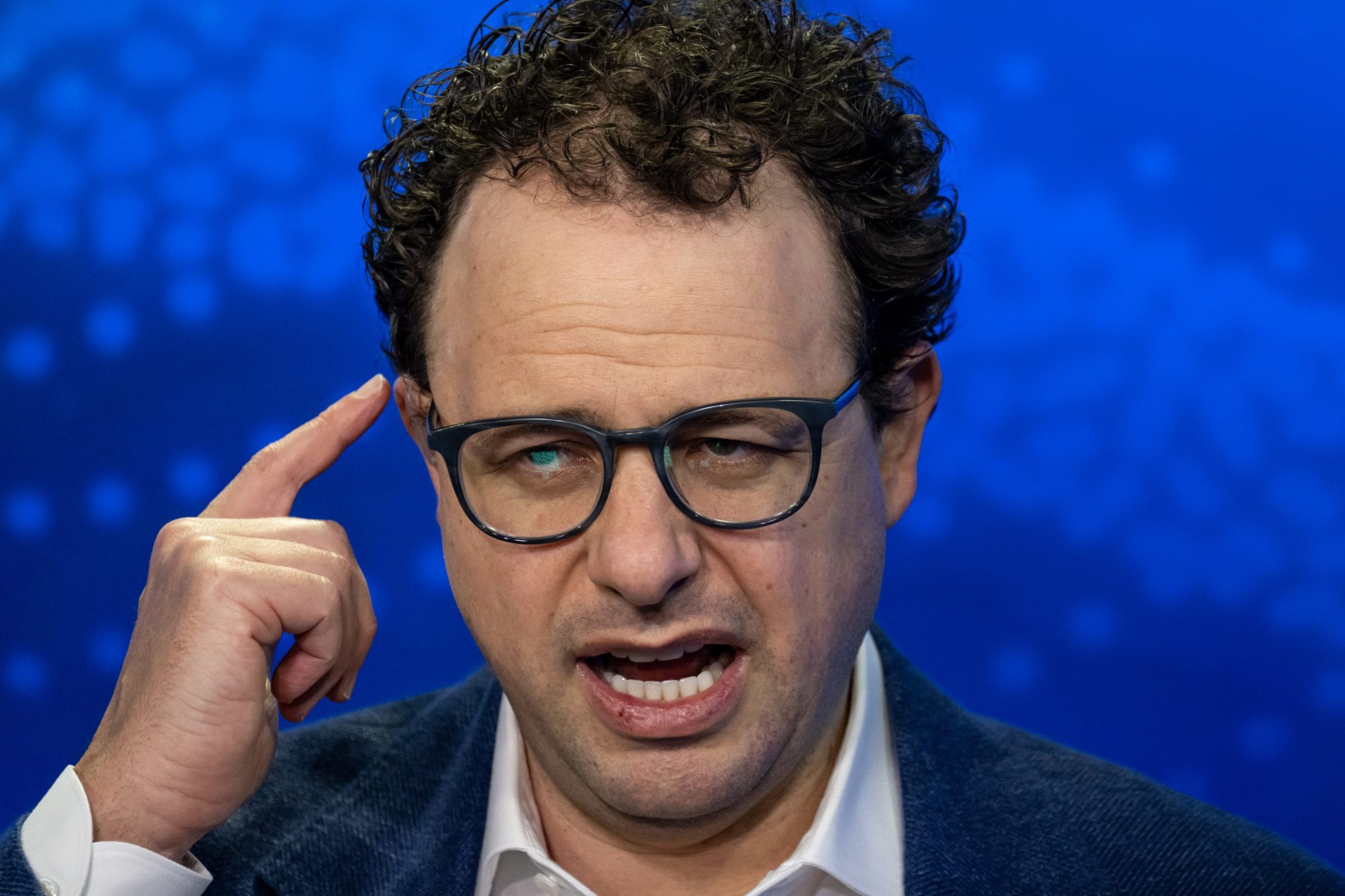
Anthropic co-founder and CEO Dario Amodei believes AI carries big potential risks, and he keeps talking about them. He also has tried to position Anthropic as the AI company most committed to building AI safely. But that might be part of the problem.
He told Fortune previously, “AI safety continues to be the highest-level focus,” and that safety-first positioning is what’s given corporate buyers assurance its models are less risky than those from other competitors.
He and sister Daniela even split from OpenAI in 2021 due in part to differences over its approach to safety. He has also raised concerns about autonomous weapons and AI surveillance with the Pentagon.
Still, the public remains deeply skeptical. A recent Gallup survey found that nearly half of adults under 30 now believe AI does more harm than good, up sharply from the year before, and that trust in businesses’ use of AI has fallen after two years of gains. Pew‘s 2026 numbers are even worse: most Americans say AI is advancing too fast, and only a small minority expect its impact over the next two decades to be net positive. A Quinnipiac poll found that more than three-quarters of Americans say they trust AI only rarely or sometimes, even as use keeps climbing.
In a lengthy X post recently, Amodei—who rarely goes on social media so the post in itself was unusual—said he’s written one major essay on AI’s risks and one on its benefits. He wrote that negative public perceptions of AI were not due to his, or any other AI CEO’s, comments about AI risks, but rather because the AI industry had not yet delivered enough of the positive benefits it has claimed AI can bring, such as curing human diseases.
But while Amodei is trying to reassure the public about AI, he keeps associating Anthropic with “safety” in a regard that implies the whole AI industry is unsafe.
Amodei is falling into a trap PR agencies have known for decades: the problem of association.
The airline industry’s rebuke
The airline industry learned long ago to never associate itself with the word “safety” in marketing material. While it didn’t vanish from air travel, it moved out of advertising and into mandatory in-flight briefings, which airlines have spent years turning into short films and songs rather than solemn warnings.
That’s because even a legally required safety demonstration reads better as entertainment than as a reminder. Safety simply leaves people with a bad taste; it’s not something people want to think about before a flight.
Historian Richard Popp’s research on airline advertising found that by the 1930s, carriers already operated under a set of unwritten rules meant to keep any hint of danger out of the picture entirely: no ads showing mountains, night flying, large bodies of water, or maintenance work, because each risked evoking the possibility of a crash before anyone said a word about safety.
Despite the taboo, Pan Am spent the 1980s running its own reassurance campaign amid a wave of hijacking and bombing threats against transatlantic flights, insisting on its own safety and security even as the threats mounted.
Then in December 1988, a bomb brought down Pan Am Flight 103 over Lockerbie, Scotland, killing 270 people. Aviation security expert Glen Winn said that disaster is what finally convinced the whole industry to retire the word “safe” for good.
What Dario can learn
The airline industry discovered that stating a fear about yourself is worse than saying nothing, because the word does the same work against you. Linguist George Lakoff’s 2004 book Don’t Think of an Elephant put that theory to work: telling someone not to think of an elephant requires them to picture the elephant first, and the instruction to stop thinking about it does nothing to make the image go away.
When Amodei created a Responsible Scaling Policy modeled on biosafety tiers and put out public warnings about AI risk and job losses, it worked on one audience that’s primarily made up of engineers, safety researchers, enterprise buyers, and investors who see Anthropic’s concerns for “catastrophic risk” as diligence.
But arguably, they were the audience that would always trust Anthropic’s motives, so the danger imagery didn’t attach to the company the same way it might have elsewhere. Now, Amodei’s approach of directly addressing concerns may be pushing the users of AI against it.
When Anthropic ran a television ad called “There’s hope in hard questions,” it opened on a burning house, cut to a crowd being scanned by facial recognition, a person sleeping on a city street, and rows of tombstones in an image that resembled a national cemetery, all under a voiceover asking things like “Can AI be trusted?”
After he first saw it, OpenAI CEO Sam Altman said “i thought this was satire” and mistook it for a parody. To a general audience, what stuck in their mind is not the idea that Anthropic is the only AI company willing to grapple honestly with AI’s biggest risks, but rather the idea that all AI companies, including Anthropic were ushering in a dystopian future.
That’s the lesson airlines learned about selling safety. And it’s one that the AI industry may need to relearn today.
This story was originally featured on Fortune.com