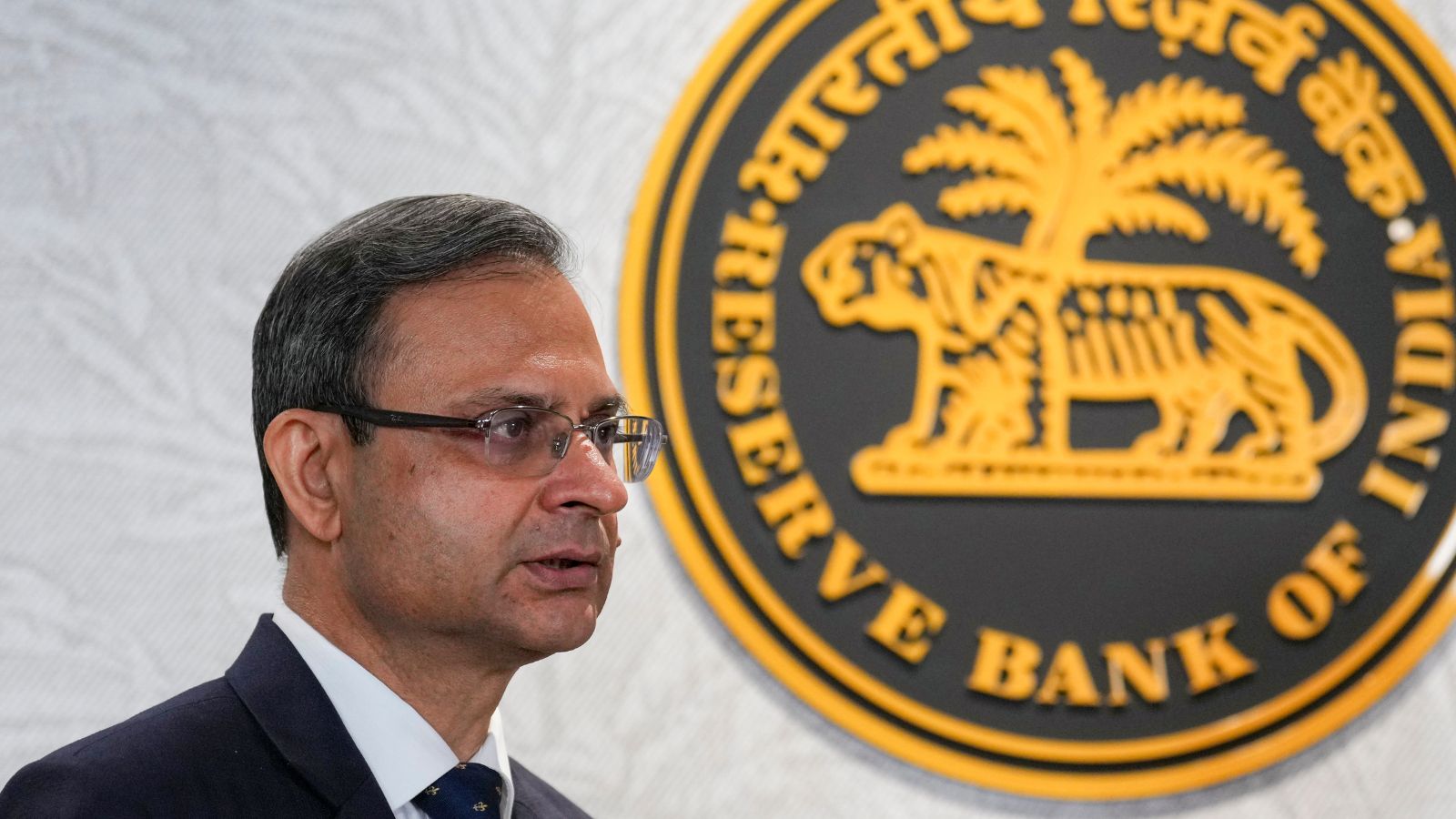
West Asia war’s second round effects the real concern, RBI in wait-and-watch mode: Governor Sanjay Malhotra
Weather ePaper Today’s Paper Journalism of Courage Home ePaper Politics Explained Opinion India Business Premium Cities UPSC Entertainment Sports World Lifestyle Tech Subscribe Sign In TrendingUPSC OfferIPL 2026US NewsPuzzles & GamesLegal NewsFresh TakeHealthResearch🎙️ Podcast Advertisement function checkAndLoadWindowSizeScript() { if (window.jQuery) { // jQuery is loaded, include your script jQuery(document).ready(function($) { // Your existing script for checking window width if (window.innerWidth) var page_w = window.innerWidth; else if (document.all) var page_w = document.body.clientWidth; if (page_w > 1024) { $(".add-left, .add-right").show(); } else { $(".add-left, .add-right").hide(); } }); } else { // jQuery is not loaded, check again after 0.2 seconds setTimeout(checkAndLoadWindowSizeScript, 200); } } // Initial call to the function checkAndLoadWindowSizeScript(); NewsBusinessWest Asia war’s second round effects the real concern, RBI in wait-and-watch mode: Governor Sanjay Malhotra West Asia war’s second round effects the real concern, RBI in wait-and-watch mode: Governor Sanjay Malhotra Earlier this month, the RBI’s Monetary Policy Committee left the repo rate unchanged at 5.25%, with the central bank predicting that retail inflation will more than double in 2026-27 to 4.6%. Written by: Siddharth Upasani3 min readMumbaiUpdated: Apr 21, 2026 05:51 AM IST Reserve Bank of India (RBI) Governor Sanjay Malhotra. (PTI Photo/File) Make us preferred source on Google Whatsapp twitter Facebook Reddit PRINT The Reserve Bank of India (RBI) is currently in “wait and watch mode” as it is crucial to be “agile and nimble” given the uncertainty caused by the war in West Asia and look through the initial impact of the supply shock the conflict has caused, Governor Sanjay Malhotra has said. He added that in such situations, “firm commitments” on the future path of policy have to be avoided. “Second-round effects are the real concern,” Malhotra said in a speech in Princeton University, US, on Saturday. The RBI released the text of the speech on Monday. “They can materialise if the supply chain disruptions continue for long. Then, what began as a supply shock can become embedded in the general price level. Preventing this entrenchment is where monetary policy has a primary role to play – through its influence on inflation expectations rather than through blunt demand compression,” the central bank chief added. Earlier this month, the RBI’s Monetary Policy Committee left the repo rate unchanged at 5.25%, with the central bank predicting that retail inflation will more than double in 2026-27 to 4.6%. The war in West Asia has exerted heavy pressure on the Indian rupee’s exchange rate, which tumbled past the 92- 93-, 94-, and 95-per-dollar levels in quick succession in March as foreign investors dumped Indian assets amid spiralling crude oil prices and a strengthening US dollar. While the rupee has gained some ground since then due to measures taken by the RBI — it closed at 93.12 per dollar on Monday — Foreign Portfolio Investors continue to sell Indian shares and debt heavily. After selling $13.6 billion worth of Indian debt and equity in March, FPIs have net sold $6.3 billion so far in April. Malhotra noted in his speech that the West Asia crisis particularly impacts India as the region contributes about “one-sixth of our exports, one-fifth of our imports, half of our crude oil imports, two-fifths of our fertilisers imports, and almost two-fifths of our inward remittances”. While India’s headline retail inflation in March rose only marginally to 3.4%, wholesale inflation surged to a 38-month high of 3.88% due to a sharp increase in prices of petroleum products. While the government has shielded consumers — the pump price of petrol and diesel has not changed — from the sharply higher crude oil prices, producers have seen an increase in their costs. Economists expect producers to soon pass on these higher costs to consumers. Malhotra, who has a Master in Public Policy from Princeton, also said the resilience of the Indian economy was not a “chance” development but shaped by robust policy frameworks. “… our financial system is very healthy and resilient today, thereby supporting economic development,” he added. Siddharth Upasani is a Deputy Associate Editor with The Indian Express. He reports primarily on data and the economy, looking for trends and changes in the former which paint a picture of the latter. Before The Indian Express, he worked at Moneycontrol and financial newswire Informist (previously called Cogencis). Outside of work, sports, fantasy football, and graphic novels keep him busy. ... Read Moreالمصدر: Indian Express | Source: Indian Express
ملاحظة تحريرية | Editorial Note: نُشر هذا المقال في الأصل بواسطة Indian Express. خبر (Khabr) هي منصة إعلامية أردنية مرخّصة تعمل بالذكاء الاصطناعي. نضيف قيمة تحريرية من خلال: تحليل ذكي للأخبار، ملخصات تلقائية، رواية صوتية بالذكاء الاصطناعي، ترجمة متعددة اللغات، وتدقيق الحقائق. هدفنا جعل الأخبار أكثر وضوحاً وسهولةً للقارئ العربي.
This article was originally published by Indian Express. Khabr is a licensed Jordanian AI-powered news platform (Registration #82086). We add editorial value through: AI-powered news analysis, automated summaries, AI audio narration, multi-language translation (Arabic, English, French, Turkish), and AI fact-checking. Our mission is to make news more accessible and understandable for Arabic-speaking audiences worldwide.