Waltz: 'It is up to President Trump' to determine if Iran violated ceasefire
•34||h=1&&(this.target=t[0]),t.length>=2&&(this.opts=t[1]);var n,r=this.opts||{},i=this.target;if("string"==typeof i?n=i:"object"==typeof i&&i instanceof y?n=i.url:window.URL&&"object"==typeof i&&i ins...
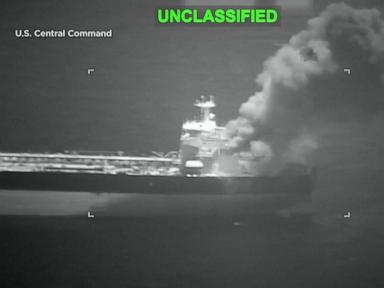
•Central Command on its X account on May 8, 2026, appears to show a strike on the Iranian-flagged tanker M/T Sevda.
•forces fired on and disabled two Iranian-flagged tankers that attempted to violate the American blockade of Iran's ports on May 8, 2026, the U.S.
هذا الخبر من ABC News. خبر يقدم أدوات ذكاء اصطناعي للتلخيص والترجمة والاستماع.
34||h=1&&(this.target=t[0]),t.length>=2&&(this.opts=t[1]);var n,r=this.opts||{},i=this.target;if("string"==typeof i?n=i:"object"==typeof i&&i instanceof y?n=i.url:window.URL&&"object"==typeof i&&i instanceof URL&&(n=i.href),o(this,n),"data"!==this.params.protocol){var s=(""+(i&&i instanceof y&&i.method||r.method||"GET")).toUpperCase();this.params.method=s,this.txSize=m(r.body)||0}}),u.on("fetch-done",function(t,e){if(this.endTime=a.now(),this.params||(this.params={}),"data"===this.params.protocol)return void g("Ajax/DataUrl/Excluded");this.params.status=e?e.status:0;var n;"string"==typeof this.rxSize&&this.rxSize.length>0&&(n=+this.rxSize);var r={txSize:this.txSize,rxSize:n,duration:a.now()-this.startTime};s("xhr",[this.params,r,this.startTime,this.endTime,"fetch"],this)})}},{}],18:[function(t,e,n){var r={};e.exports=function(t){if(t in r)return r[t];if(0===(t||"").indexOf("data:"))return{protocol:"data"};var e=document.createElement("a"),n=window.location,o={};e.href=t,o.port=e.port;var i=e.href.split("://");!o.port&&i[1]&&(o.port=i[1].split("/")[0].split("@").pop().split(":")[1]),o.port&&"0"!==o.port||(o.port="https"===i[0]?"443":"80"),o.hostname=e.hostname||n.hostname,o.pathname=e.pathname,o.protocol=i[0],"/"!==o.pathname.charAt(0)&&(o.pathname="/"+o.pathname);var a=!e.protocol||":"===e.protocol||e.protocol===n.protocol,s=e.hostname===document.domain&&e.port===n.port;return o.sameOrigin=a&&(!e.hostname||s),"/"===o.pathname&&(r[t]=o),o}},{}],19:[function(t,e,n){function r(t,e){var n=t.responseType;return"json"===n&&null!==e?e:"arraybuffer"===n||"blob"===n||"json"===n?o(t.response):"text"===n||""===n||void 0===n?o(t.responseText):void 0}var o=t(22);e.exports=r},{}],20:[function(t,e,n){function r(){}function o(t,e,n,r){return function(){return u.recordSupportability("API/"+e+"/called"),i(t+e,[f.now()].concat(s(arguments)),n?null:this,r),n?void 0:this}}var i=t("handle"),a=t(31),s=t(32),c=t("ee").get("tracer"),f=t("loader"),u=t(25),d=NREUM;"undefined"==typeof window.newrelic&&(newrelic=d);var p=["setPageViewName","setCustomAttribute","setErrorHandler","finished","addToTrace","inlineHit","addRelease"],l="api-",h=l+"ixn-";a(p,function(t,e){d[e]=o(l,e,!0,"api")}),d.addPageAction=o(l,"addPageAction",!0),d.setCurrentRouteName=o(l,"routeName",!0),e.exports=newrelic,d.interaction=function(){return(new r).get()};var m=r.prototype={createTracer:function(t,e){var n={},r=this,o="function"==typeof e;return i(h+"tracer",[f.now(),t,n],r),function(){if(c.emit((o?"":"no-")+"fn-start",[f.now(),r,o],n),o)try{return e.apply(this,arguments)}catch(t){throw c.emit("fn-err",[arguments,this,t],n),t}finally{c.emit("fn-end",[f.now()],n)}}}};a("actionText,setName,setAttribute,save,ignore,onEnd,getContext,end,get".split(","),function(t,e){m[e]=o(h,e)}),newrelic.noticeError=function(t,e){"string"==typeof t&&(t=new Error(t)),u.recordSupportability("API/noticeError/called"),i("err",[t,f.now(),!1,e])}},{}],21:[function(t,e,n){function r(t){if(NREUM.init){for(var e=NREUM.init,n=t.split("."),r=0;r0){var r=n[n.length-1];if(f&&f 8:02This screen grab made on May 10, 2026, from a video released by the U.S. Central Command on its X account on May 8, 2026, appears to show a strike on the Iranian-flagged tanker M/T Sevda. U.S. forces fired on and disabled two Iranian-flagged tankers that attempted to violate the American blockade of Iran's ports on May 8, 2026, the U.S. military said.U.S. Central Command Public Affairs/AFP via Getty ImagesMike Waltz, U.S. ambassador to the United Nations, said Sunday that President Donald Trump is giving diplomacy with Iran "every chance" before restarting military strikes, even as the two countries continue to exchange fire after Trump declared a ceasefire. "[It is] up to President Trump as commander-in-chief to determine what constitutes a violation, when to go back to military action or when to continue to give diplomacy a chance," Waltz told ABC News' "This Week" co-anchor Martha Raddatz. Trump said that the ceasefire with Iran had not been violated despite Iran and the U.S. taking shots at each other over the Strait of Hormuz, telling ABC News that the strikes were "just a love tap." Iran accused the U.S. of violating the ceasefire. U.S. Ambassador to the United Nations Mike Waltz appears on ABC News' "This Week" on May 10, 2026.ABC NewsAfter weeks of negotiations with no agreement, Waltz said Sunday that Trump will continue to pursue diplomacy. "When the mediators, in this case Pakistan, ask us ... to give this negotiation another chance before we go back to bombing Iran, then I think that's completely an appropriate choice for President Trump to make," Waltz said. "He is giving diplomacy every chance we possibly can before going back to hostilities." Retired Adm. William McRaven, who commanded U.S. Special Operations Command when the U.S. killed Osama Bin Laden 15 years ago, appeared after Waltz on "This Week" and said it was clear that the ceasefire had been violated. "Of course, the ceasefire has been violated, Martha," McRaven said. "Now, I understand Ambassador Waltz's position. At the end of the day, this is about hopefully getting the Iranians to agree to the proposal ... the fact of the matter is, when you're shooting at each other, then you no longer have a ceasefire." The U.S. submitted a proposal to Iran that would have Iran gradually open the Strait of Hormuz and have the U.S. ease its blockade over a 30-day period, according to officials familiar with the matter. While in its current form, the one-page memo doesn't include terms related to Iran's nuclear program, the expectation is that during that time, the two countries would negotiate how to handle Iran's enriched uranium. The Trump administration has repeatedly emphasized that preventing Iran from enriching uranium with the capability to build a nuclear weapon is a key objective of the war. Iran has maintained that it is not seeking to build a nuclear weapon. Retired Adm. William McRaven, a former commander of U.S. Special Operations Command, appears on ABC News' "This Week" on May 10, 2026.ABC NewsIranian state media reported on Sunday that Tehran had sent its response to the U.S.-proposed text outlining a possible end to the war through Pakistani mediators but did not provide details. McRaven said Sunday that he thought 30 days was too short of a period to negotiate a significant nuclear deal. "It took over two years to negotiate the JCPOA. So this idea that somehow we will negotiate, you know, a very challenging nuclear deal with the Iranians, I think 30 days is way too compressed of time," McRaven said, referring to the 2015 Iran nuclear deal negotiated under the Obama administration that was officially called the Joint Comprehensive Plan of Action. Raddatz also pressed Waltz on Trump's threat to Iran several weeks ago that it had to open the Strait of Hormuz within 48 hours or face the destruction of its largest power plants. Trump did not follow through with that threat, and the strait still is not open, sending global oil prices soaring over recent weeks. Waltz defended the timeline by criticizing Iran for its obstruction of the strait, saying he is pushing for a U.N. resolution to prevent any country from blocking shipping in an international waterway. "I think we should take a step back -- 50 days to deal with a 50-year-old problem," Waltz said. "This isn’t the first time Iran has either threatened or actually done this ... that’s why we’re pushing now another U.N. resolution that says Iran cannot do this. No country can do what Iran is doing in international waterways." 24/7 coverage of breaking news and live events Mike Waltz, U.S. ambassador to the United Nations, said Sunday that President Donald Trump is giving diplomacy with Iran \"every chance\" before restarting military strikes, even as the two countries continue to exchange fire after Trump declared a ceasefire. \"[It is] up to President Trump as commander-in-chief to determine what constitutes a violation, when to go back to military action or when to continue to give diplomacy a chance,\" Waltz told ABC News' \"This Week\" co-anchor Martha Raddatz. Trump said that the ceasefire with Iran had not been violated despite Iran and the U.S. taking shots at each other over the Strait of Hormuz, telling ABC News that the strikes were \"just a love tap.\" Iran accused the U.S. of violating the ceasefire. After weeks of negotiations with no agreement, Waltz said Sunday that Trump will continue to pursue diplomacy. \"When the mediators, in this case Pakistan, ask us ... to give this negotiation another chance before we go back to bombing Iran, then I think that's completely an appropriate choice for President Trump to make,\" Waltz said. \"He is giving diplomacy every chance we possibly can before going back to hostilities.\" Retired Adm. William McRaven, who commanded U.S. Special Operations Command when the U.S. killed Osama Bin Laden 15 years ago, appeared after Waltz on \"This Week\" and said it was clear that the ceasefire had been violated. \"Of course, the ceasefire has been violated, Martha,\" McRaven said. \"Now, I understand Ambassador Waltz's position. At the end of the day, this is about hopefully getting the Iranians to agree to the proposal ... the fact of the matter is, when you're shooting at each other, then you no longer have a ceasefire.\" The U.S. submitted a proposal to Iran that would have Iran gradually open the Strait of Hormuz and have the U.S. ease its blockade over a 30-day period, according to officials familiar with the matter. While in its current form, the one-page memo doesn't include terms related to Iran's nuclear program, the expectation is that during that time, the two countries would negotiate how to handle Iran's enriched uranium. The Trump administration has repeatedly emphasized that preventing Iran from enriching uranium with the capability to build a nuclear weapon is a key objective of the war. Iran has maintained that it is not seeking to build a nuclear weapon. Iranian state media reported on Sunday that Tehran had sent its response to the U.S.-proposed text outlining a possible end to the war through Pakistani mediators but did not provide details. McRaven said Sunday that he thought 30 days was too short of a period to negotiate a significant nuclear deal. \"It took over two years to negotiate the JCPOA. So this idea that somehow we will negotiate, you know, a very challenging nuclear deal with the Iranians, I think 30 days is way too compressed of time,\" McRaven said, referring to the 2015 Iran nuclear deal negotiated under the Obama administration that was officially called the Joint Comprehensive Plan of Action. Raddatz also pressed Waltz on Trump's threat to Iran several weeks ago that it had to open the Strait of Hormuz within 48 hours or face the destruction of its largest power plants. Trump did not follow through with that threat, and the strait still is not open, sending global oil prices soaring over recent weeks. Waltz defended the timeline by criticizing Iran for its obstruction of the strait, saying he is pushing for a U.N. resolution to prevent any country from blocking shipping in an international waterway. \"I think we should take a step back -- 50 days to deal with a 50-year-old problem,\" Waltz said. \"This isn’t the first time Iran has either threatened or actually done this ... that’s why we’re pushing now another U.N. resolution that says Iran cannot do this. No country can do what Iran is doing in international waterways.\"المصدر: ABC News | Source: ABC News
ملاحظة تحريرية | Editorial Note: نُشر هذا المقال في الأصل بواسطة ABC News. خبر (Khabr) هي منصة إعلامية أردنية مرخّصة تعمل بالذكاء الاصطناعي. نضيف قيمة تحريرية من خلال: تحليل ذكي للأخبار، ملخصات تلقائية، رواية صوتية بالذكاء الاصطناعي، ترجمة متعددة اللغات، وتدقيق الحقائق. هدفنا جعل الأخبار أكثر وضوحاً وسهولةً للقارئ العربي.
This article was originally published by ABC News. Khabr is a licensed Jordanian AI-powered news platform (Registration #82086). We add editorial value through: AI-powered news analysis, automated summaries, AI audio narration, multi-language translation (Arabic, English, French, Turkish), and AI fact-checking. Our mission is to make news more accessible and understandable for Arabic-speaking audiences worldwide.