
Burnout feels like a thoroughly modern concept – one borne from our age of global digital communication and long office hours. But the Victorians also had an idea of burnout, one they termed “overwork”.
The Victorian doctor, C.H.F. Routh, for example, published On Overwork and Premature Mental Decay: Its Treatment, which ran to four editions between 1873 and 1888. Although the language differs, the underlying concerns are similar. Victorian overwork was a new development in their era of empire and industrialisation, with its railways and telegraphs which enabled rapid global communication and an ever-quickening speed of life.
The Victorians were undoubtedly followers of what the philosopher Thomas Carlyle described as the “Gospel of Work”. But they were also acutely aware of the health problems which could come from devotion to this new religion.
In America, neurologist George Beard had introduced the concept of neurasthenia, a condition linked to the overstrain of nerves. But in Britain, overwork was viewed as altogether more manly – and indeed almost a badge of pride.
As now, with our concepts of executive burnout, overwork was very much associated with mental activity and the professional classes. It therefore excluded the overburdened working classes from consideration. Doctors were a particular cause for concern.
Routh cites the case of Dr Golding Bird, a successful physician, who advised him to ease off in his work. He told him to take an annual six weeks holiday: “otherwise you will find yourself, at my age, a prosperous practitioner, but a dying old man”. Bird was still practising, but died a few weeks later at the age of 39.
Travel for health
For those suffering from overwork and other forms of illness or malaise, the primary prescription (for the professional classes) was travel to a health resort, preferably in Europe.
In 1870 the Scottish publisher William Chambers printed Wintering at Menton, an account of his own breakdown of health from overwork, following his time as Lord Provost of Edinburgh and his subsequent recovery. He writes in amazement of the beauties of the landscape in this spot on the French Riviera, its blue skies and caressing climate, and asks his contemporaries to reconsider their lives. Too many were dropping into their graves, having “succumbed in the feverish, and we might almost say, insane, battle of life. Too long and too diligently have they stuck to their professional pursuits.”
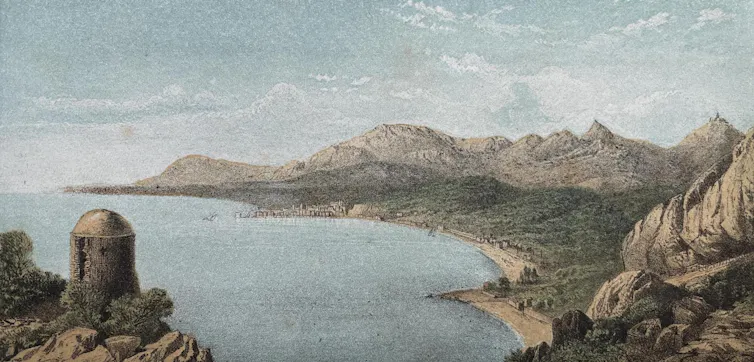
Menton became the favoured spot for the British to recuperate from overwork and other forms of breakdown of health. This was due in large part to the publication by Dr James Henry Bennet of a series of works, including Menton and the Riviera as a Winter Climate (1861), and the numerous editions of Winter and Spring on the Shores of the Mediterranean (1865-75).
The latter offered a guide to health travel, sampling all the resorts around the Mediterranean coast, but concluded that Menton offered the best climate and conditions for recovery.
The reasons for the extraordinary influence of Bennet’s work can be traced to his narrative of his own recovery, which formed a preface to all his books:
Five and twenty years devoted to a laborious profession and the harassing cares which pursue a hard-worked London physician, broke down vital powers. In 1859 I became consumptive, and strove in vain to arrest the progress of the disease.
Believing himself to be dying, Bennet headed for the Riviera. But finding himself under the “genial sky” of Menton, and “freed from the labours and anxieties of former life”, he found to his great surprise that his health improved. He decided to spend winter there every year, and set up a practice. Menton, as a consequence, grew from a small village to a major health resort, complete with its own English quarter.
The medical climatology revolution
Bennet was a leading figure in the development of what was termed “medical climatology”. This was the belief that many conditions (including consumption, or tuberculosis), could actually be cured, or at least arrested, by moving to a resort with the right climate.
In part this movement was in response to the choking smog of industrial cities. “Diseases of the chest”, as they were known, inevitably fared better amid the pure air and blue skies of the Riviera in winter.
Bennet’s form of treatment was viewed as almost revolutionary at the time. Invalids were to escape the hot, close confines of an English sickroom and stride out into the hills, absorbing the rays of the sun and the pure air, while feasting their senses on the wonders of nature around them. No medicine required.
It was also a prescription for the elderly, or infirm. They could be driven out each day to a different, sheltered and sunny spot: “The range of observation is thus increased without fatigue, the glorious scenery of the district is seen and enjoyed in its ever-varying phases, and the mind is refreshed by change.” It is an inspiriting vision of what might be possible in late-life care today.
For those suffering from overwork, Bennet recommended a minimum of three full winters spent in the resort. This was a far cry from the short stays in spas in the 18th century, or our own quick “wellness” breaks.
What he offered was a concept of “legitimate idleness”, where the hardworking professional could lead a “quiet, contemplative life”, basking in the sun “like an ‘invalided’ lizard on his wall”.
Queen Victoria brought her son Leopold, a haemophiliac, to “beloved and beautiful Mentone” and writers and artists, from Robert Louis Stevenson and Aubrey Beardsley to Katherine Mansfield, flocked to the resort. They left extraordinary records of the pleasures and pains of their times in medical exile.
My own book, In Quest of a Cure: Literary and Medical Cultures of the Health Resort, explores many of these lives – in Menton, Davos and elsewhere – and the changing patterns of treatment. For cases of overwork, and other conditions, time was of the essence: in place of the hurry and worry and snatched time of Victorian city life, time was to be extended, as invalids relaxed into a state of “legitimate idleness” amid the healing powers of nature.
This article features references to books that have been included for editorial reasons, and may contain links to bookshop.org. If you click on one of the links and go on to buy something, The Conversation UK may earn a commission.

Sally Shuttleworth's research for this article was funded by an Advanced Investigator Grant, 'Diseases of Modern Life: Nineteenth-Century Perspectives' from the European Research Council (Seventh Framework, grant number 340121).