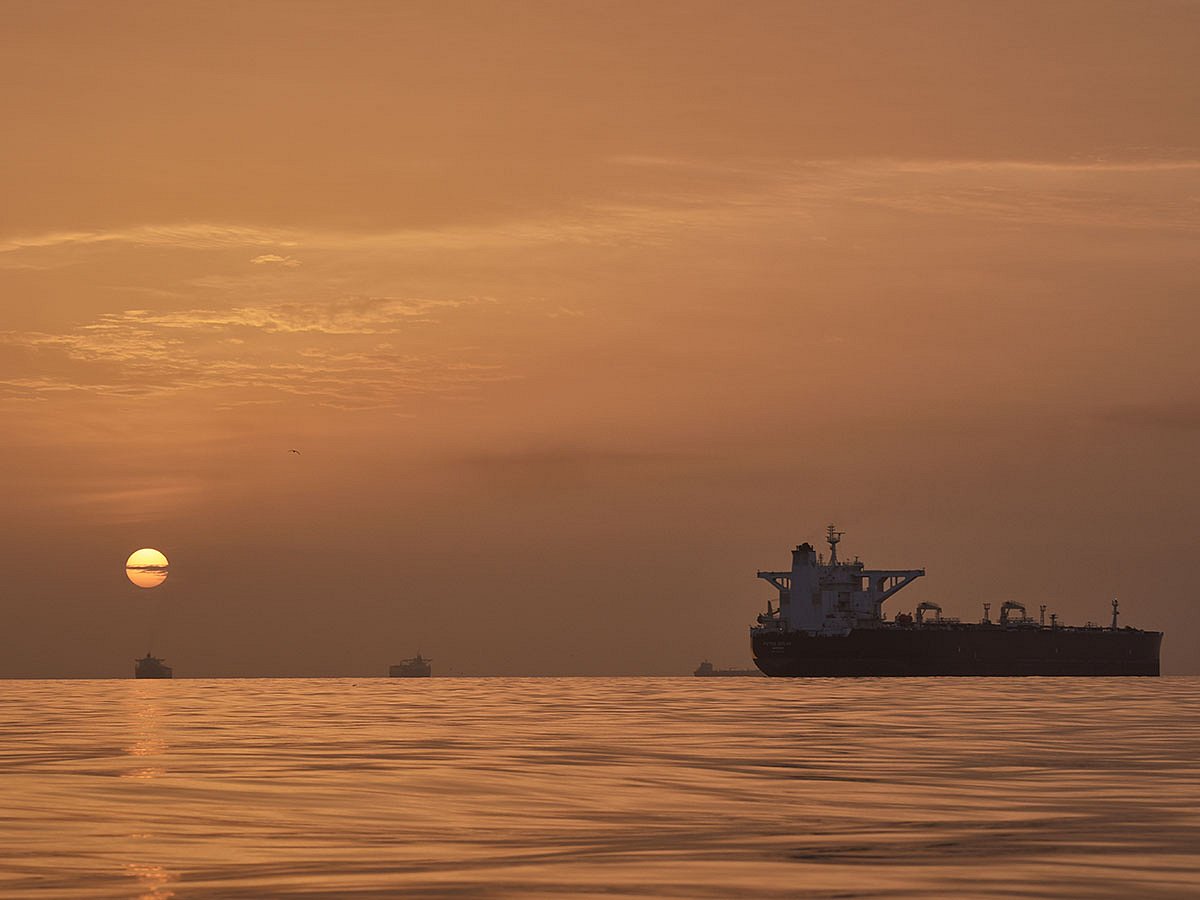
Strait of Hormuz to stay closed until port blockade lifts, Iran says
The crucial Strait of Hormuz will not reopen until the United States lifts its naval blockade on Iranian ports, Tehran said Saturday, as a top official warned that a final peace deal remained "far" off.
Mohammad Bagher Ghalibaf, speaker of the Iranian parliament, said in a televised address that there has been "progress" in talks with Washington "but there are many gaps and some fundamental points remain."
"We are still far from the final discussion," said Ghalibaf, one of Tehran's negotiators in the talks aimed at ending the war launched by Israel and the United States against the Islamic Republic.
A two-week ceasefire is set to end on Wednesday unless it is renewed.
US President Donald Trump said meanwhile that "very good conversations" were going on with Iran but warned Tehran against trying to "blackmail" the United States.
On Friday, Tehran had declared the Strait of Hormuz, which usually carries a fifth of the world's oil and liquefied natural gas, open after a ceasefire was agreed in Israel's war with Iran's ally Hezbollah in Lebanon.
This prompted elation in global markets and sent oil prices plunging, but with Trump insisting the blockade of Iranian ports would continue until a deal is struck to end the wider war, Tehran said it was shuttering the strait once more.
"If America does not lift the blockade, traffic in the Strait of Hormuz will definitely be limited," Ghalibaf said.
Iran's supreme leader Mojtaba Khamenei, who has yet to be seen since taking power, said meanwhile in a written message that Iran's navy "stands ready" to defeat the United States.
Trump, speaking to reporters at a White House event, accused Iran of getting "a little cute" with its recent moves and warned Tehran not to try to "blackmail" Washington with its flip-flopping on the Strait of Hormuz.
"We have very good conversations going on," the president said, adding that the United States was "taking a tough stand."
Get updated faster and for FREE: Download the Gulf News app now - simply click here.
Iran's speaker says US negotiations have progressed but far from final deal
Progress had been made in negotiations with the United States to end the war, Iran's parliamentary speaker said on Saturday night, but added the sides were still far from an agreement.
"We are still far from the final discussion," Mohammad Bagher Ghalibaf, who is also one of Iran's negotiators, said in a national televised address, adding "we made progress in the negotiations, but there are many gaps and some fundamental points remain".
Iran 'victorious' in war with US, speaker says
Iran had been "victorious in the field" during weeks of war and had only agreed to a temporary truce with the United States because its demands had been met, the Iranian parliamentary speaker said on Saturday.
The two-week ceasefire is set to end Wednesday unless it is renewed, with a permanent deal that mediators including Pakistan are pushing to get over the line still not finalised and progress on key sticking points uncertain.
"We were victorious in the field," Speaker Mohammad Bagher Ghalibaf said in a national televised address, adding the United States had not achieved its goals and Iran controlled the strategic Strait of Hormuz maritime transit route.
"If we accepted the ceasefire, it was because they accepted our demands," he said, referring to the United States.
"The enemy's every effort was to impose its demands on us and it is important that we register our rights, so this is where negotiation is a method of struggle."
Ghalibaf and his delegation held closed door talks in Islamabad with US Vice President JD Vance on April 11, in the highest level Iran-US contacts since before the 1979 Islamic revolution.
The talks did not result in a final deal and officials have signalled mediations are continuing, though Iran's deputy foreign minister said on Saturday no date had been set for a new round of talks.
Amid US tensions, Mexico, Spain, Brazil urge respectful dialogue with Cuba
Mexico, Spain and Brazil voiced concern Saturday over the "dramatic situation" in Cuba, which has faced months of pressure from US President Donald Trump, with the trio urging "sincere and respectful dialogue."
Without explicitly mentioning the United States, the three leftist-led countries expressed "deep concern regarding the grave humanitarian crisis that the people of Cuba are enduring, and call for the adoption of necessary measures to alleviate this situation."
The countries, in a joint statement issued by Mexico's Ministry of Foreign Affairs, called for a "sincere and respectful dialogue" in line with international law.
The purpose of such a dialogue should be to "find a lasting solution to the current situation and to ensure that it is the Cuban people themselves who decide their own future in full freedom," the statement said.
The appeal came as a summit of leftist leaders is taking place in Barcelona, led by Spanish Prime Minister Pedro Sanchez, one of the biggest critics of the United States and Israel's bombing campaigns in the Middle East.
Mexican President Claudia Sheinbaum and Brazil's Luiz Inacio Lula da Silva were among the attendees, who called for efforts to "protect democracy."
Cuba has been bracing for a possible attack following repeated warnings from Trump that Cuba is "next" after he toppled Venezuela's leader Nicolas Maduro and went to war against Iran.
Trump has imposed an oil blockade of Cuba, aggravating the impoverished island's worst economic and energy crisis in decades.
France blames Hezbollah for French peacekeeper's death
A French soldier was killed and three others wounded in an ambush Saturday on UN peacekeepers in Lebanon that French President Emmanuel Macron blamed on Hezbollah, an accusation the group has denied.
The attack follows an agreement between Israel and Lebanon on Thursday for a 10-day ceasefire to negotiate an end to six weeks of fighting between Israel and the Iran-backed group.
"Everything points to Hezbollah being responsible for this attack," Macron said on X, urging Lebanese authorities to arrest the perpetrators.
UN Secretary-General Antonio Guterres condemned the attack in a statement and said an initial assessment by the United Nations Interim Force in Lebanon (UNIFIL) found it was carried out by the Iranian-backed group.
But Hezbollah - which is strongly opposed to the planned talks with Israel - denied involvement in the attack that killed the French peacekeeper, identified as staff sergeant Florian Montorio.
"Hezbollah denies any connection to the incident that occurred with UNIFIL forces in the Ghandouriyeh-Bint Jbeil area," it said in a statement.
The group urged "caution in making judgements and assigning responsibilities" pending the results of the Lebanese army's investigation into the incident.
The fighting in Lebanon - one of the fronts in the Middle East war - has seen UNIFIL deployed there repeatedly targeted, by both Israeli and Hezbollah forces.
Montorio, was caught in an "ambush" as his unit headed to a UNIFIL outpost cut off by fighting and he died from a "direct gunshot", France's armed forces minister Catherine Vautrin said on X.
He is the second French soldier to die since the start of the war in the Middle East, after an Iranian-designed drone killed Arnaud Frion last month in Iraq's Kurdistan region.
Iran closes Hormuz Strait again, as Trump warns against 'blackmail'
Iran's military declared the Strait of Hormuz closed again on Saturday, prompting ships to abandon attempts to transit and President Donald Trump to warn Tehran against trying to "blackmail" the United States.
On Friday, Tehran had declared the strait, which usually carries a fifth of the world's oil and liquefied natural gas, open after a ceasefire was agreed in Israel's war with Iran's ally Hezbollah in Lebanon.
This prompted elation in global markets and sent oil prices plunging, but with Trump insisting that a US naval blockade of Iranian ports would continue until a deal to end the wider war was concluded, Tehran said it was shuttering the strait once more late Saturday morning.
Iran's central military command said that, in response to the US blockade, Hormuz was again "under strict management and control of the armed forces". The powerful Revolutionary Guards warned that any effort to cross "will be considered cooperation with the enemy, and the offending vessel will be targeted".
Trump had previously said the two sides were "very close" to striking a deal, but following Iran's announcement on Saturday, he insisted Tehran "can't blackmail us", even as he maintained communications were ongoing.
"We'll be talking about Iran later. We have very good conversations going on," he added, accusing Tehran of getting "a little cute" with its recent moves.
Iran's top national security body said during a visit by the military chief of mediator Pakistan that "new proposals have been put forward by the Americans, which the Islamic Republic of Iran is currently reviewing and has not yet responded to".
It went on to say, however, that Iran's negotiating delegation would not offer "even the slightest compromise, retreat or leniency" in talks with Washington.
Iran reports 3,468 dead in war with US, Israel: official
Iran's state-run Foundation of Martyrs and Veterans Affairs said on Saturday that the war with the United States and Israel had killed more than 3,400 people in the Islamic republic.
The announcement comes in the midst of a two-week ceasefire in the conflict, which erupted in late February with US-Israeli strikes on Tehran.
Foundation head Ahmad Mousavi was quoted by the ISNA news agency as saying that 3,468 "martyrs... fell during the recent conflict".
A previous toll from the head of the Iranian Legal Medicine Organization issued on April 12 said 3,375 people in Iran had been killed in the war.
The US-based Human Rights Activists News Agency (HRANA) said on April 7 that at least 3,636 people had been killed, including 1,701 civilians - among them at least 254 children - as well as 1,221 military personnel and 714 people whose status had not been classified.
Due to reporting restrictions, AFP is not able to access the sites of strikes nor to independently verify tolls in Iran.
Israeli army carries out demolitions in south Lebanon town: state media
Israeli forces on Saturday carried out demolitions in the southern Lebanese town of Bint Jbeil, the scene of intense fighting with Hezbollah prior to the recently agreed 10-day truce, Lebanese state media reported.
"The Israeli enemy is repeating its house detonating operations in the town of Bint Jbeil," Lebanon's state-run National News Agency (NNA) said, also reporting demolitions in other border towns where Israeli troops are present.
Bint Jbeil, located around five kilometres north of the Israeli border, had been the scene of heavy fighting between Israeli forces and Hezbollah for days before the truce went into force at midnight on Thursday.
The town has long been both a symbolic and strategic flashpoint in confrontations between Israel and Hezbollah.
It was the site of some of the fiercest fighting during the 2006 war, when Hezbollah's resistance there became central to the group's narrative of defiance.
And it was from the stadium in Bint Jbeil in 2000 that the group's former chief Hassan Nasrallah delivered his "Liberation" speech following Israel's withdrawal from southern Lebanon after 22 years of occupation.
Israeli Defence Minister Israel Katz has previously said house demolitions would be carried out "in order to remove once and for all the border-adjacent threats" as part of efforts to establish a security zone in south Lebanon.
His Lebanese counterpart Michel Menassa decried the plans as evidence of an intention to "forcibly displace hundreds of thousands of citizens, and systematically destroy villages".
After a November 2024 ceasefire sought to end the last conflict between Israel and Hezbollah - during which Nasrallah and other top leaders were killed - Israeli troops also carried out a series of demolitions in certain towns.
US‑Israel war on Iran: Recent developments
Day 50: Indian ships reverse course in Strait of Hormuz
Day 49: Trump says Iran agrees to 'never' close Hormuz strait again
Day 48: Trump: Iran agreed to hand over its enriched uranium
Day 47: US optimistic about reaching peace deal with Iran
Day 46: 2 days to US-Iran talks in Pakistan? Trump thinks so
Day 45: US, Iran discuss 'another round' of direct talks
Day 44: US to begin 'blockade' of Iranian ports on Monday
Day 43: 3-way talks with the US and Iran begin in Pakistan
Day 42: Trump says Iran has 'no cards' as Vance heads for talks
Day 41: Kuwait condemns drone attacks, US warns vs Hormuz toll