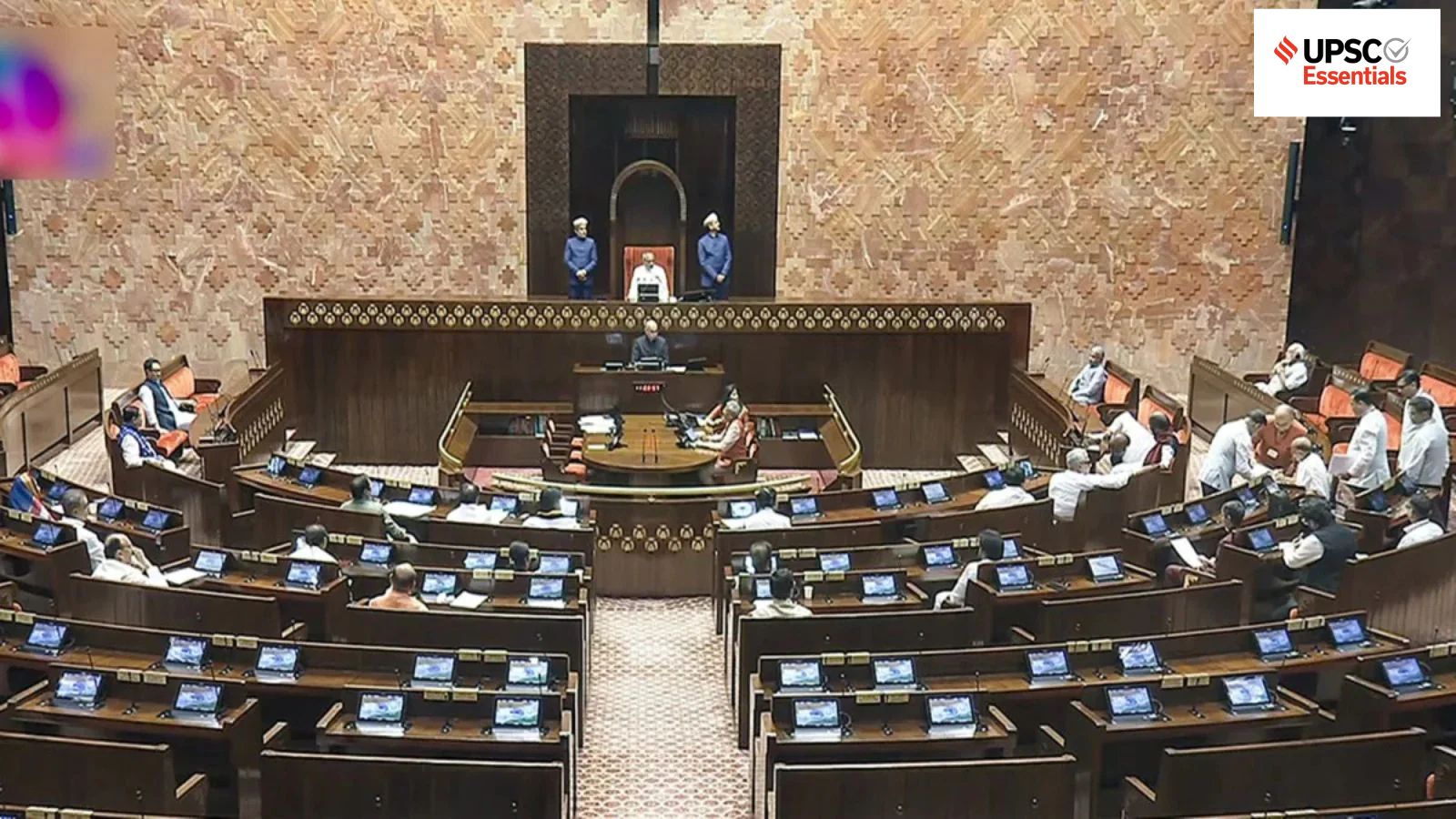
Weather ePaper Today’s Paper Journalism of Courage Home ePaper Politics Explained Opinion India Business Premium Cities UPSC Entertainment Sports World Lifestyle Tech Subscribe Sign In TrendingUPSC OfferIPL 2026US NewsPuzzles & GamesLegal NewsFresh TakeHealthResearch🎙️ Podcast Advertisement function checkAndLoadWindowSizeScript() { if (window.jQuery) { // jQuery is loaded, include your script jQuery(document).ready(function($) { // Your existing script for checking window width if (window.innerWidth) var page_w = window.innerWidth; else if (document.all) var page_w = document.body.clientWidth; if (page_w > 1024) { $(".add-left, .add-right").show(); } else { $(".add-left, .add-right").hide(); } }); } else { // jQuery is not loaded, check again after 0.2 seconds setTimeout(checkAndLoadWindowSizeScript, 200); } } // Initial call to the function checkAndLoadWindowSizeScript(); NewsUPSC Current AffairsUPSC EssentialsUPSC Essentials | Mains answer practice — GS 2 : constitutional framework governing delimitation and inter-state river water disputes (Week 150) UPSC Essentials | Mains answer practice — GS 2 : constitutional framework governing delimitation and inter-state river water disputes (Week 150) UPSC Civil Services Mains Exam: Strengthen your conceptual clarity and answer-writing skills with structured guidance, key points, and self-evaluation prompts. Do not miss points to ponder and answer in the comment box below. Written by: Nitendra Pal Singh9 min readNew DelhiApr 16, 2026 03:10 PM IST Are you preparing for Civil Services Exam 2026? Attempt a question on the constitutional framework governing delimitation in today's answer writing practice. (File Photo) Make us preferred source on Google Whatsapp twitter Facebook Reddit PRINT UPSC Essentials brings to you its initiative for the practice of Mains answer writing. It covers essential topics of static and dynamic parts of the UPSC Civil Services syllabus covered under various GS papers. This answer-writing practice is designed to help you as a value addition to your UPSC CSE Mains. Attempt today’s answer writing on questions related to topics of GS-2 to check your progress. Gear up for UPSC Prelims 2026—Practice smarter, revise faster, and succeed with our Special Quiz Magazine. (Click Here) 🚨 Click Here to read the UPSC Essentials magazine for March 2026. Share your views and suggestions in the comment box or at manas.srivastava@indianexpress.com🚨 Discuss the constitutional framework governing delimitation in India. How might recent proposals relating to seat expansion and women’s reservation reshape the country’s electoral landscape? Rising water scarcity is emerging as a major challenge to India’s internal stability and development. Discuss the constitutional provisions for the adjudication of inter-state river water disputes in India. QUESTION 1: Discuss the constitutional framework governing delimitation in India. How might recent proposals relating to seat expansion and women’s reservation reshape the country’s electoral landscape? Relevance: The question highlights the constitutional provisions governing delimitation. It gains significance in light of debates surrounding the post-2026 delimitation exercise and its potential impact on federal balance and regional equity. Aspirants must also focus on Centre–State relations, demographic shifts, and their implications for political representation in Parliament. Note: This is not a model UPSC answer. It only provides you with a thought process which you may incorporate into the answers. — Delimitation literally means the act or process of fixing limits or boundaries of territorial constituencies in a country or a province having a legislative body. The job of delimitation is assigned to a high power body. Such a body is known as Delimitation Commission or a Boundary Commission. In India, such Delimitation Commissions have been constituted 4 times – in 1952 under the Delimitation Commission Act, 1952, in 1963 under Delimitation Commission Act, 1962, in 1973 under Delimitation Act, 1972 and in 2002 under Delimitation Act, 2002. — The Delimitation Commission in India is a high power body whose orders have the force of law and cannot be called in question before any court. These orders come into force on a date to be specified by the President of India on this behalf. You may incorporate some of the following points in your answer: — The government has tethered the delimitation exercise to the second landmark change — the implementation of the Women’s Reservation Act, which seeks to reserve one-third of seats in Lok Sabha and the state Assemblies for women. The Women’s Reservation Act was passed through another Constitutional amendment in 2023 but had been kept in abeyance till the seats in Lok Sabha and state Assemblies were increased through the long-pending delimitation exercise. — This dual move — the increase in seats in Lok Sabha and state Assemblies, and 33% reservation for women in these legislatures — represents one of the most fundamental changes in Indian democracy since Independence. — Women’s reservation had already become a part of the Constitution in 2023. All that was left was its actual implementation in the elections. This implementation had been linked to the delimitation exercise, which seemed feasible only after 2027 after the publication of the results of the Census that had been set in motion earlier this year. — The Constitutional amendment Bill, made public recently, however, does not make a mention of the 50% across-the-board increase. All it does is propose to increase the total number of seats in Lok Sabha to up to 850 (815 from the states, 35 from the Union Territories) from the existing 543. — It seeks to do some other important things as well. It proposes to delink the delimitation exercise from the Census, and does away with the Constitutional necessity of carrying out a delimitation after every Census. Henceforth, a delimitation can be carried out whenever Parliament approves such an exercise. It would be based not on the results of the last published Census report, but on the Census report decided by Parliament. — The amendment proposes changing the definition of population from the “last preceding census” to “population as ascertained at such census, as Parliament may by law determine”. — This will enable the current government to carry out a delimitation exercise on the 2011 Census report, without having to wait for the results of the 2027 Census. This also gives Parliament a wider option when it comes to allotment of seats. — Article 82 of the Constitution provides for ‘readjustment’ of constituencies of Lok Sabha and the state Assemblies after every Census. The readjustment can lead to a change in the number of seats or a change in boundaries of constituencies. This is done to account for the changes in population over time, the main idea being that the value of the vote cast by every voter across the country has a similar value or weight. — Article 81 says the number of Lok Sabha seats allocated to every state should be such that “the ratio between that number and the population of the state is, so far as practicable, the same for all states”. (Source: Explained: How government’s delimitation push will reshape states’ representation in Lok Sabha) How do Articles 82 and 170 shape the process of redrawing parliamentary and assembly constituencies? How does the principle of “one person, one vote, one value” influence the delimitation process? Examine the need for electoral reforms as suggested by various committees, with particular reference to the ‘‘One Nation–One Election’’ principle. (2024) QUESTION 2: Rising water scarcity is emerging as a major challenge to India’s internal stability and development. Discuss the constitutional provisions for the adjudication of inter-state river water disputes in India. Relevance: The question addresses growing water stress and its implications for governance, federalism, and national stability. Aspirants must go through the constitutional provisions and institutional frameworks for resolving inter-state river disputes. Note: This is not a model UPSC answer. It only provides you with a thought process which you may incorporate into the answers. — Since agriculture is the largest consumer of water, the equitable sharing of river water has become a complex and emotionally charged issue, particularly in states with large farming populations. — Most Indian rivers flow through numerous states, therefore disputes frequently develop when upstream states attempt to impede or divert water by building dams or barrages. You may incorporate some of the following points in your answer: Legal framework governing inter-state disputes — Article 246 of the Constitution provides a framework to distribute legislative powers between the states and the Centre through the Seventh Schedule, which includes the Union List, the State List and the Concurrent List. — Entry 17 of the State List deals with water – covering water supplies, irrigation and canals, drainage and embankments, water storage and water power – subject to the provisions of entry 56 of the Union list. — Entry 56 of the Union List provides that the regulation and development of inter-State rivers and river valleys is declared by Parliament by law. Article 262 further provides Parliament with powers related to the adjudication of inter-state river water disputes related to its use, control, distribution, etc. — Under Article 262, Parliament has enacted the Inter-State River Water Disputes (ISRWD) Act, 1956, for the adjudication of disputes relating to waters of inter-state rivers and river valleys. The act has been amended four times, with the last amendment being in 2002. — If the Centre is of the opinion that the given dispute cannot be settled by negotiations, it can constitute a Water Disputes Tribunal for the adjudication. Examples of major inter-state river water sharing disputes — Krishna Water Disputes Tribunal (KWDT-I) – Maharashtra, Andhra Pradesh, Karnataka — Godavari Water Disputes Tribunal (GWDT) – Maharashtra, Andhra Pradesh, Karnataka, Madhya Pradesh and Odisha — Cauvery Water Disputes Tribunal (CWDT) Kerala, Karnataka, Tamil Nadu and Puducherry — The Tribunal consists of a Chairman and two other members, nominated by the Chief Justice of India from among persons who, at the time of such nomination, are judges of the Supreme Court or of a High Court. Furthermore, two or more persons can also be appointed as assessors to advise the Tribunal. — While Article 262 of the Constitution says that the Supreme Court has no jurisdiction on the inter-state water disputes being dealt by tribunals, Article 131 gives the apex court mandate to adjudicate matters of inter-state as well as centre-state disputes. (Source: Rising water stress and inter-state river disputes) What are the key causes of rising water scarcity in India? How effective have river water tribunals been in resolving disputes? Constitutional mechanisms to resolve the inter-state water disputes have failed to address and solve the problems. Is the failure due to structural or process inadequacy or both? Discuss. (2013) UPSC Essentials: Mains answer practice — GS 3 (Week 150) UPSC Essentials: Mains answer practice — GS 3 (Week 149) UPSC Essentials: Mains answer practice — GS 2 (Week 148) UPSC Essentials: Mains answer practice — GS 2 (Week 149) UPSC Essentials: Mains answer practice — GS 1 (Week 148) UPSC Essentials: Mains answer practice — GS 1 (Week 149) Subscribe to our UPSC newsletter and stay updated with the news cues from the past week. Stay updated with the latest UPSC articles by joining our Telegram channel – IndianExpress UPSC Hub, and follow us on Instagram and X.
المصدر: Indian Express
| Source: Indian Express
ملاحظة تحريرية | Editorial Note:
نُشر هذا المقال في الأصل بواسطة Indian Express.
خبر (Khabr) هي منصة إعلامية أردنية مرخّصة تعمل بالذكاء الاصطناعي.
نضيف قيمة تحريرية من خلال: تحليل ذكي للأخبار، ملخصات تلقائية، رواية صوتية بالذكاء الاصطناعي، ترجمة متعددة اللغات، وتدقيق الحقائق.
هدفنا جعل الأخبار أكثر وضوحاً وسهولةً للقارئ العربي.
This article was originally published by Indian Express.
Khabr is a licensed Jordanian AI-powered news platform (Registration #82086).
We add editorial value through: AI-powered news analysis, automated summaries, AI audio narration, multi-language translation (Arabic, English, French, Turkish), and AI fact-checking.
Our mission is to make news more accessible and understandable for Arabic-speaking audiences worldwide.