Tuchel blames England's 'DNA' for World Cup exit
•Thomas Tuchel says he is "100 per cent" committed to continuing his role as England boss into the next European Championships in two years, and he has hit back at critics who have questioned his tacti...
•Tuchel has been heavily criticised in the aftermath of the semi-final loss in Atlanta, accused of negative tactics which turned the game in Argentina's favour, and turned a 1-0 lead into a 2-1 defeat....
•"In this moment my feeling was no structure in the world could have helped us," Tuchel said."Because actually we were too passive and we were not physical enough, we didn't stop runners arriving in ou...
هذا الخبر من Sky Sports Football. خبر يقدم أدوات ذكاء اصطناعي للتلخيص والترجمة والاستماع.
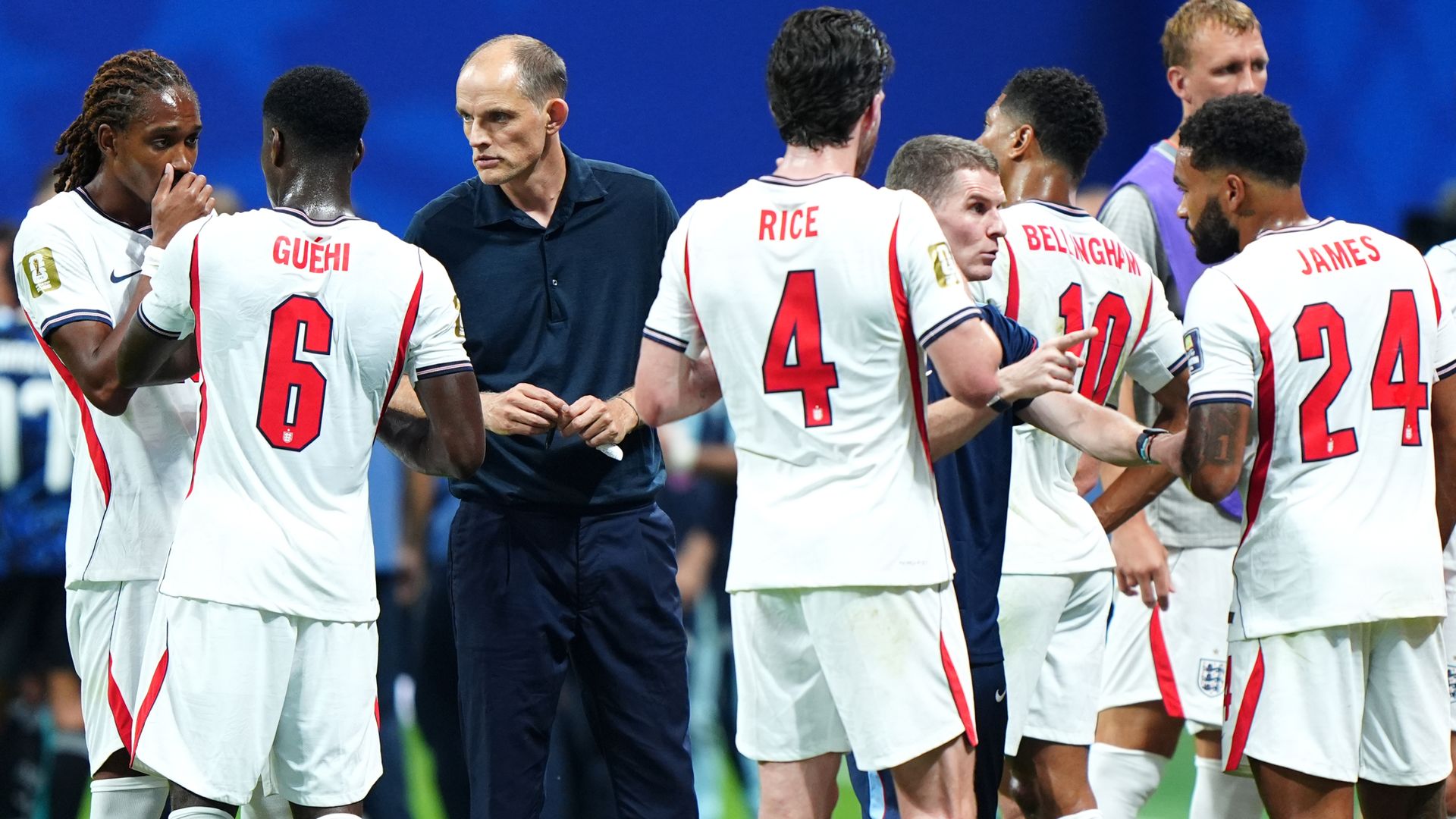
Thomas Tuchel says he is "100 per cent" committed to continuing his role as England boss into the next European Championships in two years, and he has hit back at critics who have questioned his tactics, saying instead it is a problem with English football's "DNA".المصدر: Sky Sports Football | Source: Sky Sports FootballTuchel has been heavily criticised in the aftermath of the semi-final loss in Atlanta, accused of negative tactics which turned the game in Argentina's favour, and turned a 1-0 lead into a 2-1 defeat.
- Neville: I won't lump in on Tuchel - England have had same issues for years
- Thomas Tuchel vows to stay on as criticism of England's tactics mounts
- How Thomas Tuchel's changes spectacularly backfired
- Report | As it happened | Teams | Stats | Knockout bracket
But now, the head coach has chimed back, saying that it wasn't his formation that was wrong in Atlanta; the problem instead is a weakness in the English football "DNA" which means the players struggle to keep possession when under pressure.
"In this moment my feeling was no structure in the world could have helped us," Tuchel said.
"Because actually we were too passive and we were not physical enough, we didn't stop runners arriving in our box and the deliveries were wrong too.
"I haven't seen the data yet, but I think just right after the goal the momentum swings completely and ball possession drops dramatically. We couldn't find any duels anymore; that's why we dropped deeper and deeper. It was never the plan, but it happened.
"(We) couldn't stop the runners from the second line, the midfielders, through our gaps, and the deliveries were on the highest level. You need to get back on the ball; otherwise you cannot break the pressure, and you cannot get the momentum back.
"I think ball possession plays a crucial role; it's maybe not in our DNA like it is in our Spanish DNA or in our Argentinian-Brazilian DNA, to take the ball and control the game with the ball."
One of England's best players in tight spaces is Kobbie Mainoo, who hasn't played a single minute at this tournament. And Tuchel decided to leave arguably England's most technically gifted footballer, Phil Foden, out of his World Cup squad altogether.
Tuchel is adamant that switching to a back five with more than 30 minutes still to play when England were a goal up was not a negative step. Seventeen minutes after Anthony Gordon's goal, he was substituted for Ezri Konsa. Tuchel says that should have helped his players deal with the increased threat he was seeing from Argentina.
"We just get too passive within our structure and try to help. Not to help in a back five, to become more passive, but actually to be more active, to be quicker out to the wingers, to not open up the gaps in between the back four. We encourage everyone to step out and to be more active within the structure, but we just struggle."
England have clocked up more air miles than any other team at the World Cup, covering 14,365 miles in five weeks. Tuchel says that, together with the extreme conditions at the tournament, also took its toll on the players.
"We struggled a bit physically as well, I think, over the whole tournament, playing in the heat, playing at an altitude, playing with a man down and so on. It cost us in the end a lot."
Nevertheless, Tuchel says he has seen enough from the players to believe that they can still win a major tournament whilst he is in charge. He says his appetite for the job has not diminished.
"One hundred per cent, and there's still enough to improve, still enough to improve and I'm more than happy to do that.
"I still think we can impose ourselves more on the ball, I still think we can still show how good football players we are. I think it's still in us because I see it in training in every camp and here also in the World Cup and I still feel there is an extra level that we need to conquer and we need to step up on the next level and then to get the big prize."
Is DNA really the problem?
England's 2014 DNA philosophy set out a blueprint for developing future national teams from youth level upwards. Built around five pillars-identity, playing style, player development, coaching and support-it aimed to create technically gifted, tactically intelligent, physically resilient and psychologically strong players.
The framework promoted possession-based, adaptable football, consistent coaching methods, pride in representing England and multidisciplinary support through sports science, psychology, analysis and nutrition.
Sky Sports News' Rob Dorsett:
"There is a fair comment that England's players, when they are under pressure, don't keep the ball well enough.
"It's ironic that Tuchel has used the phrase 'England's DNA' - It's exactly the phrase that Dan Ashworth, England's Chief Football Officer, used all those years ago.
"If you look at the FA's 'DNA' - a plan that they introduced in 2014 about how England's teams would play from junior football, right through to the senior team - they addressed the England DNA 12 years ago.
"One of two things has happened here. Either the DNA programme has completely failed, I'm not convinced that it has, or Thomas Tuchel is wrong; they can't both be true."
Why wasn't Mainoo picked and do England have a midfield problem?
Analysis from Sky Sports' Peter Smith:
It's a familiar manner of exit for England with a familiar problem at the heart of it: England don't have midfield players who can control a football match.
Or at least, they don't have any Tuchel was willing to select.
What was the point of taking Kobbie Mainoo to this World Cup? He hasn't got on for a single minute.
The 21-year-old - a starter in the Euro 2024 final, don't forget - played a key role in Man Utd's upturn in form in the second half of the Premier League season. Among midfield regulars, only Spain and Man City star Rodri had a better passing accuracy in the opposition half than Mainoo during that period.
How England could have done with some of that composure in the final half an hour against Argentina, when they gave up possession and territory to try to hang on. Against Mexico, even with the caveat of having a man less, and against Norway, England were unable to get on the ball and keep it to ease the pressure on their backline.
Elliot Anderson and Declan Rice were understandably first-choice for this tournament, but Tuchel turned to Reece James, Jordan Henderson, Jude Bellingham, Eberechi Eze and Morgan Rogers when replacements were required in the centre of the pitch ahead of Mainoo.
If Mainoo isn't his man, then that's the coach's call. But unless Tuchel can find a solution in midfield to England's age-old problem, he'll go on getting the same outcomes.
Peter Smith
ملاحظة تحريرية | Editorial Note: نُشر هذا المقال في الأصل بواسطة Sky Sports Football. خبر (Khabr) هي منصة إعلامية أردنية مرخّصة تعمل بالذكاء الاصطناعي. نضيف قيمة تحريرية من خلال: تحليل ذكي للأخبار، ملخصات تلقائية، رواية صوتية بالذكاء الاصطناعي، ترجمة متعددة اللغات، وتدقيق الحقائق. هدفنا جعل الأخبار أكثر وضوحاً وسهولةً للقارئ العربي.
This article was originally published by Sky Sports Football. Khabr is a licensed Jordanian AI-powered news platform (Registration #82086). We add editorial value through: AI-powered news analysis, automated summaries, AI audio narration, multi-language translation (Arabic, English, French, Turkish), and AI fact-checking. Our mission is to make news more accessible and understandable for Arabic-speaking audiences worldwide.