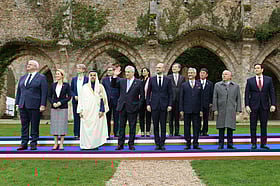
US Secretary of State Marco Rubio faced an uphill task on Friday as he sought to convince sceptical allies of Washington’s strategy on Iran, with deep divisions surfacing at a Group of Seven (G7) meeting in France.
The gathering comes amid the fourth week of the Iran war and growing instability in global energy markets, with the Strait of Hormuz largely disrupted. Rubio’s challenge has been compounded by US President Donald Trump’s sharp criticism of NATO allies, further straining ties just as Washington seeks broader support for its military approach.
Of the G7 nations - besides the US - Britain, Canada, France, Germany and Italy are members of the trans-Atlantic military alliance. Japan is the only one that is not.
Despite US efforts to rally backing, most allies signalled discomfort with the direction of the conflict, instead calling for restraint and a renewed diplomatic push.
France: “The war is not ours”
France, hosting the meeting near Versailles, struck one of the clearest notes of caution.
Defence Minister Catherine Vautrin said the conflict in the Middle East “is not ours,” underlining that France’s position remains strictly defensive.
“The aim is truly this diplomatic approach, which is the only one that can guarantee a return to peace,” she said, reflecting broader European unease over the escalation.
French military officials have also expressed frustration over a lack of coordination, with Chief of Defence Staff Gen. Fabien Mandon criticising Washington for launching operations without informing allies.
“They have just decided to intervene in the Near and Middle East without notifying us,” Mandon said.
UK: Support with limits
Britain signalled a more nuanced position, backing defensive measures while distancing itself from offensive operations.
Foreign Secretary Yvette Cooper said London supported efforts to counter threats but acknowledged differences with Washington’s approach.
“We have taken the approach of supporting defensive action, but also we’ve taken a different approach on the offensive action that has taken place as part of this conflict,” she said.
Germany: Warning against wider instability
Germany emphasised the need to avoid further escalation, linking the Iran war to broader security concerns.
Foreign Minister Johann Wadephul warned that the conflict must not undermine support for Ukraine or destabilise the wider region.
“We must avoid further destabilisation, secure our economic freedom and develop perspectives for an end of and the time after the hostilities,” he said.
US: Pressure for support
Washington, however, has continued to press allies to step up.
Rubio defended the US approach, arguing that countries concerned about global shipping and international law should take a more active role.
Trump has been more blunt, openly criticising NATO for failing to support US efforts in the region.
“We are very disappointed with NATO because NATO has done absolutely nothing,” Trump said.
He also suggested that US actions were effectively a test of allied commitment.
“We’re there to protect NATO, to protect them from Russia. But they’re not there to protect us,” he said.
NATO and broader tensions
The divide over Iran comes on top of existing strains within the transatlantic alliance.
European allies remain uneasy over Trump’s earlier positions on NATO and Ukraine, as well as his broader approach to alliances. The Iran conflict has added a new layer of tension, with disagreements now extending into military strategy and diplomatic priorities.
NATO Secretary-General Mark Rutte sought to underline areas of agreement, reiterating concerns about Iran’s missile and nuclear capabilities while noting that US actions were aimed at degrading those threats.
A fragile diplomatic moment
As the G7 talks continue, the gap between Washington and its allies remains evident.
While the US pushes for stronger action against Iran, European powers are urging de-escalation and diplomacy — leaving Rubio with the difficult task of bridging a widening divide at a critical moment in the conflict.