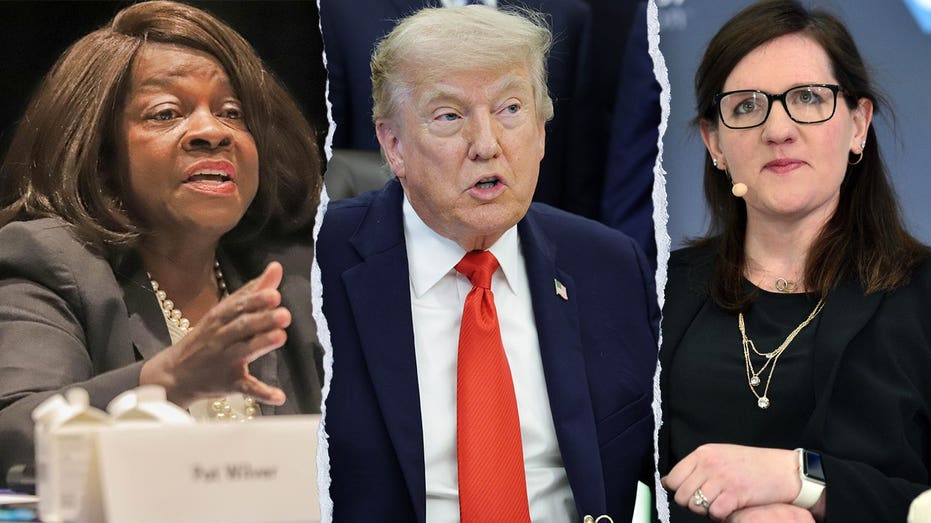
Two high-stakes Supreme Court battles over President Donald Trump's authority to remove federal officials could reshape the balance of power in Washington, but legal experts say the justices may draw a sharp line between the cases.
At the center of the debate are Slaughter v. Trump, involving the firing of Federal Trade Commission Commissioner Rebecca Kelly Slaughter, and Trump v. Cook, involving Federal Reserve Governor Lisa Cook. While both cases touch on presidential removal power, legal scholars say the disputes present fundamentally different legal questions.
In Slaughter, the administration is directly challenging statutory restrictions on the president's ability to remove FTC commissioners, arguing that limits on the president's authority to fire commissioners violate his Article II executive powers. But in Cook, the central question is whether Trump met the Federal Reserve Act's "for cause" removal requirement. Trump has argued that Cook's alleged misconduct involving mortgage disclosure documents justified her removal for cause.
Catholic University of America law professor Joel Alicea said Solicitor General John Sauer's approach during oral arguments in Slaughter differed significantly from his strategy in Cook. The Trump administration argued in Slaughter that the FTC Act's removal limit — which allows the president to fire commissioners only for reasons such as inefficiency, neglect of duty or misconduct — unconstitutionally restricts the president's Article II authority.
"In the Slaughter case, they are making the explicit constitutional argument that it doesn't matter what the statute says, the president gets to fire the FTC commissioners at will," Alicea said.
The administration was far more cautious in Trump v. Cook.
"The president's team chose not to raise the constitutional argument in Cook," Alicea explained, suggesting the Court has already indicated that the Federal Reserve presents a distinct set of constitutional issues rooted in historical precedents involving the nation's early banking system.
In its recent emergency ruling in Trump v. Wilcox, the Supreme Court allowed removals involving NLRB and Merit Systems Protection Board officials to take effect while the litigation continued.
But the Court rejected the argument that its decision would necessarily call into question the Federal Reserve Board's tenure protections, stating, "we disagree," and explaining that the Federal Reserve is a "uniquely structured, quasi-private entity" with a distinct historical tradition dating back to the First and Second Banks of the United States.
Many legal experts, including Erin Hawley, chair of Lex Politica's Supreme Court and Appellate Practice, expect the Court to be more receptive to the administration's argument in Slaughter than in Cook, where the Fed's longstanding independence may weigh heavily.
"The Supreme Court has signaled that it believes the core function of the Fed — setting monetary policy — be unique in that it has a historical analogue in the First Bank," Hawley told Fox News Digital. "Based on history, that core function may well satisfy constitutional separation of powers."
While Hawley noted that the Federal Reserve also engages in rulemaking and other activities that could be characterized as exercises of executive power, the Court is not being asked in Trump v. Cook to decide the broad constitutional validity of the Fed's removal protections in the same way it is being asked to evaluate the FTC's protections in Slaughter.
The Cook dispute has also drawn opposition from a bipartisan group of former Federal Reserve chairs, former Treasury secretaries and economists, who warned that allowing presidents greater control over Federal Reserve governors could undermine central-bank independence and create economic instability.
"There is broad consensus among economists, based on decades of macroeconomic research, that a more independent central bank will lead to lower and more stable inflation without creating higher unemployment," a brief filed by a bipartisan group to the Court stated.
SUPREME COURT SETS DATE TO HEAR FTC SLAUGHTER CASE IN TEST OF TRUMP'S FIRING POWERS
Slaughter v. Trump, meanwhile, has become a major test of the unitary executive theory, the view that Article II gives the president control over officials who exercise executive power. The justices have agreed to consider whether to overrule or narrow the 1935 precedent Humphrey's Executor v. United States, which upheld statutory limits on the president's ability to remove FTC commissioners.
"This isn't about Trump's power so much as it is about the power of the president generally — the same authority over the executive branch in this case is going to apply to the next president as well," said Carrie Severino, president of the Judicial Crisis Network.
"Indeed, President Biden was very aggressive in using the firing power, and maybe if he had a second term, he would have gotten down to firing this level of officers as well," Severino continued.
Another issue emerging from Slaughter concerns the remedies available to courts when an agency head is allegedly removed unlawfully.
"The idea that the federal courts get to order the president to reinstate an executive officer he has fired? That's actually a novel question," Alicea said. "It's not something that has been adjudicated before when you're dealing with an agency head."
The Court could therefore face not only whether Trump had authority to remove officials but also whether judges possess the power to compel their reinstatement.
Critics of expanding presidential removal authority warn that a ruling for Trump in Slaughter could weaken the independence of agencies Congress intentionally insulated from political pressure.
CONGRESS EXPANDED THE EXECUTIVE—ONLY FOR TRUMP TO QUASH MUCH OF THE ADMINISTRATIVE STATE
Constitutional law expert Robert McWhirter argued that supporters of broader presidential power should consider how that authority might be used by future administrations.
"The underlying policy issues to be considered is let's say that you're all pro-Donald Trump and you think he should have that power," McWhirter said. "Well, do you really want to make sure that any president has that power?"
McWhirter also defended independent boards as valuable safeguards that remove certain decisions from day-to-day partisan politics. He argued that many executive powers ultimately derive from congressional delegations, giving Congress significant authority to structure agencies as independent entities.
"So, if you think about anything, Trump's immigration enforcement policies, he only has that power because Congress passed the Immigration Nationality Act," McWhirter said. "He acts under acts of Congress, delegation of power from Congress, and he has a duty to faithfully execute."
Supporters of broader presidential removal power see the issue differently, arguing that the president should have the power to remove heads of independent agencies because they cannot be thrown out by voters in elections.
"A ruling for the president in the Slaughter case would be very significant. It would ensure that the president is able to direct and control independent agencies, even those with multi-member heads," Hawley said. "Were the rule otherwise, that would mean that unelected bureaucrats would be calling the shots."
"Such a result is not only anti-democratic but inconsistent with the Constitution's allocation of power."