The unconstitutionality of abolishing Kashmiri refugee seats
المصدر: Dawn | Source: DawnIn the charged political landscape of Azad Jammu and Kashmir (AJK), the Joint Awami Action Committee (JAAC)’s core demand to abolish the 12 reserved seats for Kashmiri refugees in the legislative assembly strikes at the heart of constitutional governance, historical justice, and the enduring Kashmir cause.
These seats, constitutionally entrenched under Article 22 of the AJK Interim Constitution 1974, are not mere administrative privileges or tools for “electoral engineering,” as JAAC alleges. They represent a solemn recognition of the displaced Kashmiri population’s integral role in the state’s polity. Any attempt to abolish them — whether through executive fiat, street pressure, or even hasty legislative action — stands on shaky constitutional ground and risks violating fundamental rights and principles of state policy as guaranteed by the AJK Constitution.
While the AJK Supreme Court, recognising the situation, issued in haste its 32-page advisory opinion in response to a presidential reference under Article 46-A, it correctly affirmed that these seats enjoy constitutional protection and cannot be altered, abridged or abolished through executive action. However, in an exceptional concession, the Court stated that such abolition is possible through a formal amendment under Article 33. Most humbly, the opinion arguably errs in its framing by implying that this remains a viable path open to the Assembly, for a variety of tangible reasons. To understand the argument, one has to accept that the constitution grants refugees equal status with local Kashmiris, defining both as “state subjects”.
The 12 refugee seats — typically allocated as six for Jammu and six for the Kashmir Valley refugees settled in AJK and Pakistan post-1947 — trace their roots to electoral arrangements dating back to 1960, reinforced in 1964 and 1970, and explicitly incorporated into the 1974 Interim Constitution.
Article 22 delineates the composition of the Assembly, embedding these seats as a structural feature alongside directly elected constituencies. This was no afterthought; it reflects the indivisibility of the Kashmiri nation across the Line of Control. Refugees and their descendants are not outsiders but state subjects who fled persecution and continue to embody the unresolved dispute.
Equality before the law
The Court’s observation that refugees are state subjects is accurate but incomplete. As state subjects under the Constitution, all Kashmiris (refugees or otherwise) enjoy equality before the law and non-discrimination as fundamental rights.
Article 4 of the Constitution further dictates that any law, custom or usage inconsistent with these rights shall be void. Abolishing dedicated representation would disenfranchise a distinct class of citizens on the basis of their migratory history and origin — precisely the kind of differentiation the ocnstitution guards against. Such action would contravene the principles of policy laid down in Article 3 of the constitution, which mandate that the state promote social justice, protect vulnerable groups, and ensure equitable participation by discouraging parochial and similar prejudices.
Refugees, having endured displacement, do not forfeit their political voice; rather, the constitution affirmatively protects it as a fundamental right. Accordingly, any legislative move to abolish the refugee seats, even if procedurally compliant with Article 33, would invite judicial scrutiny under the doctrine of basic structure or implied limitations on the amending power and would be constitutionally void.
Abolishment of these seats would disrupt the delicate balance the AJK constitution strikes between local representation (predominantly 33+ seats from AJK territories) and the broader Kashmiri diaspora’s voice.
The Supreme Court rightly noted the historical lineage, but its opinion could have gone further in underscoring that these seats are not discretionary quotas subject to majoritarian whims.
They form part of the basic structure of representation in a disputed territory whose final status remains pending. The constitution of AJK is distinct in its form: while it exercises territorial jurisdiction over Azad Jammu & Kashmir (pending final solution to the Kashmir issue as per UN dictates), its personal jurisdiction extends over all Kashmiris (as per the 1927 borders of the erstwhile State of Jammu & Kashmir).
Accordingly, treating the refugee seats as mere perks and privileges and abolishing them via amendment ignores the constitutional framework which prioritises the liberation and unity of the entire former State of Jammu and Kashmir. Such an amendment would amount to a constitutional fraud on the foundational compact that AJK embodies as a liberated zone.
Courts worldwide, including in Pakistan’s jurisprudence, have struck down amendments that erode fundamental features like representation, equality before the law and minority protections.
Abolishment would set a dangerous precedent
The AJK Supreme Court’s advisory stance, while providing an immediate solution, underplays this substantive barrier: fundamental rights and policy principles bind the Assembly itself. It cannot, in the name of “local grievances,” marginalise a community integral to the state’s identity. Notwithstanding the moral and political issues involved, such an action borders on unconstitutionality.
While advisory opinions are not binding, they carry their own interpretive legal weight; hence, a review may be in order on the stated grounds.
The JAAC’s portrayal of these seats as mere privileges doled out to Kashmiri refugees outside territorial AJK overlooks constitutional, demographic and historical realities. Refugee voters, though dispersed, maintain legitimate stakes. Their elimination would not enhance democracy but contract it, potentially violating the right to effective political participation by marginalising refugees, who are considered a protected class in international law. Beyond domestic law, the protected status of refugees is firmly anchored in international instruments.
The 1951 Refugee Convention and 1967 Protocol, along with customary international law, prohibit measures that exacerbate vulnerability or deny political and socio-economic rights to displaced persons. Kashmiri refugees specifically embody a collective claim tied to self-determination under UN resolutions on Kashmir. Marginalising their legislative voice through abolition constitutes a form of constructive denial of rights — an offence against international humanitarian norms and Pakistan’s consistent diplomatic stance.
Seen in this light, JAAC’s agitation not only crosses into unconstitutionality when it demands erasure of this protected representation, but also mirrors a rising far-right agitational group bent upon marginalising a protected community.
Beyond the AJK Supreme Court’s opinion, which rightly rejects executive capitulation to protests and agitation, affirming that constitutional amendments are not concessions to be wrested, thus confirming the universal principle of what falls within the ambit of peaceful assembly or not.
Abolishment would set a dangerous precedent: politicising displacement, eroding minority-like protections, and inviting legal challenges while narrowing the Kashmir issue. It would betray the sacrifices of 1947 and undermine AJK’s legitimacy as a beacon for the oppressed Kashmiris across the divide.
Policymakers, jurists, and citizens must reject this demand not as a political concession, but as a matter of constitutional imperative, fundamental rights, and international obligations.
In upholding the refugee seats, the AJK government is reaffirming that Kashmir’s struggle is holistic — one people, one destiny. Deeper introspection of the core demand reveals that it is not about perks and privileges but about fundamental rights and protection thereof.
While one may rewrite parts of the constitution, they cannot erode guaranteed rights. The Assembly, if it ever contemplates change, must do so with utmost caution, lest it commit a constitutional and moral offence against its own displaced brethren as well as the cause.
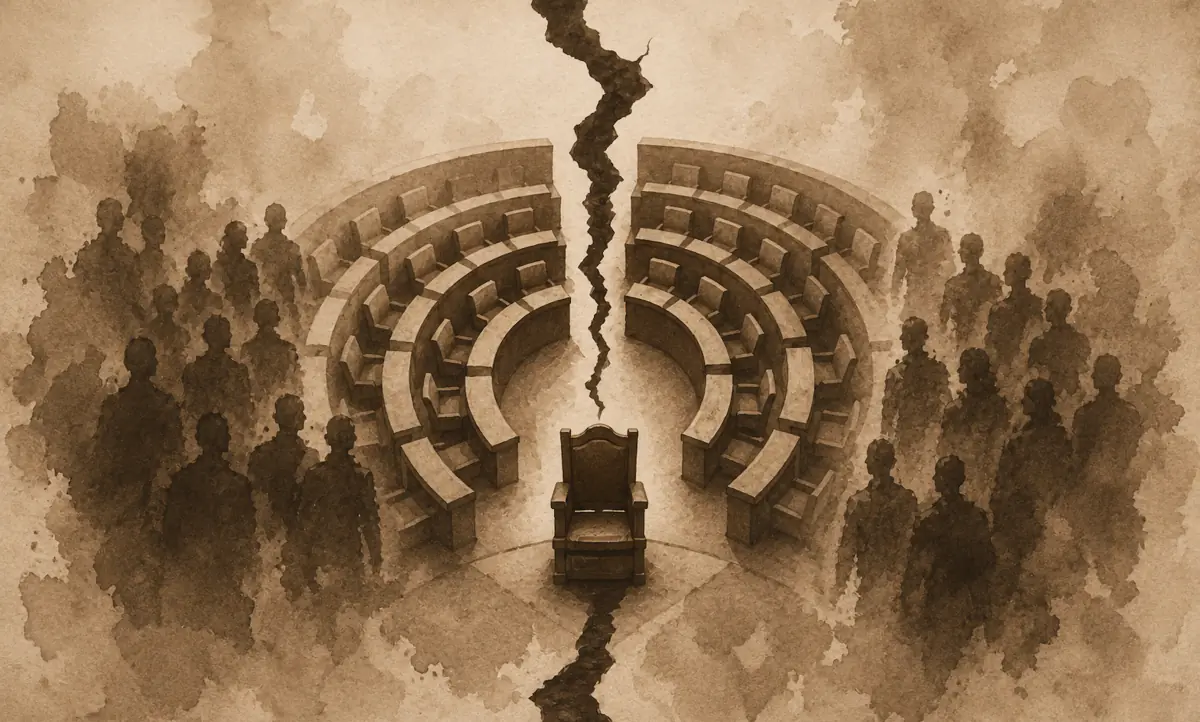
Header image created with Generative AI
ملاحظة تحريرية | Editorial Note: نُشر هذا المقال في الأصل بواسطة Dawn. خبر (Khabr) هي منصة إعلامية أردنية مرخّصة تعمل بالذكاء الاصطناعي. نضيف قيمة تحريرية من خلال: تحليل ذكي للأخبار، ملخصات تلقائية، رواية صوتية بالذكاء الاصطناعي، ترجمة متعددة اللغات، وتدقيق الحقائق. هدفنا جعل الأخبار أكثر وضوحاً وسهولةً للقارئ العربي.
This article was originally published by Dawn. Khabr is a licensed Jordanian AI-powered news platform (Registration #82086). We add editorial value through: AI-powered news analysis, automated summaries, AI audio narration, multi-language translation (Arabic, English, French, Turkish), and AI fact-checking. Our mission is to make news more accessible and understandable for Arabic-speaking audiences worldwide.