With the cover blown on the Epstein files, a large part of the goings on across the world have been proven to be an illusion. The emails recovered from the Epstein estate have cast a shadow on the integrity of some of the world’s movers and shakers. From the greatest minds of our time to political lynchpins and business moguls, anyone who has brushed past Epstein and his accomplice Ghislaine Maxwell carries the mark of the devil and nothing less.
After the initial shock of this unmasking of names like Bill Gates and Noam Chomsky (men who enjoyed great influence in the contemporary world for most of their lives) we have raised suspicions about anyone who has even a bit of fame. The critical, logical thinkers among us are suddenly more open to what was previously called conspiracy theories. We are less trustful of the power game played behind the scenes in international politics seeing how many world leaders are pedophiles and sex criminals.
But most of all, we have also become gaslighters for averting our attention from those who were sacrificed for the pedophiles' limitless carnal evil. The victims of Epstein and Maxwell's sex trafficking ring, which was spread across half the continents, are not foremost in our thoughts when the salacious details of the crimes are discussed in sensational headlines. If we divide the world of morals before and after the files, then that is the only constant. We didn't care, we didn't know and we didn't help the girls who were abused before and we extend the same indifference and ignorance towards their plight now.
Yet still, some of us are more self righteous. Many Pakistani Muslims displayed spiritual wisdom and took this opportunity to disregard any surprise at the uncovering of this heinous case. This case was thrown up as a distraction, they warned us, and this is not anything new. Distraction from what, they didn't share. From unwavering trust in God or Trump's next move (to make war on Iran), the explanation was a cliffhanger and a broad brushstroke in the dark. Yet they too failed to keep the innocent girls in their prayers, as sanctimonious as they are.
The way the US Department of Justice released the three million page document did ensure that we were distracted, no matter how we looked at the overwhelming expose.
What has followed the release of the files is not the examination of a crime and a cause to seek justice for the victims. Instead, we got busy in a kind of restless digging that feels important without actually being so. Three million pages later, everyone is suddenly an investigator, typing in names, pulling out fragments, building their own versions of the truth. It creates the illusion of participation, of being closer to something real, when in fact it does the opposite. The scale of it all is paralysing. There is too much to read, too much to verify, and so most of it slips through. The story has become about the files themselves instead of what was actually done, and to whom.
The girls are still silent, invisible. Not entirely, but enough for it to matter. They become background to the spectacle, reduced to a necessary detail in a story that is now driven by powerful men and their proximity to a convicted trafficker. We move quickly from what happened to them to who else might be implicated, as if the greater scandal lies in reputations being tainted rather than lives being destroyed. It is easier to follow the trail of power than to sit with the reality of abuse. So, even now, with everything laid out in front of us, we repeat the same failure — we look everywhere except where it actually hurts.
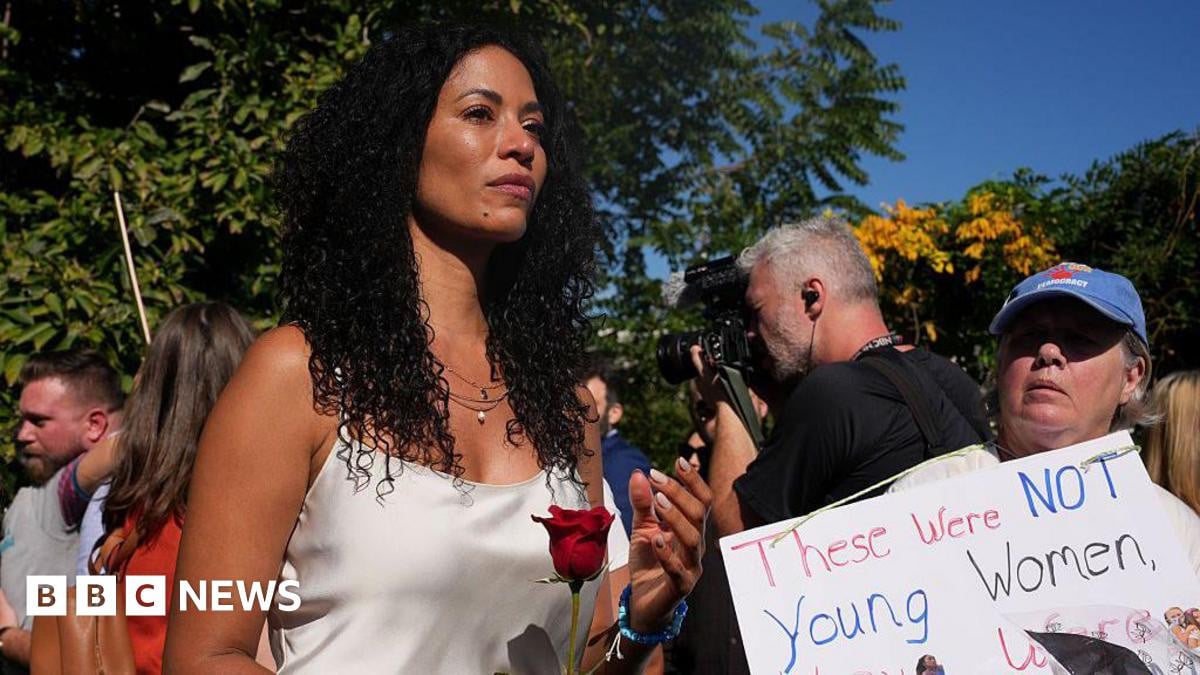
The alarm bells had rung nearly two decades ago. Victims’ rights lawyer Brad Edwards had said in court in 2008 that Epstein might be the most dangerous sexual predator in US history. Edwards has represented 200 of Epstein's survivors. When Epstein was finally arrested in 2019, after fighting many, many civil suits, some of the survivors came forward to tell their stories again. Virgina Giuffre, Jennifer Araoz, Courtney Wild. Late last year, more survivors gathered publicly in Washington DC calling for the the release of the files so that the names of all those who abused and raped them could be known. The girls who spoke up were now women. Annie Farmer, Marina Lacerda, Jess Michaels, Harvey Robson. They warned that Epstein was protected but they knew who their abusers were and would make their own list of names to expose them. A few months later, when the DOJ made the three million pages of the files public, including emails exchanges with his accomplices, the power balance did not really shift in favour of the victims. The shocking names were once again what we were fascinated by. Our imagination stops at how many girls each man must have violated and how frequently, how young and vulnerable they were being abused by men enjoying world wealth and fame. In a way, we the public wield the power to sway the balance and revisit the stories of the victims’ abuse. Yet we continue to treat them like a blur in the background of a photograph.
Minimising or trivialising someone's legitimate feelings or concerns is one of the techniques of gaslighting. The term gaslighting ironically became popular on social media in the mid 2000s and was so widely used that it became a cultural phenomenon, leading it to be recorded in the dictionary as a new word. The widespread use of this term helps people recognise and validate their own experiences with manipulation, providing a shared language for something that was previously difficult to articulate. To be gaslit is not only to be told that something did not happen, but to have the weight of what happened constantly displaced. These women have already fought to have their abuse recognised in a world that protected their abusers, now even in exposure, they are made peripheral to their own story. What we the public are handing out to them by doomscrolling and armchair expertise is a subtle cruelty. In our curiosity and outrage we are gaslighting them enough to briefly acknowledge them as an abstract entity subject to something sinful and criminal but not the centre of our focus or concern in making sense of our world.
What has been striking in the aftermath is not just who has been named, but how quickly the tremors travel when power recognises itself at risk. Careers wobble and associations are clarified with the urgency of damage control. Figures like Peter Mandelson, whose proximity to Jeffrey Epstein has long been scrutinised, become part of a wider spectacle of accountability — or at least the appearance of it. The political order, so often insulated, briefly looked porous. There is a sense that something might finally give and that reputations built over decades could be undone by a few lines in a document. It is this possibility that grips public attention: the idea that power might, even momentarily, be forced to answer for itself.
And yet, even as that order appears to totter, the scale of what enabled it does not command the same gravity. The abuse itself — systematic, prolonged, spanning continents — struggles to hold the centre for more than a passing moment. It is acknowledged, but not dwelt upon with the same intensity as the fallout among the powerful. The imbalance is difficult to ignore. A resignation or a carefully worded denial can dominate the cycle for days, while the lives that were altered irreversibly remain backgrounded. There is something revealing in this hierarchy of attention. It suggests that what unsettles us most is not the existence of cruelty, but the instability it introduces into structures we recognise and, in some ways, rely on.
This is where the moral failure sharpens. Because it is not enough to say that powerful men should be held accountable — that is the baseline. The more uncomfortable truth is that we are far more responsive to the threat of reputational collapse than to the reality of sustained harm inflicted on those without power. We track the movements of elites with forensic detail, but we do not extend the same sustained attention to the slow, uneven pursuit of justice by the victims. Their testimonies do not circulate with the same urgency. Their names do not trend in the same way. Their fight is ongoing, but it does not produce the kind of spectacle that holds us.
There is also a certain convenience in this. To focus on the instability of the political and social order allows us to engage with the story at a remove. It keeps the conversation within the realm of systems, influence and consequence, rather than forcing a confrontation with the intimacy of what was done. It is easier to discuss networks than it is to sit with individual suffering. Easier to analyse fallout than to reckon with the fact that, for years, this abuse was facilitated, ignored, or quietly accommodated by environments that many of these same figures moved through. The files may have exposed connections, but they have not, in themselves, guaranteed a shift in what we choose to centre.
The uneven weight we assign to different kinds of moral crises should give us pause. When power is threatened, we watch closely. When the powerless seek justice, we rarely acknowledge it with the same sustained focus. It is a distortion that does not require conspiracy or intent to persist. It operates through habit, through what we are drawn to. In that sense, the release of the files has done more than unsettle reputations. It has exposed the limits of our own moral attention — how quickly it gravitates upward, and how readily it drifts away from those who needed it most.
المصدر: Express Tribune
| Source: Express Tribune