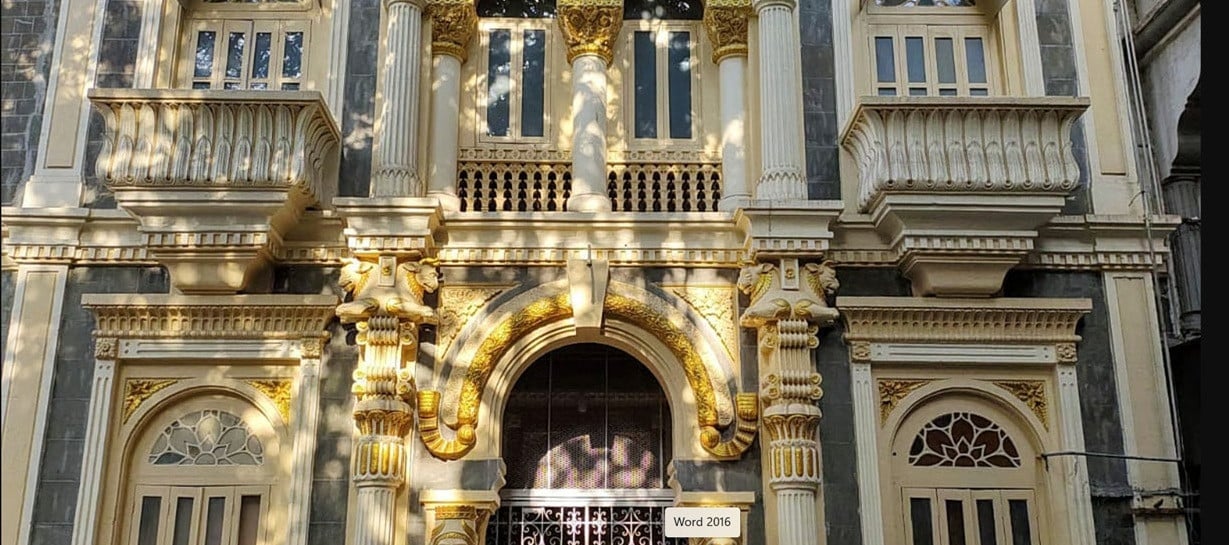
One of the smallest religious communities in Pakistan, the Zoroastrians, are more commonly known by their South Asian name, Parsis. By the most recent estimates from community leaders, there are perhaps 900 of them left in Karachi, with a few dozen more scattered across Lahore, Quetta, and Islamabad. They built much of the physical and civic fabric of modern Karachi, schools, hospitals, the city's first elected mayor and their name is more likely to summon associations with hotel chains or old colonial era mansions.
But at the centre of their religious life sits something few people, Parsi or otherwise, have properly reckoned with: a music tradition older than Sanskrit devotional music. Transmitted not on paper but in the memory of priests, it is now closer to disappearing in Pakistan than it was ever before in its recorded history.
This is not, in the end, a story about religion. It is a story about what happens to a hymn that was never composed to be beautiful, when the last people who can produce it correctly are old, few, and without successors.
The word "Parsi" means Persian, but the community's more accurate origin story runs through Gujarat, not Iran. After the fall of the Sasanian Empire to Arab conquest in the seventh century, Zoroastrian refugees left Persia in waves. The community's own foundational narrative, the Qissa-i-Sanjan, a Persian poem composed in 1599 by the priest Bahman Kaikobad, describes a group of refugees who sailed from Hormuz to the Gujarati coast and were granted asylum by a local Hindu ruler, Jadi Rana, on the condition that they adopt local dress, language, and customs while retaining their faith. Historians place the actual landing anywhere between the eighth and tenth centuries; the exact date matters less than what it set in motion, eight hundred years of quiet, largely agrarian settlement in coastal Gujarat, long before the community's fortunes changed with the rise of Bombay.
Pakistan's Parsis are, culturally and genealogically, an extension of that Gujarati story, not a separate migration from Iran. Their visual and linguistic inheritance, the way older Parsi women still wear the gara sari, the Gujarati inflected Hindustani many speak at home, traces back to Sanjan and Navsari, not to Yazd or Shiraz. A Parsi presence in the territory that is now Pakistan is a comparatively recent, colonial era development; the first Parsi home in Karachi was built in 1844, a year after the British conquest of Sindh, and the city's first fire temple followed in 1849. Interestingly, archaeologists have found Sasanian era silver coins at Banbhore, near modern Karachi, evidence of Zoroastrian trade contact with Sindh many centuries earlier but that is a different, disconnected thread from the community that exists today, which is Gujarati Parsi, not ancient Persian, in ancestry.
What followed was disproportionate to the community's size. Parsis built the Mama Parsi and BVS schools, funded hospitals, and gave Karachi its first elected mayor, Jamshed Nusserwanjee Mehta, remembered to this day as "Baba-e-Karachi." But the population curve has moved in only one direction since Partition, from just over five thousand in the 1951 census to roughly 2,800 by the mid-1990s, to under 1,500 by 2015, to the low hundreds today.
The reasons are structural rather than dramatic, emigration of the young, low birth rates, and strict endogamy (Zoroastrianism does not, in the mainstream Parsi interpretation, admit converts or the children of interfaith marriages into the priesthood or, in many cases, the fire temple itself). It is a community that is not being pushed out so much as quietly running out of arithmetic.
Zoroastrian worship centres on the recitation of the Avesta, the religion's scripture, composed in an ancient Iranian language that ceased to be anyone's spoken tongue well over a thousand years ago. The oldest layer, the Gathas, are 17 hymns attributed to the prophet Zarathustra himself– verses scholars date to somewhere between 1500 and 1000 BCE, making them among the oldest continuously recited religious texts in human use.
These, along with later liturgical material, form the Yasna, the central act of Zoroastrian worship, a 72 chapter recitation performed by an ordained priest, built around the ritual preparation of a sacred offering, and, critically, recited entirely from memory.
It is the whole architecture of the tradition. Zoroastrian priests do not read the Yasna from a text while performing it. They are trained from childhood to be, in the words of scholars who study the tradition's orality, "word-perfect" because the belief system holds that a manthra, a sacred utterance, only carries its spiritual force if every syllable is reproduced exactly as transmitted. Get the sound wrong, and you have not performed a slightly imperfect version of the ritual; in the tradition's own logic, you have failed to perform it at all. This is why the Avesta survived over a thousand years as pure oral transmission before anyone wrote it down, and why, to this day, the test of a priest's competence is not interpretation or eloquence but exactness.
Here is where the question of music enters, and where it gets genuinely interesting for anyone who studies music. Is this chanting "music"? The honest scholarly answer is, not by design, and not in the sense that a qawwal or a classical vocalist would use the word. There is no melodic composition to speak of, no notation, no aesthetic brief. The one serious ethnomusicological study of this recitation, a 2004 doctoral thesis by Raiomond Mirza at London's SOAS, built on more than an hour of field recordings of priests across Iran and India, found something that should unsettle any tidy division between "music" and "not music."
Priests, Mirza discovered, reproduce identifiable musical structures, recurring melodic movement, a specific interval he documented as a tri-semitone shift, patterns of ornamentation, without being taught any of it, and largely without being aware they are doing it. Priestly training focuses entirely on memorisation and correct pronunciation of the Avestan text. Nobody sits a young priest down and teaches him a "melody." Generation after generation, priests who have never heard of each other's recordings produce a structurally similar sound. The musicality is not composed. It is inherited, the way a regional accent is inherited, absorbed by ear from the priest who trained you, who absorbed it from the priest who trained him, in a chain that likely runs back centuries.
This is, in effect, music as an accidental art form. Something whose formal qualities are real and analysable, but whose entire justification lies elsewhere, in ritual precision rather than beauty. A nineteenth century American scholar visiting a Yazd fire temple described the presiding priest's voice as "high, nasal and resonant," his pace "so rapid that he had to pause at times to catch his breath", a description that could apply, with minor variation, to recitation recorded in Karachi or Mumbai a century later. The consistency itself is the argument, whatever this is, it has held its shape with a fidelity that almost no deliberately composed musical tradition manages to sustain.
For readers unfamiliar with the layers of Zoroastrian worship, it helps to know that not all Avestan recitation is equal in weight or occasion. The Khordeh Avesta, the "little Avesta," contains everyday prayers any Zoroastrian, lay or ordained, may recite, the five daily Gah prayers tied to divisions of the day, brief invocations before eating or on waking. These require no special ordination and can happen anywhere, at home or at a fire temple.
The Yasna sits a tier above this, a full liturgical service, performed only by an ordained priest, inside consecrated ritual space, incorporating the Gathas along with later Avestan material and involving the preparation of a sacred offering before the fire. Above that again are the extended "inner" liturgies, the Visperad and, longest of all, the Vendidad, a ceremony that traditionally begins at midnight and runs for roughly nine hours, reserved for the highest grade of consecrated fire.
Fires themselves are graded by the intensity of their consecration. An Atash Behram, the highest grade, requires fire gathered and purified from sixteen different sources in an elaborate months-long process; an Atash Adaran is a step below; an Atash Dadgah is the most modest, and the type most commonly found in smaller communities. Pakistan, befitting the size of its Zoroastrian population, has no Atash Behram at all, that highest grade of fire, and the extended liturgies that go with it, exist only in India and Iran.
Karachi's two functioning fire temples, the Behrana Dar-e-Meher in Saddar (consecrated in 1849) and the Wadia Dar-e-Meher (1869), are both Adaran grade. Lahore and Quetta maintain smaller Dadgah temples. What this means, practically, is that the full liturgical range of Zoroastrian recitation, the longest, most demanding, most musically elaborate forms, is simply not performed in Pakistan any longer, not because the community has chosen to abandon it, but because it never had the infrastructure to sustain the highest tier in the first place, and now lacks the ordained personnel to attempt even what it once could.
This is where the story turns from historical description to something closer to an emergency, quietly unfolding without much public attention. Karachi's Zoroastrian community sustains its two fire temples, and priests continue to perform recitation for daily prayers, funerary rites, and the navjote initiation ceremony that formally inducts young Zoroastrians into the faith.
Journalistic accounts over the past decade describe a temple staffed by as few as three priests, two of them well past eighty. A National Geographic feature in 2024 documented an active Karachi priest performing a home blessing, proof that the practice continues but the same reporting, alongside interviews with community leaders, consistently returns to the same structural fact, Pakistan has no functioning seminary to train new priests.
Ordination into the Zoroastrian priesthood, the Navar and Martab ceremonies currently require travel to Mumbai's Dadar Athornan Institute, one of only two remaining Parsi priestly seminaries in the world, and by recent counts a shrinking one, with just over a dozen students enrolled. Traditional practice holds that the priesthood passes through priestly families, sons trained by their fathers from a young age. A community of roughly nine hundred people, already leaking its young to emigration, is not a population base that reliably produces priestly sons willing to undertake years of specialised training in another country for a vocation with no clear economic future at home. The chain does not need doctrinal upheaval to break. It only needs one generation in which nobody makes the trip to Mumbai and returns ordained.
What is being lost, if this chain breaks, is not simply "religious practice" in the abstract. It is a specific, embodied vocal technique, the tri-semitone shifts, the breath patterns, the ornamentation Mirza documented that has never been written down as music, was never intended to be studied as music, and exists nowhere except in the trained voices of a shrinking number of old men.
There is no score to consult. There is no institution in Pakistan actively recording it. The tradition that survived the collapse of the Sasanian Empire, a sea crossing to Gujarat, eight centuries of minority life under changing rulers, the upheaval of Partition, and the steady emigration of the twentieth century, may turn out to be more vulnerable to a seminary shortage than it ever was to conquest.
India has moved on this, the UNESCO-backed Parzor Foundation has spent two decades recording Zoroastrian oral tradition, prayer, and priestly knowledge specifically because scholars recognised that this knowledge dies with individual priests and cannot be reconstructed afterward. SOAS's Multimedia Yasna project went further, filming and annotating a complete Yasna performance in Mumbai in 2017, creating what is now the most rigorous audiovisual record of this liturgy that exists anywhere. Nothing comparable has happened in Karachi. The scholarship on Parsi liturgical sound is, without exception, Indo-Iranian in its fieldwork. Pakistan's version of this tradition, shaped by its own history of migration within migration, its own aging clergy, its own particular temples has never been the subject of a single dedicated ethnomusicological recording project. At least not that I know of.
The Parsi case is simply the starkest version of the problem, because the population math is so unambiguous and the timeline so short. It offers, in that sense, a genuinely useful diagnostic question for anyone thinking about cultural preservation in this country, not "is this tradition sacred or important," which nearly everyone will answer in the affirmative and then do nothing about, but "if the last person who can perform this correctly dies next year, does a recording of them exist?" For Zoroastrian priests, as of this writing, the answer is, let’s see, I am sure some one will do it.
The writer is a music enthusiast and cultural critic. He writes about the intersection of music, society, and the human condition. He can be reached at brian.bassanio@gmail.com
All facts and info are the sole responsibility of the writer
المصدر: Express Tribune
| Source: Express Tribune