What is the driving force behind the decision to do an Executive MBA? For some people it is rapid career progression. Others aim for a significant uplift in their salary. For successful entrepreneur Ashley Lawrence it was the potential on offer – the opportunity to build, scale and internationalise his existing multi-brand staffing group business.
When Ashley started his Executive MBA in 2016 at Bayes Business School (then known as Cass Business School), he had already founded two successful recruitment brands, one focused on technology, the other on regulatory recruitment. The business employed 40 people across London and Dublin. Ashley explains:
“Going into the MBA, I had achieved commercial success, had a good career trajectory, and understood the staffing landscape, but I was excited by the potential for immersive learning through the cohort. I wanted to gain exposure to a much broader spectrum of opinions and perspectives from a diverse array of sectors.”
Another factor was perception. “I was already a capable entrepreneur pre-MBA, but people place weight on someone with an Executive MBA. It gives others confidence in you as a leader and entrepreneur, and that factored into my thinking too.”
Flexible study formats
The Bayes Executive MBA is offered in two part-time formats and is designed to fit around busy careers and personal lives. Executives choose between the twice-weekly evening or the monthly long-weekend format, allowing them to study flexibly whilst working.
As the only business school located in London’s finance and tech hub, “the Square Mile”, Bayes’ location offers direct access to global firms, venture capital and top industry leaders. It was another factor in Ashley’s decision-making process:
I could leave my office in the City, get to the business school 15 minutes later, and spend three hours there two evenings a week. The structure worked for me – I could build it into my routine without creating a major opportunity cost.
Understanding the bigger picture
The Executive MBA curriculum combines key areas of finance, leadership, strategy, operations, marketing and innovation. It equips executives with the knowledge, skills and perspective to navigate complex business challenges and deliver immediate impact.
“I definitely gained confidence in areas like finance and accounting, but what I became really obsessed with was organisational behaviour,” says Ashley. “That module completely changed my thinking around people, culture, and engagement. Staffing is an asset-light service industry, so your people are your assets. Understanding how to drive engagement, shape behaviours and values, and execute against a vision became incredibly important to me.”
After completing his MBA, Ashley says his business saw a “hockey-stick curve in growth,” expanding into multiple international markets, and rapidly increasing the number of employees. Today, Ashley is the CEO and founder of Trinnovo Group, a multi-brand staffing business. It focuses on technology, artificial intelligence, and regulatory staffing across the UK, Ireland, the DACH region, and North America.
We have just under 100 full-time employees across brands and locations. We have also expanded from staffing into advisory, consulting, and embedded hiring.
My MBA played a huge role in scaling the business. I graduated in 2018, then went through a private equity transaction and continued scaling aggressively afterward. My preparation, planning, and ability to communicate strategy all improved significantly because of the MBA.
Sponsoring an employee generates its ROI
Matthew Goddard is Trinnovo Group’s Head of Legal and Compliance. A conversation with Ashley about his professional development led Matthew to undertake his own Executive MBA at Bayes, sponsored by Trinnovo.
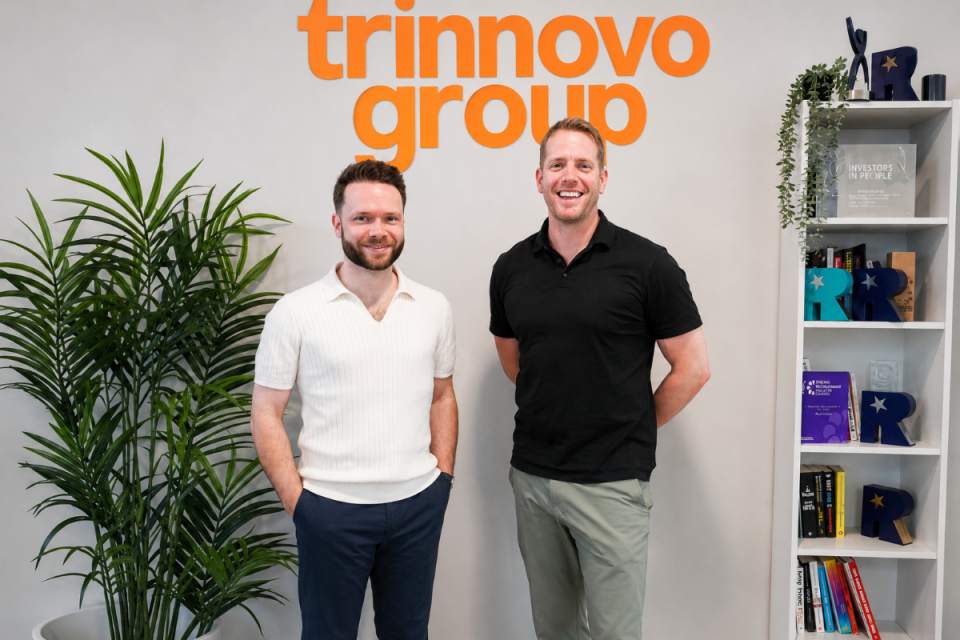
Ashley explains:
I knew what the MBA process involved and that it would benefit him and Trinnovo. Matthew was already ambitious and willing to learn. What’s changed is that he now brings new ideas forward more confidently and contributes more meaningfully to discussions about the future of the business. I believe the MBA will give him the confidence and capability to launch a new business line for us.
With a young family and busy career to juggle, Matthew is following the monthly modular format. He says: “Without the flexibility offered by Bayes, I would not have been able to pursue an MBA. The experience has given me the academic theories, frameworks, and industry insight across all functional and operational areas, and I can apply the learning directly to my role. Ashley’s commitment to and investment in my personal development has given me the confidence to take on challenges I would not have even considered before.”
What advice would Ashley give someone considering an MBA at Bayes?
“You need to think beyond the money and time commitment and ask what role the MBA plays in your long-term journey. Completing an MBA shouldn’t be the objective in itself — it should be an accelerator toward larger goals.”
Asked to reflect on the highlight of his time at Bayes, Ashley responds: “It’s the people. Everyone at the business school shares a willingness to support each other. It felt more like a community than a transactional educational experience.”
The environment is driven by good people who genuinely want to help others grow. Without those people, it would have been a very different experience.
Considering an Executive MBA? Take Bayes Business School’s 4-minute MBA quiz to discover which format best fits your ambitions.