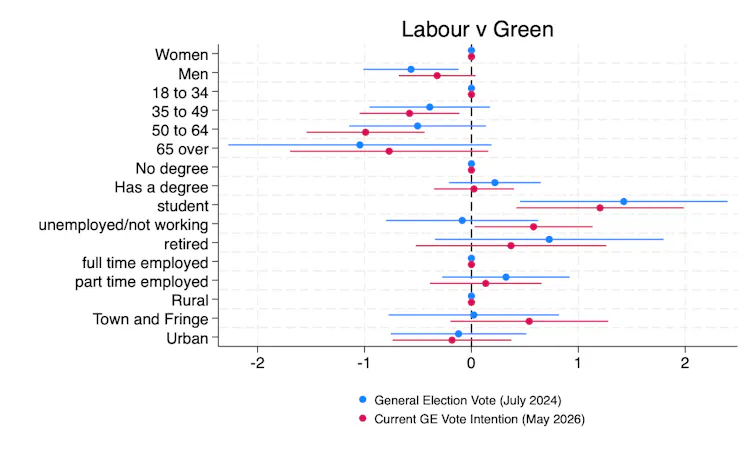
Voters in England are increasingly turning away from the two main parties, as elections in 2024 and 2026 showed. Much discussion has focused on the rise of Reform UK, particularly among younger men. But what’s happening among women – and how is it affecting voting behaviour on the left?
Women, especially younger women, have been more likely than men to support parties on the left since at least 2017. Gender divides in support for the Greens and Reform UK (or UKIP/Brexit party) drove much of this split at the 2019 European Parliament elections and the 2024 general election.
As Green support rises, we asked who is now turning to the party and what issues matter most to these voters. As part of our ongoing research, we surveyed around 2,000 people in the UK with YouGov in early May (just before the local elections). We have now done some analysis of these results.
Overall, we found that the demographic profile of those who said they would vote for a leftwing rather than a rightwing party has changed little since the general election in 2024. Younger voters remain less likely to vote for rightwing parties, while those with a university degree or who live in an urban area are more likely to vote on the left.
But what about party support within this group of potential leftwing voters? Compared to Labour supporters, those saying they voted Green in 2024 or would vote Green in 2026 are notably younger and more likely to be students. We didn’t find differences by their level of education or whether they live in a city.
And, although at the 2024 general election, other research uncovered a gender gap whereby women were more likely than men to vote Green, in our data we found only a small gender difference.
Voting patterns: Labour v Green

The next general election
This absence of a significant gender gap doesn’t necessarily imply that men and women are equally likely to support the Greens at the next general election. It may partially be due to the data we used. At the time of the 2026 local elections, 14% of women said they didn’t know how they would vote in a general election compared to just 7% of men.
There was also a higher number of women reporting that they would not vote at all – 13% compared to 8% for men. But it would be unusual to have a turnout gap at a general election, and these figures probably reflect the timing, with women perhaps making their mind up later. This has been suggested as one reason for a late swing to the Green party at the Gorton and Denton byelection.
Read more: Late deciders, higher turnout: what the Gorton and Denton byelection taught us about voters
Previous research also tells us that gender gaps in Green support across Europe are particularly likely in younger age groups and among the highly educated. We investigated whether a similar pattern was present in the UK by examining the predicted probability of voting Green versus voting for any other party among men and women from different age groups and degree status.
We found this was true in England – Green voters were particularly likely to be women aged 18 to 34, and also to be women with a degree. The scale of shift is notable – more than 40% of women in the youngest age group said they would vote Green, compared to 25% who reported having voted Green in 2024.
The gender gap among young Green voters narrowed a little between 2024 and 2026 in our data, although this comes with the same caveats – more women than men currently say they don’t know how they would vote.

So, what issues are important to these voters? We asked voters to identify in their own words the most important political issue to them. We then compared their responses by current voting intention.
In some ways, supporters of leftwing parties were very similar, especially when compared to Reform or Conservative supporters. They were relatively unconcerned about immigration, but likely to be worried about the cost of living, which is the top area of concern for both Labour and Green voters.
However, there was some nuance here. Despite the Green party diversifying their issue platform in recent years, their supporters are still the most likely of all groups to say the environment is the most important issue to them.
The split on the left in the English electorate is primarily driven by younger, university-educated women who have migrated towards the Greens from Labour. And Green voters are not primarily motivated by environmental concerns – cost of living is their top issue.
Where Green and Labour voters differ more sharply is on cultural questions: 74% of Green supporters sympathise with Palestine over Israel, compared to 44% of Labour supporters. And 44% believe equal opportunities for transgender people have not gone nearly far enough, against 15% of Labour supporters. So it may be the case that leftwing voters are broadly united by economic anxiety, but divided in cultural attitudes.
The implications for Labour are serious. Its recent focus on the cost of living may yet win back Green switchers, but the data suggests it is losing far more votes to the left than to Reform. The Greens are not the only threat – the Liberal Democrats, SNP and Plaid Cymru are all competing for a similar pool of the electorate. Our results so far suggest Labour should be wary of chasing those Reform voters who are primarily concerned with immigration. This could come at the expense of losing those who were core to their success in 2024.

The survey data for this article was provided to the authors, including Ceri Fowler, as part of the EPOP/YouGov Survey award.
The survey data for this article was provided to the authors as part of the EPOP/YouGov Survey award.