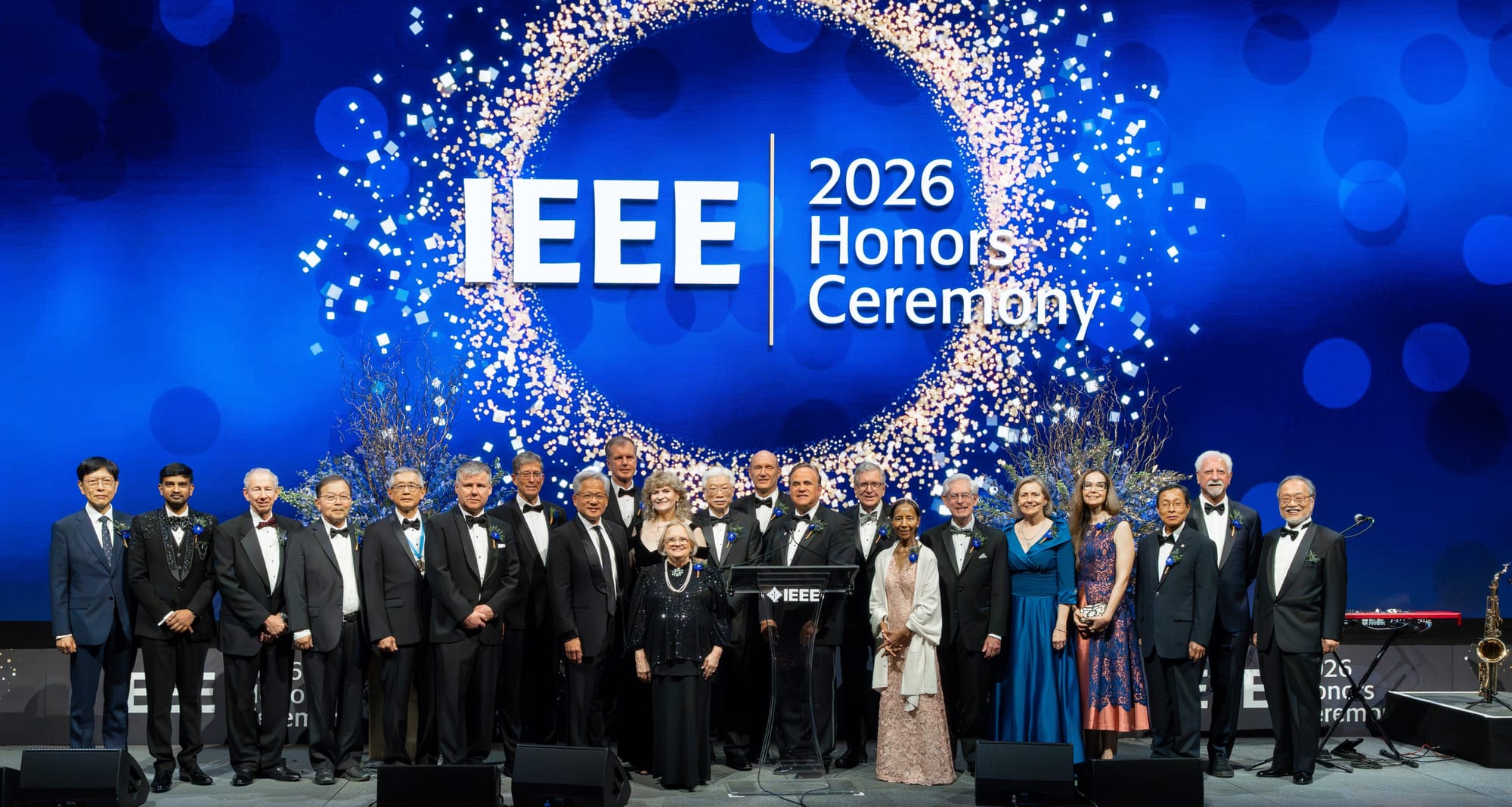
When IEEE, the world's largest technical professional organisation, gathers its most honoured engineers and scientists each year, the ceremony tends to reflect decades of quiet, incremental work that most people never see but almost everyone depends on. This year, three engineers from Ericsson's Stockholm research team, Erik Dahlman, Stefan Parkvall and Johan Sköld, have been jointly awarded the IEEE Jagadish Chandra Bose Medal in Wireless Communications for their contributions to developing and standardising the cellular technologies that now define modern life.
With more than 500,000 members across 190 countries, IEEE is the professional home of much of the world's engineering community. Recognition from the organisation carries particular weight because it comes from peers rather than industry bodies or governments.
For Parkvall, the award prompted a moment of reflection he does not often allow himself. “Normally, one just works on without really stopping and considering the impact your work really has,” he says. “When you receive this kind of award, you realise that what you have done has really had an impact on the world.”
The trio's work covers every upgrade cycle the mobile industry has gone through since the 1990s. Where earlier engineers built networks for voice calls and basic messaging, Dahlman, Parkvall and Sköld helped design the systems that let a phone anywhere in the world stream video, move money or book a flight. Dahlman is clear about what drove it. “As researchers, we have primarily been driven by the technical challenges and by solving interesting problems,” he says. Timing, he adds, was as important as the technology itself. Mobile broadband arrived in the mid-2000s just as the first smartphones appeared that could use it, triggering an expansion in data consumption and new applications that nobody had fully anticipated.
The economic consequences are measurable. According to GSMA figures, mobile technologies generated 5.4 per cent of global GDP in 2023, contributing around $5.7 trillion in economic value and supporting 35 million jobs worldwide. Sköld points to what that means in practice. “4G enabled all the things we today take for granted, booking tickets, ordering goods, searching for information,” he says. Countries that have moved quickly on 5G are better placed still. “Countries like UAE and Saudi Arabia that have been quick in adopting high-performing networks are in general in a good position to capture benefit from this innovation platform,” Dahlman says.
5G has moved well beyond the handset, connecting robots, machines and remote-controlled vehicles in ways 4G was never designed to handle. 6G will go further still, and its relationship with AI is central to that vision. “The future is unknown and changes happen at an increasing pace, but yet we need to design 6G to handle these future applications,” Sköld says. “The AI and 6G connectivity form a symbiosis where one cannot thrive without the other,” adds Parkvall.
IEEE's role extends well beyond handing out awards. Its conferences and publications connect researchers across borders, and its standardization work is what makes global connectivity possible in the first place. Different companies arrive at bodies like 3GPP and IEEE with competing proposals, and what emerges is typically better than any single input. “The resulting solution, after the standardization process has run its course, is almost always significantly improved compared to the different original input proposals,” Dahlman says. “Standardisation is thus more than just agreeing on a single solution, it is also a refinement process.”
For young engineers in the region, Parkvall has one piece of advice that cuts against the caution that often surrounds large, complex fields: “Always be prepared to challenge what is stated to be truths, especially statements like 'It cannot be done.'”
The IEEE Honors Ceremony took place in New York on 24 April.