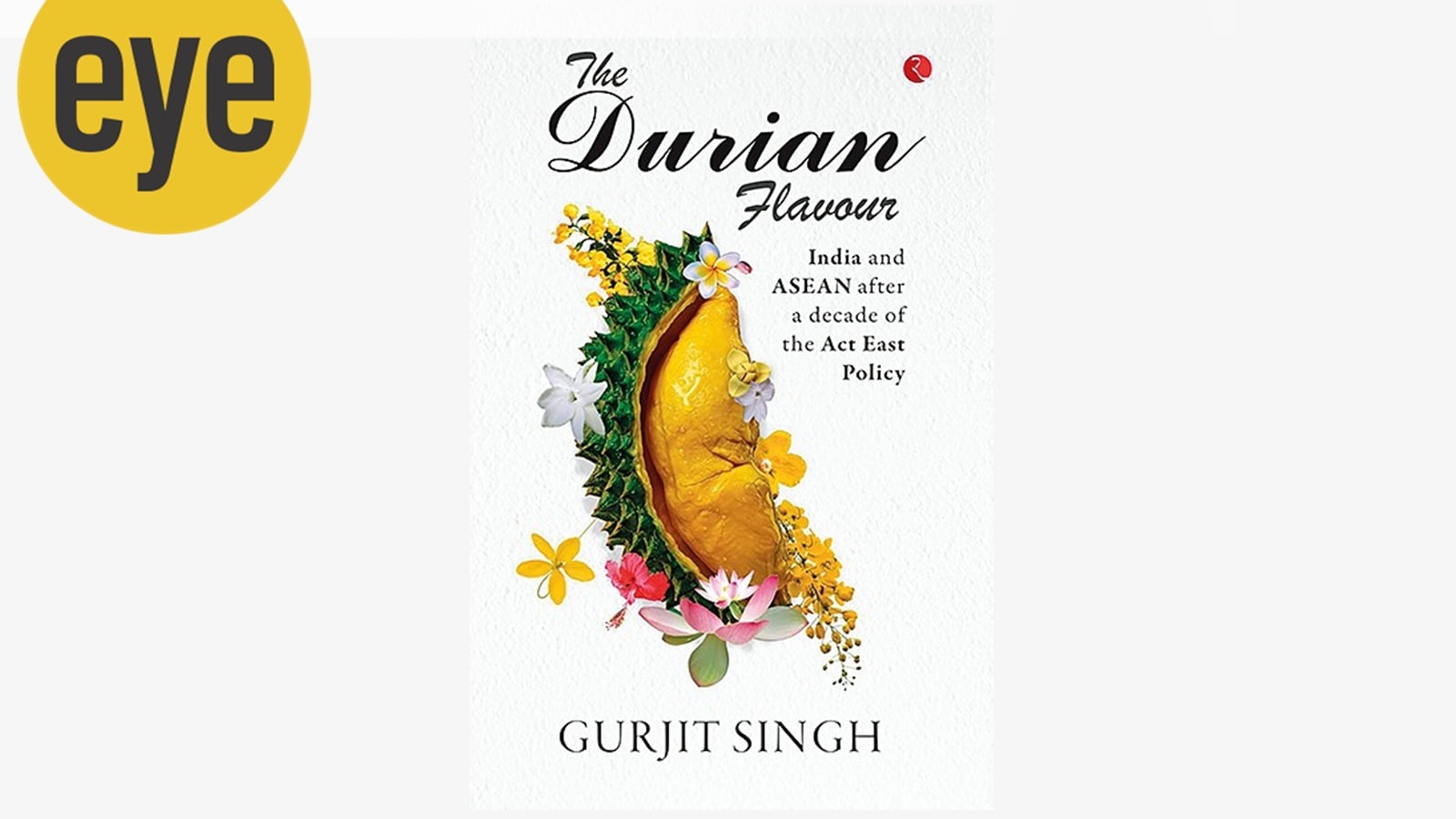
Weather ePaper Today’s Paper Journalism of Courage Home ePaper Politics Explained Opinion India Business Premium Cities UPSC Entertainment Sports World Lifestyle Tech Subscribe Sign In TrendingUPSC OfferIPL 2026US NewsPuzzles & GamesLegal NewsFresh TakeHealthResearch🎙️ Podcast Advertisement function checkAndLoadWindowSizeScript() { if (window.jQuery) { // jQuery is loaded, include your script jQuery(document).ready(function($) { // Your existing script for checking window width if (window.innerWidth) var page_w = window.innerWidth; else if (document.all) var page_w = document.body.clientWidth; if (page_w > 1024) { $(".add-left, .add-right").show(); } else { $(".add-left, .add-right").hide(); } }); } else { // jQuery is not loaded, check again after 0.2 seconds setTimeout(checkAndLoadWindowSizeScript, 200); } } // Initial call to the function checkAndLoadWindowSizeScript(); NewsBooks and LiteratureThe Durian Flavour by Gurjit Singh explains India-ASEAN ties in a changing world Premium The Durian Flavour by Gurjit Singh explains India-ASEAN ties in a changing world The book is as much a study of regional diplomacy as it is a reflection on how partnerships can be built to endure uncertainty Written by: Amitabh Kant5 min readApr 18, 2026 10:00 AM IST The Durian Flavour by Gurjit Singh (Amazon.in) Make us preferred source on Google Whatsapp twitter Facebook Reddit PRINT In a moment when the international order is visibly under strain, The Durian Flavour: India, ASEAN and the Act East Policy arrives as a relevant book. Gurjit Singh’s work is rooted in a larger question that matters well beyond India and Southeast Asia: how should countries in the Global South respond when globalisation becomes fragile, connectivity becomes more vulnerable and great power-politics becomes more unpredictable? The book addresses that question through the India-ASEAN relationship, making it useful not just as a study of regional diplomacy but also as a reflection on how partnerships can be built to endure uncertainty. Framing of India’s engagement with ASEAN within the broader turbulence of world politics, it draws attention to the concern that countries such as India are increasingly exposed to disruptions not of their own making, especially as supply chains and connectivity become more uncertain. It identifies practical building blocks for regional engagement that can withstand international disorder. It is not simply describing diplomatic history but arguing for a more resilient way of thinking about cooperation. The book’s discussion of the Act East Policy is central to this argument. Drawing on his experience as India’s Ambassador to ASEAN, Singh traces the evolution of the policy and explains how it helped place ASEAN at the heart of India’s eastern outreach. The contrast with the earlier Look East Policy is also significant. While Look East focused broadly on East Asia, Act East gave ASEAN a central role. The shift marked a deliberate and strategic turn in India’s foreign policy. The book helps the reader understand why the policy mattered and why ASEAN became such an important reference point. It also appears to take ASEAN seriously on its own terms rather than treating it as a single undifferentiated bloc. Singh examines ASEAN’s three communities — the Political-Security, the Economic and the Socio-Cultural, and evaluates India’s engagement with each. In doing that, it suggests a granular reading of the partnership. Instead of reducing India-ASEAN ties to summit meetings and statements, the book looks at the institutional dimensions of the relationship. This makes the analysis useful for anyone interested in regional diplomacy. A particularly strong strand in the book is the argument that implementation must go beyond governments and official agencies. Singh calls for a bigger role for businesses, CEOs, universities, academic institutions and private foundations in the diversification of the partnership. This is a valuable point because many regional partnerships remain stuck at the level of formal diplomacy. The book, therefore, pushes for a wider ecosystem of cooperation, one in which economic and intellectual actors help make state-led frameworks more effective. That is a practical and constructive idea, especially in a relationship as broad as India-ASEAN ties. The book also identifies four areas where India-ASEAN engagement remains insufficient. These include the way both sides approach China, India’s withdrawal from the Regional Comprehensive Economic Partnership, the slow pace of reviewing suggestions from both sides, and the tendency for India and ASEAN, despite both belonging to the Global South, to look beyond each other for partnerships rather than strengthening ties between themselves. These are useful themes because they keep the review anchored in actual policy questions. The book is not presented as celebratory or sentimental. It is presented as analytical and forward-looking, with attention to where the relationship still falls short of its potential. The discussion of Regional Comprehensive Economic Partnership (RCEP), in particular, is important. It captures a wider disappointment within ASEAN after India’s exit from the arrangement. The book uses that moment to reflect on the broader implications for economic engagement. That allows the review to move from one policy event to the larger issue of trust and sustained commitment. It also reinforces the book’s broader message that strategic partnerships are not built only through declarations but through consistent follow-through and practical economic participation. In its conclusion, the book points toward cooperation in the green economy, green skilling, impact investing, youth opportunities and economic complementarities between India and ASEAN. These themes make it future-facing and suggest that the relationship is not only about managing geopolitics but also creating real opportunities for growth, skills and shared development. The idea of depoliticising aspects of the relationship and redefining the meaning of strategic partnership is also significant, because it suggests a more workable and less rhetoric-heavy approach to regional cooperation. What emerges from the book is a serious, policy-driven and grounded account of India-ASEAN relations. It combines analysis of history, institutions and political context with a practical argument for broader engagement. Its value lies in the way it presents India-ASEAN ties not as a fixed achievement but as an evolving project that still requires effort, imagination and wider participation. The book also places this partnership within the larger story of post-colonial regional cooperation, linking it to the spirit of Bandung and to the Comprehensive Strategic Partnership formalized in 2023. The Durian Flavour, therefore, appears to be an important contribution to discussions about India’s eastern diplomacy and ASEAN engagement. It offers a clear-eyed account of where the relationship stands and where it could go next. In a world marked by fragmentation and uncertainty, that is a useful and timely intervention. The author is chairman, Fairfax Centre for Free Enterprise and former CEO, NITI Aayog
المصدر: Indian Express
| Source: Indian Express
ملاحظة تحريرية | Editorial Note:
نُشر هذا المقال في الأصل بواسطة Indian Express.
خبر (Khabr) هي منصة إعلامية أردنية مرخّصة تعمل بالذكاء الاصطناعي.
نضيف قيمة تحريرية من خلال: تحليل ذكي للأخبار، ملخصات تلقائية، رواية صوتية بالذكاء الاصطناعي، ترجمة متعددة اللغات، وتدقيق الحقائق.
هدفنا جعل الأخبار أكثر وضوحاً وسهولةً للقارئ العربي.
This article was originally published by Indian Express.
Khabr is a licensed Jordanian AI-powered news platform (Registration #82086).
We add editorial value through: AI-powered news analysis, automated summaries, AI audio narration, multi-language translation (Arabic, English, French, Turkish), and AI fact-checking.
Our mission is to make news more accessible and understandable for Arabic-speaking audiences worldwide.