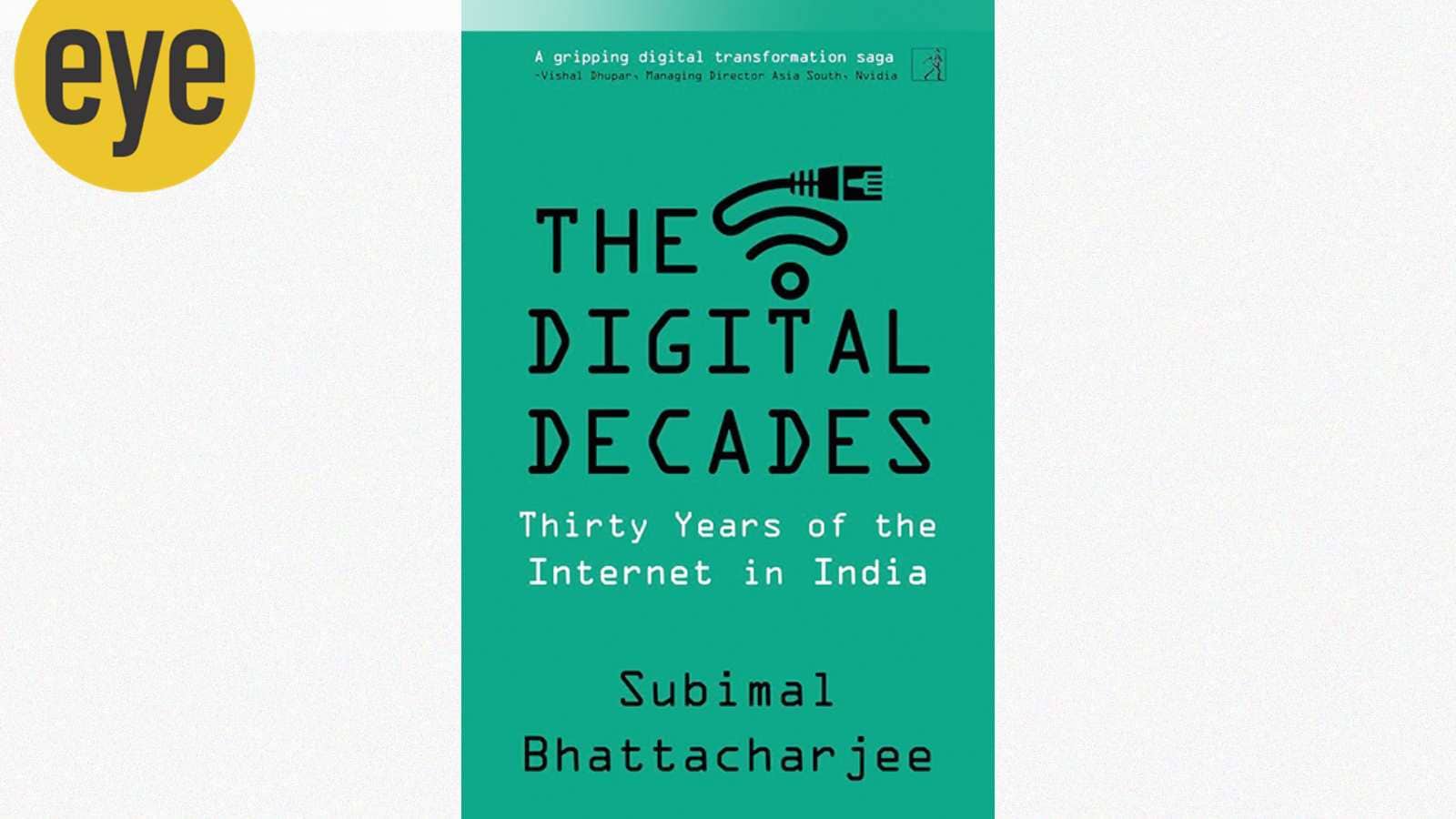
The digital decades by Subimal Bhattacharjee shows how India became a digital powerhouse
•Weather ePaper Today’s Paper Journalism of Courage Home ePaper Politics Explained Opinion India Business Premium Cities UPSC Entertainment Sports World Lifestyle Tech Subscribe Sign In TrendingUPSC Of...
•Written by: Srinath Sridharan4 min readNew DelhiApr 18, 2026 02:06 PM IST Book cover Make us preferred source on Google Whatsapp twitter Facebook Reddit PRINT India, for all its civilisational depth a...
•The Digital Decades is a notable corrective.
هذا الخبر من Indian Express. خبر يقدم أدوات ذكاء اصطناعي للتلخيص والترجمة والاستماع.
Weather ePaper Today’s Paper Journalism of Courage Home ePaper Politics Explained Opinion India Business Premium Cities UPSC Entertainment Sports World Lifestyle Tech Subscribe Sign In TrendingUPSC OfferIPL 2026US NewsPuzzles & GamesLegal NewsFresh TakeHealthResearch🎙️ Podcast Advertisement function checkAndLoadWindowSizeScript() { if (window.jQuery) { // jQuery is loaded, include your script jQuery(document).ready(function($) { // Your existing script for checking window width if (window.innerWidth) var page_w = window.innerWidth; else if (document.all) var page_w = document.body.clientWidth; if (page_w > 1024) { $(".add-left, .add-right").show(); } else { $(".add-left, .add-right").hide(); } }); } else { // jQuery is not loaded, check again after 0.2 seconds setTimeout(checkAndLoadWindowSizeScript, 200); } } // Initial call to the function checkAndLoadWindowSizeScript(); NewsBooks and LiteratureThe digital decades by Subimal Bhattacharjee shows how India became a digital powerhouse The digital decades by Subimal Bhattacharjee shows how India became a digital powerhouse This is India’s story of harnessing technology as an instrument of governance and economic mobility. Written by: Srinath Sridharan4 min readNew DelhiApr 18, 2026 02:06 PM IST Book cover Make us preferred source on Google Whatsapp twitter Facebook Reddit PRINT India, for all its civilisational depth and institutional complexity, has been less disciplined about recording its own transformations. The Digital Decades is a notable corrective. An expansive, meticulously layered narrative, it captures not merely the chronology of India’s digital transformation but its underlying grammar. In doing so, Subimal Bhattacharjee offers a work that reads as both institutional memory and strategic foresight. Spanning three decades, from the tentative dial-up connections of August 1995 to India’s current positioning as a digital powerhouse, the book unfolds like a national ledger of technological ambition. At one level, it is a story of infrastructure. From VSNL’s early gateways and cyber cafés to ubiquitous smartphones and a billion-plus internet users, the scale is staggering. At a deeper level, it examines how a democracy with India’s complexity negotiated, absorbed and ultimately harnessed technology as an instrument of governance and economic mobility. Bhattacharjee structures this journey across 19 chapters, each anchored in a distinct epoch. The early years are rendered with a sense of fragility, marked by ERNET experiments, evolution of the Internet globally, policy hesitations and a public still unfamiliar with connectivity. The narrative then gathers pace through the turbulence of the dot-com era and the early stirrings of mobile telephony. It reaches a decisive inflection in the 2010s. Aadhaar achieves scale. Data becomes dramatically cheaper with Jio’s entry. UPI quietly reshapes financial behaviour at population scale. What emerges is a transformation that touches state capacity, markets and citizen experience simultaneously. The book’s refusal to isolate technology from politics and policy elevates it beyond a conventional technology history. It clearly demonstrates that India’s digital ascent was constructed, at times deliberately and often unevenly, through policy interventions, institutional experiments and market disruptions. Digital India, the contours of the DPDP Act and India’s evolving position on data sovereignty are presented as elements of an emerging national framework rather than isolated initiatives. This book deserves to sit alongside the defining works on India’s economic liberalisation and entrepreneurial rise. There is also an admirable pedagogical discipline in the prose. Bhattacharjee pauses at critical moments to return the reader to first principles. “Many people confuse the Web with the Internet. The fact is that the Web is just one of the applications that runs on the Internet like electronic mail.” The simplicity reminds the reader that conceptual clarity is often the first casualty in policy discourse. Across platform economies, digital payments and artificial intelligence, influence is constantly being redistributed between state and citizen, incumbents and disruptors, and increasingly across nations. What emerges, often implicitly, is India’s attempt to chart a distinct path. It is neither Silicon Valley’s laissez-faire model nor Beijing’s command architecture but a hybrid still in formation, shaped by democratic compulsions, market forces and strategic anxieties. This is most visible in its approach to digital public infrastructure, which begins to resemble not merely a stack of systems but a doctrine of governance. Yet, the book gestures towards the tensions inherent in digital scale but does not always press them to their limits. Those who have engaged with digital policy will recognise that ambition often outpaces institutional readiness, and systems built for inclusion can, over time, acquire the attributes of control. The narrative remains grounded through well-explained anecdotes. Entrepreneurs navigating regulatory ambiguity, policymakers grappling with unprecedented scale and citizens in smaller towns discovering digital opportunity, all find space, preventing abstraction. The book prompts a set of pointed reflections: a) Are we digitally empowered or digitally dependent? b) Do we understand the systems or merely use them? c) Is scale masking structural fragility beneath the surface? d) Who writes the rules of India’s digital future — the state, the market or the algorithm? If the three digital decades were about access and scale, the next will be about control, resilience and strategic autonomy. Artificial intelligence, semiconductor ambitions, cybersecurity risks and the fragmentation of global technology regimes will define this phase. In that sense, this book sets the context necessary to observe what lies ahead. The writer is senior fellow at the Centre for Policy Research, New Delhiالمصدر: Indian Express | Source: Indian Express
ملاحظة تحريرية | Editorial Note: نُشر هذا المقال في الأصل بواسطة Indian Express. خبر (Khabr) هي منصة إعلامية أردنية مرخّصة تعمل بالذكاء الاصطناعي. نضيف قيمة تحريرية من خلال: تحليل ذكي للأخبار، ملخصات تلقائية، رواية صوتية بالذكاء الاصطناعي، ترجمة متعددة اللغات، وتدقيق الحقائق. هدفنا جعل الأخبار أكثر وضوحاً وسهولةً للقارئ العربي.
This article was originally published by Indian Express. Khabr is a licensed Jordanian AI-powered news platform (Registration #82086). We add editorial value through: AI-powered news analysis, automated summaries, AI audio narration, multi-language translation (Arabic, English, French, Turkish), and AI fact-checking. Our mission is to make news more accessible and understandable for Arabic-speaking audiences worldwide.