Fez– A team of researchers in Switzerland has introduced a new approach,allowing robots with different designs to learn and perform the same task without rewriting code from scratch.
The breakthrough comes from the École Polytechnique Fédérale de Lausanne (EPFL), where scientists have developed what they describe as a “motor intelligence” framework.
According to Al Jazeera , the study addresses one of the most persistent challenges in robotics: how to teach a single skill to machines with different physical structures.
For decades, robotics development has been slowed by what experts call “morphological dependency.”
In simple terms, even small changes in a robot’s design, such as the length of an arm, often require extensive reprogramming.
This has made upgrades costly and time-consuming, especially in industrial settings.
The new system seeks to break this link by separating the concept of a skill from the physical characteristics of a specific robot.
Instead of copying exact movements, the framework translates human actions into general mathematical strategies that any robot can interpret based on its own mechanical limits.
The research team, led by Aude Billard, developed the system through a three-step process.
First, human movements such as pushing, placing, or throwing objects are recorded using motion capture technology.
These movements are then converted into abstract mathematical models.
Finally, each robot adapts the task to its own structure, taking into account factors such as joint range and stability.
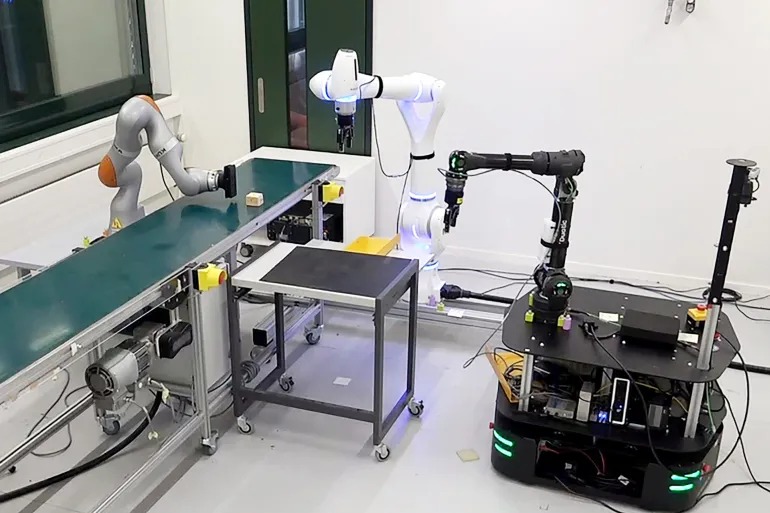
In practical tests, three different commercial robots were able to complete a complex sequence: pushing a wooden block, placing it on a table, and then throwing it safely.
The system remained effective even when the sequence of actions was distributed differently among the robots.
Researchers say the key advantage of this framework is predictability.
Unlike many experimental learning systems that perform well in controlled environments but fail in real-world conditions, this approach ensures that each robot operates within safe physical limits.
This reduces the risk of mechanical failure and improves reliability in practical applications.
The implications for industry are significant. Manufacturers could update or replace robots without long interruptions for reprogramming, lowering costs and improving efficiency.
The approach could also make automation more accessible to smaller companies by reducing the need for highly specialized programming teams.
Beyond industry, the researchers see broader potential.
The system could support more natural interaction between humans and robots, where simple verbal instructions are translated into physical actions adapted to each machine’s design.
This shift marks a move from programming machines to teaching them skills, an approach that mirrors how humans learn and share knowledge.
As robotics continues to evolve, this framework may help extend the use of robots beyond structured factory environments into more complex settings such as homes and hospitals, where flexibility and adaptability are essential.
The post Swiss Researchers Develop System to Transfer Skills Across Robots appeared first on Morocco World News.