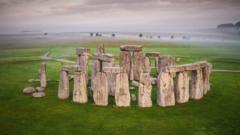
Simpler, older version of Stonehenge found three miles from famous site
Simpler, older version of Stonehenge found three miles from famous siteJust nowShareSaveAdd as preferred on GoogleAlison Francis,Senior Science JournalistandRebecca Morelle,Science EditorEnglish HeritageThe huge stones at Stonehenge mark the movements of the Sun Archaeologists believe they have discovered an earlier, much simpler version of Stonehenge about 3 miles (5km) away from the prehistoric monument.All that remains of the older structure is two holes in the ground, but the team says they held wooden posts that lined up with the Sun on the summer and winter solstices - the longest and shortest days of the year - in the same way as Stonehenge.The site has been dated to about 5,000 years old, which predates Stonehenge by 500 years.Artefacts were also found at the site, including pottery, flint tools and animal bone, suggesting prehistoric people held gatherings there.Phil Harding, from Wessex Archaeology, who led the excavation, said it was one of the best finds of his long career."Two post pits tell me [much] more about the people 5,000 years ago," he said."This tells me about the whole community, this tells me about how they were thinking, how they were behaving, how they were revering the heavens."Tony Jolliffe/BBC NewsPhil Harding says discovering the structure has been a career highThe huge stones at Stonehenge are precisely placed to line up with the Sun. If you stand in middle of the circle at sunrise on the summer solstice, you will see the Sun come up over a stone called the heel stone to the north east of the circle. On midwinter, if standing in the centre of the circle, you would see the sun set over an alter stone to the south west of the site. The structure, discovered in the village of Bulford, was a much more simple construction made up of just two wooden posts, which have long since rotted away. They were positioned 120m (394ft) apart and estimated to be between 2m and 4m high.When Harding uncovered the intriguing holes, he no...المصدر: BBC News | Source: BBC News
ملاحظة تحريرية | Editorial Note: نُشر هذا المقال في الأصل بواسطة BBC News. خبر (Khabr) هي منصة إعلامية أردنية مرخّصة تعمل بالذكاء الاصطناعي. نضيف قيمة تحريرية من خلال: تحليل ذكي للأخبار، ملخصات تلقائية، رواية صوتية بالذكاء الاصطناعي، ترجمة متعددة اللغات، وتدقيق الحقائق. هدفنا جعل الأخبار أكثر وضوحاً وسهولةً للقارئ العربي.
This article was originally published by BBC News. Khabr is a licensed Jordanian AI-powered news platform (Registration #82086). We add editorial value through: AI-powered news analysis, automated summaries, AI audio narration, multi-language translation (Arabic, English, French, Turkish), and AI fact-checking. Our mission is to make news more accessible and understandable for Arabic-speaking audiences worldwide.


