Sicily: Italy’s moreish island, from food hubs to the coast, by Jamie Douglass
The history of Anglo-Sicilian relations is long, amicable, and has much to do with wine.
In 1773, a travelling Englishman called John Woodhouse discovered the excellence of Marsala’s wines, and helped turn it into a major export industry.
King Ferdinand III of Sicily granted Dukedom to Admiral Nelson in 1799 in gratitude for saving the island from Napoleon – and the British naval commander established the vineyard that exists to this day.
The island remains a high society talking point today: the second series of The White Lotus was filmed entirely on the island, and when I visit I find myself sitting at the same cocktail bar where Theo James looks annoyingly handsome in one of the scenes from the series.
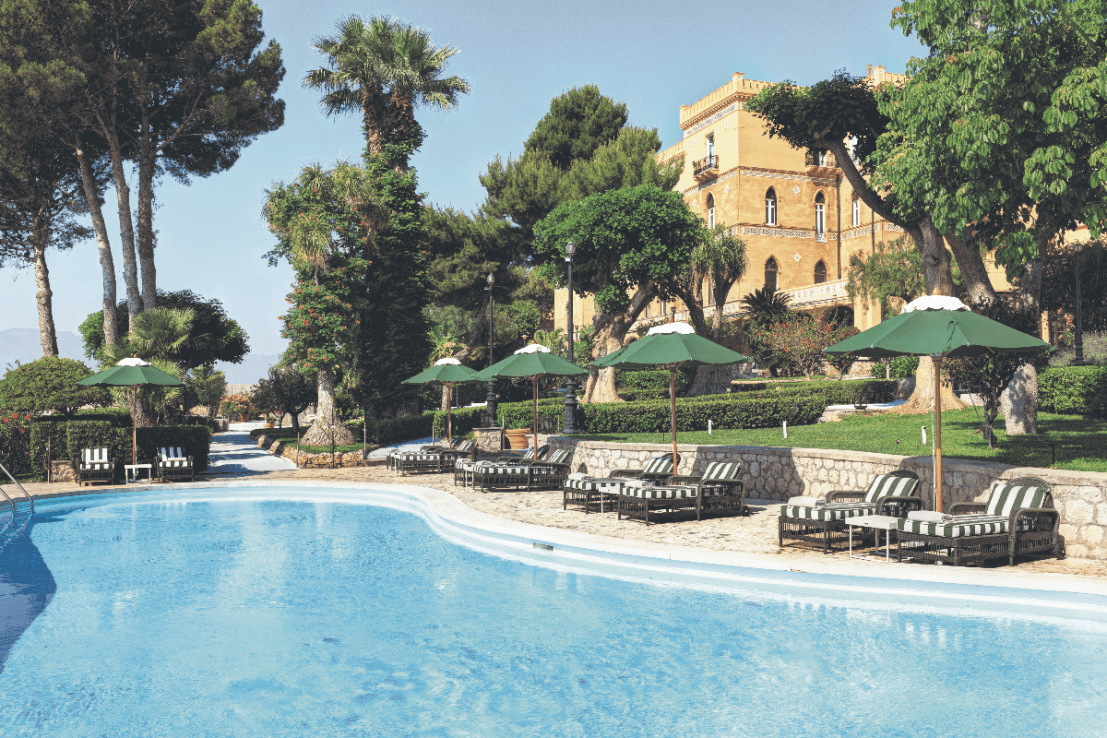
The Villa Igiea is one of the two flagship Rocco Forte properties on the island. Nestled in the shadow of Monte Pellegrino, the elegant Art Nouveau 19th century palazzo sits right on the seafront, looking straight out across an almost offensively blue Tyrrhenian Sea. It even has its own quay; guests, I am told, have the option of arriving by boat and coming straight up the tiered gardens from the port.
Two halves of Sicily
Our hosts are slightly concerned when I suggest a dip (Palermitans regard the water as too bracing much before May and they point me towards the pool instead) but they are familiar with the eccentricities of Englishmen; our room – like all of them – has a folio set of PG Wodehouse on the bookshelves.
The rooms range from extremely comfortable to ridiculously so. The Donna Franca suite offers 1,500 square feet of luxury with sea views on three sides and a private terrace. I would probably get lost trying to leave the bathroom, which is bigger than my first flat.
The villa was built in 1900 at the height of the Belle Epoque, and transformed by the powerful Florio family into one of the most famous hotels in Europe. Discreet photos on the walls record visits of both Hollywood royalty and actual royalty, and you can more than imagine yourself back in the period in the charming Florio restaurant, which maintains an air of understated elegance.
Perhaps more exciting for modern cineastes is the Igiea Terazza bar, whose sandstone vaults and bespoke murals provided a perfect setting for the tangled love-lives in White Lotus, and offers guests a series of cocktails inspired by the Sicilian diaspora.
I feel impossibly exotic sampling a Tunisian liqueur until my wife reminds me we are closer to Tunis than Rome. But there are plenty of other exotic options, including a Sicilian take on yuzu sake with sakura bitters. And chef Fulvio Pierangelini’s menu of snacks from Sicily and main plates offer a welcome counterpart to the innovative drinks.
Part of the draw of the seaside-meets-city sanctuary is the proximity to Palermo itself, and the hotel offers a convenient shuttle service into the centre every hour. Palermo is one of the finest city breaks you will find, squashed between the sea and the mountains, historic, frenetic, almost parodically charming.
Food markets sell the best fish you will ever eat in the shadow of Arabic-inspired Norman architecture. It is also superbly walkable by London standards, and if you need to stop for refreshment, you won’t find it wanting.
You should make time, however, to leave the north shore and visit the yin to Igieia’s yang – the Verdura resort in Sciacca. Just an hour and a half across gentle mountains, this 230-hectare enclave could not be more different than the vibrant chaos of the city.
The entire complex is a haven. First there is the beach, with over a kilometre of stunning waterfront – I finally get my swim – then there are stunning walks (not to mention three fully-fledged golf courses). The links, I am told, attract golfers from all over Europe to play in such idyllic surroundings.
But there is plenty of green space left over, including an olive grove with over 2,000 trees, together with almost twice as many fruit trees. Verdura is not only self-sufficient, but an exporter. There are three restaurants here, all of which aim to showcase the best of the island’s food: a relaxed Osteria, a friendly Trattoria with cliff-top sea views, and Zagara, the (exquisitely) fine-dining option.
Surrounded by candlelit tables, Vincenzo guides us through a menu that has taken Sicilian peasant classics, such as the broadbean soup Maccu, and uplifted them to something heavenly. Spanking-fresh raw gamberini rosso, artichokes three ways, a lamb fillet crusted in pistachio and stuffed with caponata.
If you are not in love with Sicilian cuisine before you go – and if not, why not? – you will be after. And as any oenophile knows, the wines of the island are more than a match for the food, and some of Italy’s best, according to our columnist.
Sicily has long exported good wines and kept the best ones at home. We stumble back to one of the 203 large, bright suites, each with its own, private Mediterranean view, to lie on the bed in a coma of excess. It is fortunate indeed there is a spa.
Indeed, Verdura is not just a resort, it aims to be one of Europe’s leading wellness centres. The extensive spa complex has everything one might expect of a five-star spa – swimming pools, treatment rooms, steam rooms and saunas – but the real draw is the four outdoor thalassotherapy pools.
Each is heated to a different temperature and the water mixed to discrete densities of salt and minerals. Surrounded by Sicily’s Edenic nature, you can ease away golfing aches, worldly cares, or the fact that the food was so good you couldn’t stop eating last night. Within no time at all, we are rejuvenated to the point I suggest a bike ride, something I haven’t done in 32 years. I don’t even fall off. Much.
Verdura is a labour of love, which took seven years to build, but is developing all the time. There are now 20 private villas available (some for sale), each with a garden and a pool alongside individually-designed rooms, which are attracting big-name guests. This is in no small part down to the rackets-sports centre. “We had a world-class tennis player bring his family here last year,” I am told. “I’m not allowed to tell you who. But it was Roger Federer.”
All too soon it is time to leave. As we drive back to the mountains we pass the Sicilian cookery classes, and a nascent equestrian school – the latest addition to the facilities. Families are more than welcome, too, with kids clubs, plenty of activities and a 24 hour babysitting service, just in case the grown-ups want to linger at one of the restaurants.
Sicily has long been a perfect destination for a break, thanks to its outrageously long season – you could be here at any time from April to November – but Rocco Forte elevates a holiday here to something bordering on the sublime.
Read more: A night at the museum: The amazing Palazzo Previtera, Sicily