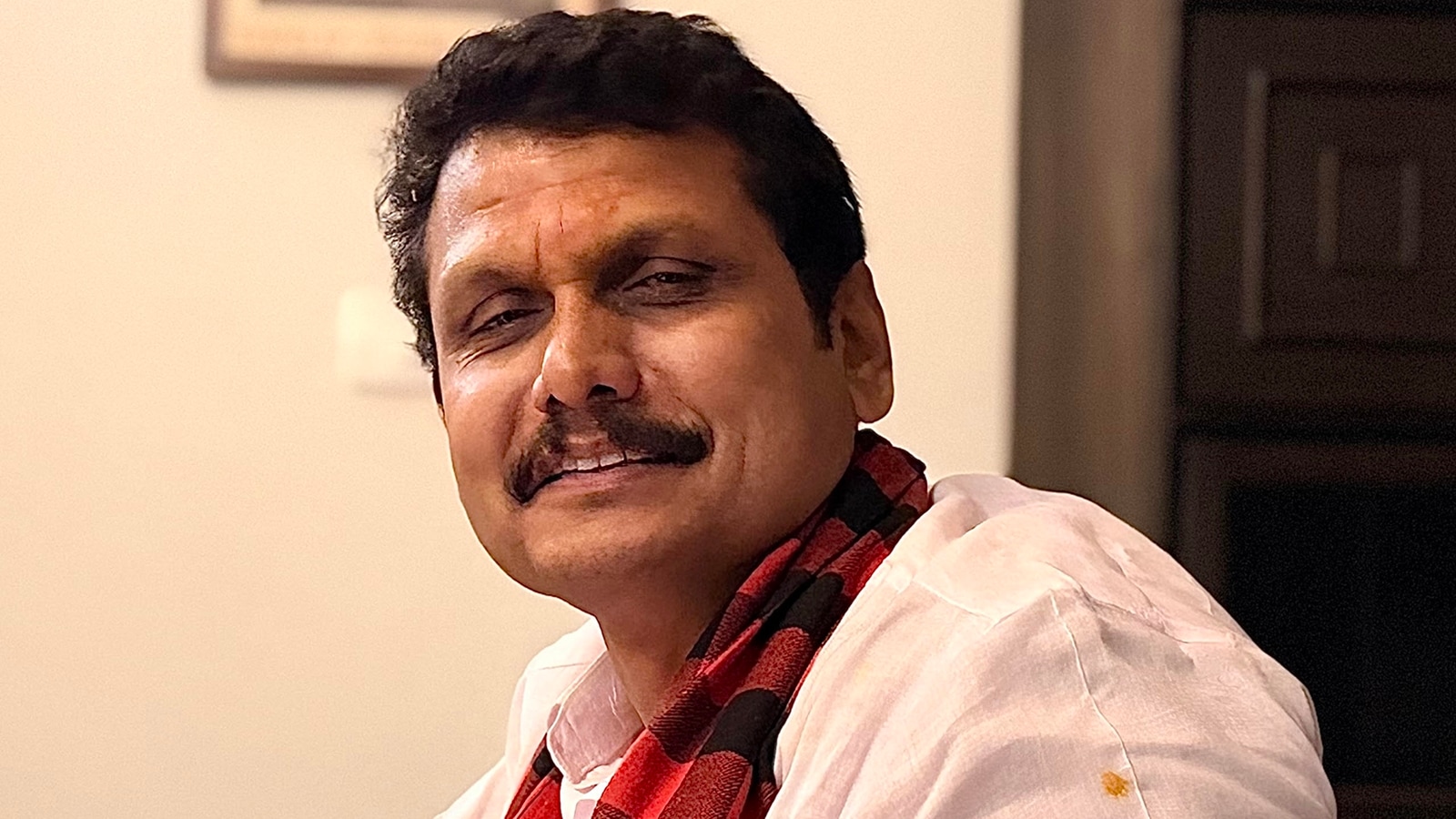
Senthil Balaji: Once a ‘prized target’, key DMK face sent to turn west Tamil Nadu
He does not arrive in a rush. He walks. Five hours in the evening, five in the morning. Street after street, house after house. He stops when someone calls. He stops even when they don’t. A woman stands at a doorway with an aarathi plate; he waits. A man begins to speak; he listens. If someone offers something, he takes it. If not, he asks what they need. “If I ride a jeep, how can I stand near them and speak?” he asks. “They would not say things, I also won’t speak.” This is how senior DMK leader and ex-minister V Senthil Balaji, 50, campaigns in his constituency, Coimbatore South – not from atop a vehicle, but on foot, in the heat, through slow conversations. This is, in a way, a return. For 471 days, there were no crowds. No streets. No noise. Only a room, a wall, and a long stretch of time. “Got used to it,” he says, virtually dismissing the time of his incarceration. “During that long gap… it was quiet. It has come back to a very normal state now. I did not feel any big difference.” His telling is not dramatic. No attempt to turn his imprisonment into a spectacle. If anything, he reduces it to a discipline of adjustment. “I should change myself according to the place I have gone to,” he says. “Like that I changed myself.” He read Tamil books in prison. He walked within his limited space. He says he did not meet visitors, not even family, except his advocate, and that too only when necessary. “I thought nobody should come there,” he says. “If there is work, come. Otherwise no need.” He did not watch television. He did not follow the noise outside. “The day I came out, the next day I forgot about it and went to the next work,” he says. Then, almost as an aside, a line that carries more weight than he lets on: “Because I was the most prized target.” Balaji was released from prison in September 2024 after the Supreme Court granted him bail in an alleged cash-for-jobs scam in which he was arrested by the ED in June 2023. In Tamil Nadu politics, Balaji occupies a space that is difficult to define and harder to ignore. He has not merely been a minister or a five-term MLA. He is, depending on who you ask, a manoeuvrer, an organiser, a target next to Stalin for the DMK’s rivals, a survivor – and, in the upcoming Assembly polls, his party’s field general in western Tamil Nadu. The party has not only shifted him from his Karur bastion to Coimbatore South, a stronghold of the Opposition AIADMK-BJP, but has also given him the charge of 35 seats across the Kongu region. It is less a candidature, more a command. “In Coimbatore, where we had no scoreboard, we are sending our most reliable match-winner,” a senior DMK leader told The Indian Express on the day the party announced its candidate list. Balaji shrugs off the scale of his task. “I already told you how we work,” he says. But the numbers matter to him. He recites them with precision, as if they are part of a map he carries in his head. On the DMK losing 10 seats in Coimbatore district, including Coimbatore South, to its rival camp in the 2021 elections, he says: “In one constituency it was minus 1,200 votes, in another minus 1,800, in another minus 4,000. In nine seats, the winning margin was all within 10,000 votes. Only Thondamuthur had a margin of over 40,000. That is now corrected.” He says it is a “myth” that Coimbatore or the western region is an “AIADMK-BJP fort”. “When the DMK strikes with force, they become weak,” Balaji says. It may be a statement of confidence, but also of method. For Balaji, politics is arithmetic built on proximity – small deficits, corrected through relentless presence. Born in a farming family in Karur, Balaji was first elected as a councillor after joining politics as he rose through the ranks of the AIADMK under J Jayalalithaa. He was once among her most visible ministers – organising events, executing schemes like Amma Water, and building up his reputation as a leader who could mobilise crowds as well as systems. His politics was both personal and performative – shaving his head in devotion to his leader, lighting lakhs of lamps, turning governance into ritual. But power in Tamil Nadu is rarely linear. Jayalalithaa dropped him from her Cabinet in 2015. After her death, he backed the party’s Sasikala–TTV Dhinakaran faction before switching to the Stalin-led DMK in 2018. It was a move that reshaped the DMK’s prospects in the western belts. He was one of the reasons the DMK could not grow in Karur for years. “Now he is the reason it can,” says a former AIADMK minister who closely worked with him. Balaji does not dwell on his transition. He does not speak ill of those he left behind. “Why should I be talking about someone?” he asks. Instead, he folds the past into the present as an experience, not an explanation. His critics accuse him of being “corrupt”. He faces multiple cases and has been the focus of agencies’ raids and investigations. His supporters call it “political targeting”. Balaji offers a simpler reading. “People will only see who will do good,” he says. On the ground, he insists, people are not interested in cases but in outcomes – “who can solve their problems, who can deliver”. And so he walks. Ten hours a day, everyday. Along with not just the DMK workers, but “at least 200 to 500 people from each neighbourhood”. “Everything is mixed,” he says, when asked about the differences between Karur and Coimbatore. Caste, class, urban, rural – these are categories analysts use. For Balaji, the constituency is a field of relationships. “For us, all 35 are the same,” he says. “It is not divided like that.” What does he see as the DMK’s advantage in the region? “People trust Chief Minister Stalin,” he says. “He has given many major schemes… that has to become a vote bank.” He lists them not as achievements but as a spread – Rs 1,000 for women, free bus travel, morning meals for children, sector-wise welfare. The task then, he says, is conversion – turning trust into votes, schemes into outcomes. There is also the question of fatigue – whether the long incarceration, the cases, the constant scrutiny have slowed him down. He rejects it. “After that, I would be even faster.” A group of people waits for him at the next corner. He moves toward them, unhurried. He does not stand above the constituency. He moves through it. “Politics, for me, is not an event. It is a way of being,” he says. Arun Janardhanan is an experienced and authoritative Tamil Nadu correspondent for Read Moreالمصدر: Indian Express | Source: Indian Express
ملاحظة تحريرية | Editorial Note: نُشر هذا المقال في الأصل بواسطة Indian Express. خبر (Khabr) هي منصة إعلامية أردنية مرخّصة تعمل بالذكاء الاصطناعي. نضيف قيمة تحريرية من خلال: تحليل ذكي للأخبار، ملخصات تلقائية، رواية صوتية بالذكاء الاصطناعي، ترجمة متعددة اللغات، وتدقيق الحقائق. هدفنا جعل الأخبار أكثر وضوحاً وسهولةً للقارئ العربي.
This article was originally published by Indian Express. Khabr is a licensed Jordanian AI-powered news platform (Registration #82086). We add editorial value through: AI-powered news analysis, automated summaries, AI audio narration, multi-language translation (Arabic, English, French, Turkish), and AI fact-checking. Our mission is to make news more accessible and understandable for Arabic-speaking audiences worldwide.