Secretive Chinese scientists publish first image of asteroid many consider Earth’s 'quasi-moon'
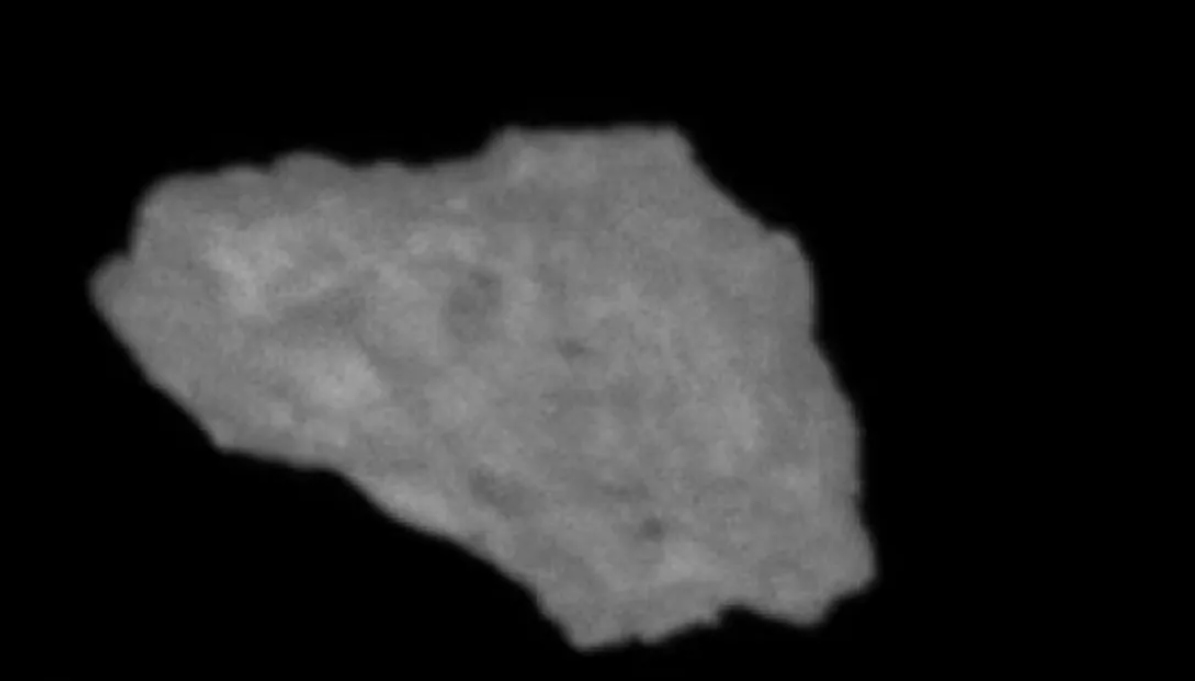
•China's Tianwen-2 spacecraft has successfully photographed Kamo'oalewa, marking the first detailed image ever captured of Earth's quasi-moon.
•The Chinese National Space Administration confirmed the probe is now in orbit around the small celestial body.Imagery obtained on July 2 from roughly 12 miles away shows an asymmetrical, angular rock...
•TRENDING Stories Videos Your Say Scientists describe the object as pointy and compact, strikingly different from the rounder, rubble-covered asteroids previously visited by spacecraft missions.Th...
هذا الخبر من GB News. خبر يقدم أدوات ذكاء اصطناعي للتلخيص والترجمة والاستماع.
المصدر: GB News | Source: GB NewsChina's Tianwen-2 spacecraft has successfully photographed Kamo'oalewa, marking the first detailed image ever captured of Earth's quasi-moon.
The Chinese National Space Administration confirmed the probe is now in orbit around the small celestial body.
Imagery obtained on July 2 from roughly 12 miles away shows an asymmetrical, angular rock measuring between 16 and 20 metres across.
The asteroid maintains a close relationship with our planet whilst technically orbiting the Sun rather than Earth itself.
TRENDINGStoriesVideosYour SayScientists describe the object as pointy and compact, strikingly different from the rounder, rubble-covered asteroids previously visited by spacecraft missions.
The unusual appearance of Kamo'oalewa has captivated researchers worldwide.
"Kamo'oalewa looks amazing, like nothing we've seen floating in space before," said Sabina Raducan, a researcher at the International Space Science Institute in Bern, Switzerland.
Its jagged, splinter-like form suggests a violent past. Cristina Thomas, a planetary scientist at Northern Arizona University, noted: "It could be a remnant of a catastrophic event."
Dr Raducan observed the asteroid resembles debris produced during laboratory impact experiments, pointing to a possible high-velocity collision between larger space rocks as its origin.
The quasi-moon represents the smallest object ever visited by a human-made spacecraft.
Tianwen-2 embarked on its journey in May 2025, traversing approximately 620 million miles through the solar system before reaching its destination.
The spacecraft will spend close to a year conducting scientific observations and mapping the asteroid's surface features before attempting to gather material.
LATEST DEVELOPMENTS
- Archaeology mystery of skeleton 'belonging' to fouth musketeer may never be solved due to blunder
- Archaeologists uncover 'massive biblical structure' in hunt for Ark of the Covenant
- First dinosaur fossil from Antarctica found in drawer after lying forgotten for 40 years
Should the sample collection prove successful, the probe is scheduled to depart Kamo'oalewa in April 2027, with the precious cargo expected to arrive on Earth by late that year.
China would become only the third nation to retrieve material directly from an asteroid, following similar achievements by Japan and the United States.
Extracting samples from Kamo'oalewa presents formidable obstacles for the Chinese mission.
Unlike the loosely bound, pebbly asteroids from which Japan and America collected material, this quasi-moon appears to be a solid, rigid rock.
"It'll be the first time we visited something like that," said Andy Rivkin, a planetary scientist at Johns Hopkins Applied Physics Laboratory.
The asteroid's rapid spin — completing one rotation every 28 minutes — creates additional hazards for any landing attempt.
Furthermore, the spacecraft's considerable mass relative to the tiny asteroid raises concerns. Dr Raducan warned that drilling operations could potentially alter Kamo'oalewa's orbital path, given the similar scale of probe and target.
Our Standards: The GB News Editorial Charter

ملاحظة تحريرية | Editorial Note: نُشر هذا المقال في الأصل بواسطة GB News. خبر (Khabr) هي منصة إعلامية أردنية مرخّصة تعمل بالذكاء الاصطناعي. نضيف قيمة تحريرية من خلال: تحليل ذكي للأخبار، ملخصات تلقائية، رواية صوتية بالذكاء الاصطناعي، ترجمة متعددة اللغات، وتدقيق الحقائق. هدفنا جعل الأخبار أكثر وضوحاً وسهولةً للقارئ العربي.
This article was originally published by GB News. Khabr is a licensed Jordanian AI-powered news platform (Registration #82086). We add editorial value through: AI-powered news analysis, automated summaries, AI audio narration, multi-language translation (Arabic, English, French, Turkish), and AI fact-checking. Our mission is to make news more accessible and understandable for Arabic-speaking audiences worldwide.