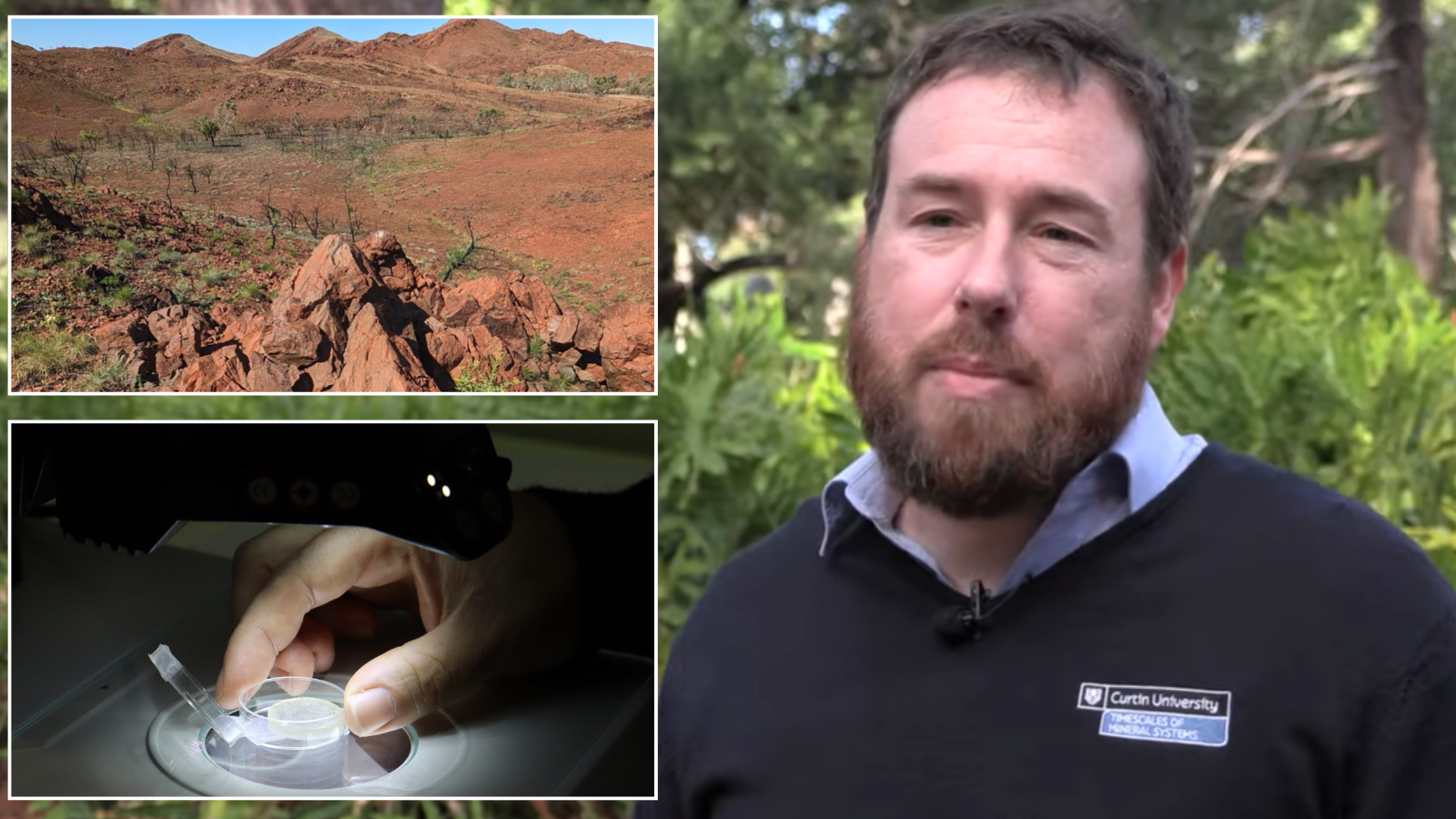
Scientists uncover history behind world's oldest known asteroid impact which smashed into Earth three billion years ago
•Scientists have uncovered the history behind the world's oldest known asteroid impact which hit the Earth approximately 3.02 billion years ago.
•The North Pole Dome, situated in the Pilbara region, in western Australia had long been suspected by researchers as the location of an ancient cosmic collision.However, definitive proof of its age had...
•TRENDING Stories Videos Your Say The space rock responsible was likely a "kilometre-scale" object, said Prof Kirkland, though determining its exact dimensions remains impossible.Despite billions...
هذا الخبر من GB News. خبر يقدم أدوات ذكاء اصطناعي للتلخيص والترجمة والاستماع.
المصدر: GB News | Source: GB NewsScientists have uncovered the history behind the world's oldest known asteroid impact which hit the Earth approximately 3.02 billion years ago.
The North Pole Dome, situated in the Pilbara region, in western Australia had long been suspected by researchers as the location of an ancient cosmic collision.
However, definitive proof of its age had remained elusive.
A team at Curtin University, Perth, led by Professor Chris Kirkland employed sophisticated mineral dating methods to establish the precise timing of the event, the Daily Mail reports.
TRENDINGStoriesVideosYour SayThe space rock responsible was likely a "kilometre-scale" object, said Prof Kirkland, though determining its exact dimensions remains impossible.
Despite billions of years of erosion erasing much of the physical evidence, the impact left permanent markers within the surrounding geology that researchers were finally able to decode.
The breakthrough came through analysis of zircon, an exceptionally durable mineral capable of maintaining its structure across vast geological timescales.
Samples extracted from rocks surrounding the crater revealed zircon crystals displaying unusual branching and skeletal formations.
Prof Kirkland identified these as crystals which had been disturbed and partially reformed when extreme temperatures from the collision altered their original structure.
Dating the transformed crystals pointed to an event occurring roughly three billion years ago.
The research team examined a second mineral called apatite, which developed as heated fluids passed through the shock-damaged rock.
"The agreement between two different mineral systems gives us confidence that we are seeing the signature of a single major event – a meteorite impact," the professor said.
LATEST DEVELOPMENTS
- Divers stunned as untouched piece of history rises from Mediterranean seabed after 1,000 years
- Archaeologists uncover skeleton at site of one of Britain's bloodiest battles
- History of iconic British treasure could be rewritten after shock new evidence emerges from soil
The collision generated an extensive network of fractures that persisted long after the initial event, with these cracks subsequently channelling fluid movement through the damaged terrain.
Prof Kirkland said: "At North Pole Dome, the impact appears to have generated a long-lived fractured system that was later reused by fluids.
"On the early Earth, that kind of process could have influenced chemical exchange between rocks and an early ocean, causing mineral alteration and potentially modifying the environments available for microbial life."
The discovery holds particular significance for geologists as it places the crater within the Archean aeon, a period when Earth's earliest landmasses were taking shape.
The fractured rock systems created by such impacts may have driven hydrothermal activity and altered mineral compositions across the young planet's surface.
Locating evidence of ancient cosmic collisions on Earth presents enormous challenges for scientists, as billions of years of geological processes including heat, pressure and fluid movement have erased or reset most traces.
The lunar surface, which offers a far more stable geological record, indicates the inner solar system endured intense meteor bombardment during this era.
Some researchers theorise this period formed part of the Late Heavy Bombardment.
This was a catastrophic phase triggered when shifts in the orbits of Jupiter, Saturn, Uranus and Neptune sent countless asteroids hurtling towards the inner planets.
"Earth must also have experienced that bombardment, but most of the evidence has been destroyed," Prof Kirkland said.
"That is why the North Pole Dome discovery is so important.
"At three billion years, it is the oldest recognised impact structure on Earth and one of the very few windows into how impacts affected the Archean Earth."
Our Standards: The GB News Editorial Charter


ملاحظة تحريرية | Editorial Note: نُشر هذا المقال في الأصل بواسطة GB News. خبر (Khabr) هي منصة إعلامية أردنية مرخّصة تعمل بالذكاء الاصطناعي. نضيف قيمة تحريرية من خلال: تحليل ذكي للأخبار، ملخصات تلقائية، رواية صوتية بالذكاء الاصطناعي، ترجمة متعددة اللغات، وتدقيق الحقائق. هدفنا جعل الأخبار أكثر وضوحاً وسهولةً للقارئ العربي.
This article was originally published by GB News. Khabr is a licensed Jordanian AI-powered news platform (Registration #82086). We add editorial value through: AI-powered news analysis, automated summaries, AI audio narration, multi-language translation (Arabic, English, French, Turkish), and AI fact-checking. Our mission is to make news more accessible and understandable for Arabic-speaking audiences worldwide.