⚡ عاجل: كريستيانو رونالدو يُتوّج كأفضل لاعب كرة قدم في العالم●⚡ أخبار عاجلة تتابعونها لحظة بلحظة على خبر●⚡ تابعوا آخر المستجدات والأحداث من حول العالم●
AI اقتراحات ذكية
AI مباشر|--مشاهد مباشر
845,027مقال403مصدر نشط224قناة مباشرة4,858خبر اليوم
آخر تحديث:منذ 3 ثواني
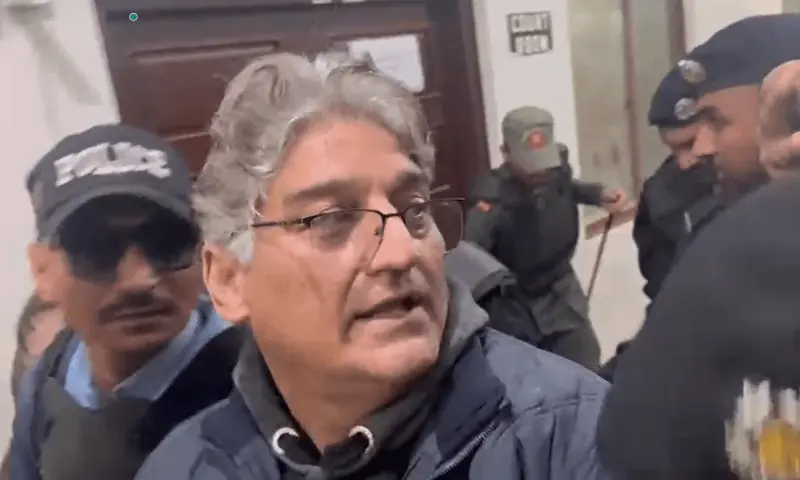
SC halts anti-terrorism court from framing charges against journalist Matiullah Jan
The Supreme Court (SC) on Thursday restrained the anti-terrorism court (ATC) from framing charges against veteran journalist Matiullah Jan, and directed the Islamabad High Court (IHC) to expeditiously decide on the challenge to the terrorism charges invoked against him.
Headed by Justice Muhammad Ali Mazhar, a three-judge SC bench took up a plea by the journalist seeking to set aside the IHC’s Feb 23, 2026, order denying ad-interim relief to stay his criminal trial.
During the hearing, the prosecution did not object to the issuance of directions to the high court, while the apex court observed that it would not go into the merits of the case at this stage so as not to prejudice it in favour of either party.
Barrister Qadeer Janjua represented Jan in the case, in which the journalist raised questions about the trial court’s jurisdiction and the applicability of terrorism charges against him.
Filed under Article 185(3) of the Constitution, the petition challenged the Feb 23 IHC order, which, while issuing notices in the criminal revision petition, refused to grant any ad-interim relief—effectively allowing the trial before the ATC to continue uninterrupted, with the framing of charges now imminent.
Matiullah Jan was arrested on Nov 28, 2024, at a police checkpoint in Sector E-9, Islamabad.
An FIR was registered at Police Station Margalla, alleging that the journalist, while in an intoxicated condition, snatched a constable’s official weapon, pointed it at police personnel, and threatened them. It was further claimed that 10 grams of “ice” (crystal methamphetamine) were recovered from his possession.
The petition argued that the high court’s order suffers from a patent illegality, as it failed to preserve the subject matter of the lis. The primary challenge in the criminal revision was to the jurisdiction of the ATC. It further contended that if the trial court is allowed to proceed unchecked, particularly up to the framing of charges, the purpose of the revision would be defeated.
The petition contended that the high court, by merely issuing notices and not staying the proceedings, failed to protect the petitioner’s rights, thereby committing an error apparent on the face of the record. It added that the high court erroneously failed to exercise its discretion to grant ad-interim relief, despite a prima facie case, the balance of convenience favouring the journalist, and the risk of irreparable loss.
It is a settled trinity of law governing the grant of interim injunctions/stays, it said.
The petition said the journalist has an overwhelmingly strong prima facie case, adding that the trial court itself, while granting bail, observed that the prosecution’s case was “full of doubts.”
Furthermore, the forensic report of the Punjab Forensic Science Agency (PFSA) refuted the primary narcotics allegation by confirming that the recovered substance was not “ice,” added the petition.
The law on what constitutes “terrorism” is no longer res integra and was definitively settled by the SC in the 2020 Ghulam Hussain case, which requires the presence of a specific design to spread terror. The petition said that the allegations in the FIR, even if taken at face value, do not meet this threshold, and that the refusal to acknowledge this strong prima facie case renders the high court order perverse.
Moreover, the balance of convenience lies entirely in favour of the petitioner. Granting a stay for a brief period until the high court decides the jurisdictional issue would cause no prejudice to the respondent/State, the petition said further.
Conversely, refusing the stay would compel the petitioner to face the rigors of a trial before a forum that may have no jurisdiction to try him, causing immense legal and personal prejudice.
The petition further stated that the loss and injury to the petitioner are not merely monetary or speculative; they are real, ongoing, and irreparable. Being tried under the harsh and stigmatising procedural framework of the Anti-Terrorism Act, 1997, without lawful authority, constitutes a grave violation of his fundamental rights, noting that “the possible liberty of the petitioners was at stake,” and such a stake cannot be compromised by denial of ad-interim relief.
ملاحظة تحريرية | Editorial Note:
نُشر هذا المقال في الأصل بواسطة Dawn.
خبر (Khabr) هي منصة إعلامية أردنية مرخّصة تعمل بالذكاء الاصطناعي.
نضيف قيمة تحريرية من خلال: تحليل ذكي للأخبار، ملخصات تلقائية، رواية صوتية بالذكاء الاصطناعي، ترجمة متعددة اللغات، وتدقيق الحقائق.
هدفنا جعل الأخبار أكثر وضوحاً وسهولةً للقارئ العربي.
This article was originally published by Dawn.
Khabr is a licensed Jordanian AI-powered news platform (Registration #82086).
We add editorial value through: AI-powered news analysis, automated summaries, AI audio narration, multi-language translation (Arabic, English, French, Turkish), and AI fact-checking.
Our mission is to make news more accessible and understandable for Arabic-speaking audiences worldwide.
هذا الخبر ضمن تغطية خبر لقسم سياسة.
نقدّم لك تحليلات ذكية وملخصات يومية لأهم الأخبار من مصادر موثوقة متعددة.
المصدر: Dawn.
يوجد 6 مقالات مرتبطة بهذا الموضوع.
This article is part of Khabr's coverage of Politics.
We provide AI-powered analysis, summaries, and multi-source aggregation to keep you informed.
Source: Dawn.
Tags: anti-terrorism, journalism, court.
🍪 نستخدم ملفات تعريف الارتباط لتحسين تجربتك وعرض الإعلانات المخصصة. باستخدامك للموقع، فإنك توافق على سياسة ملفات تعريف الارتباط وسياسة الخصوصية.
We use cookies to enhance your experience and show personalized ads. By using this site, you agree to our Cookie Policy and Privacy Policy.
FREEFree 1GB Internet + Free International Calls
$1 trial — eSIM in 190+ countries — No roaming charges