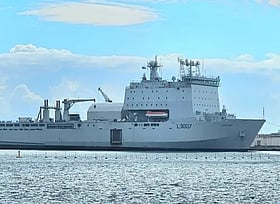
Royal Fleet Auxiliary (RFA) Lyme Bay will act as a floating command hub for uncrewed underwater drones and surface boats capable of detecting, identifying, and neutralising sea mines
UK's "Hybrid Navy" strategy blends crewed ships with autonomous platforms for greater flexibility and safety.
The Royal Navy is advancing its underwater defence capabilities with the announcement that RFA Lyme Bay will serve as a crewed “mothership” for cutting-edge minehunting systems to be located near in the Hormuz Strait to help clear the waterway.
The Bay-class support vessel is being fitted in Gibraltar with high-tech equipment that enables it to store, prepare, deploy and recover autonomous underwater drones and surface vessels, according to the Royal Navy.
These systems can detect, identify and neutralise mines, reducing risk to personnel while expanding operational reach.
The #RoyalNavy is stepping up its minehunting capabilities as @RFALymeBay gets ready to take on new cutting-edge uncrewed equipment. The kit will be able to detect, identify and neutralise threats, with Lyme Bay acting as 'mothership'.
— Royal Navy (@RoyalNavy) March 29, 2026
➡️https://t.co/sIZ2IDC7HX pic.twitter.com/fjRfqmZ506
The RFA Lyme Bay is a Bay-class auxiliary landing ship dock operated by the Royal Fleet Auxiliary (RFA).
Originally designed for amphibious troop and vehicle transport, the The RFA Lyme Bay is now adapting for mine countermeasures mothership duties.
Hybrid navy strategy: Mine countermeasures
This move forms part of the Royal Navy’s ambitious Hybrid Navy strategy, which blends crewed ships with autonomous platforms for greater flexibility and safety.
Lyme Bay’s plug-and-play command-and-control system allows rapid adaptation to threats anywhere in the world, turning a support ship into a mobile command hub for mine countermeasures (MCM).
The upgrade follows weeks of a shooting war in the Middle East and aligns with broader efforts to replace traditional crewed minehunters like the Hunt and Sandown classes with uncrewed alternatives.
Dimensions: Length 176.6 m (579.4 ft), beam 26.4 m (86.6 ft), draught 5.8 m (19 ft). Full load displacement: 16,160 tonnes. en.wikipedia.org Propulsion & Performance: Diesel-electric system with two azimuth thrusters and a bow thruster. Maximum speed 18 knots; range 8,000 nautical miles at 15 knots. royalnavy.mod.uk
The development comes amid rising global mine threats, particularly in strategic chokepoints such as the Strait of Hormuz, where uncrewed systems could help reopen shipping lanes without exposing sailors to danger.
First Sea Lord General Sir Gwyn Jenkins described it as a prime example of how crewed and uncrewed assets will work seamlessly to keep UK forces safe and sea lanes open.
Captain Mark Colley, Lyme Bay’s commanding officer, emphasised the ship’s proven adaptability after recent readiness drills.
By investing in these technologies, the Royal Navy is positioning itself at the forefront of maritime innovation.
The initiative not only enhances immediate MCM effectiveness but also supports long-term transformation toward a dispersed, digitally connected fleet.
RFA Lyme Bay is currently undergoing upgrades in Gibraltar to host “plug-and-play” command-and-control systems for uncrewed surface vessels (USVs) and underwater vehicles (UUVs).
This highlights how the Royal Navy is leveraging existing hulls with new technology for safer, more flexible operations in contested waters.
As tensions persist in key maritime regions, RFA Lyme Bay’s new role underscores Britain’s commitment to maintaining freedom of navigation through 21st-century naval power.
Fact File: RFA Lyme Bay
Capacity: Well dock for landing craft; large flight deck for helicopter operations
Cehicle deck for up to 24 Challenger 2 tanks or 150 light trucks; accommodation for ~60 core crew (up to 75) plus up to 356–500 troops. navylookout.com
Armament (Self-Defence): Typically includes 2 × Phalanx CIWS, 2 × 30 mm DS30B guns, miniguns and GPMGs.
Notable History: Entered service in 2007; has supported amphibious operations, humanitarian aid, and previously acted in mine countermeasures coordination roles in the Gulf.