Rising costs, stagnating wages: Why workers are protesting in India
✨ AI Summary
🔊 جاري الاستماع
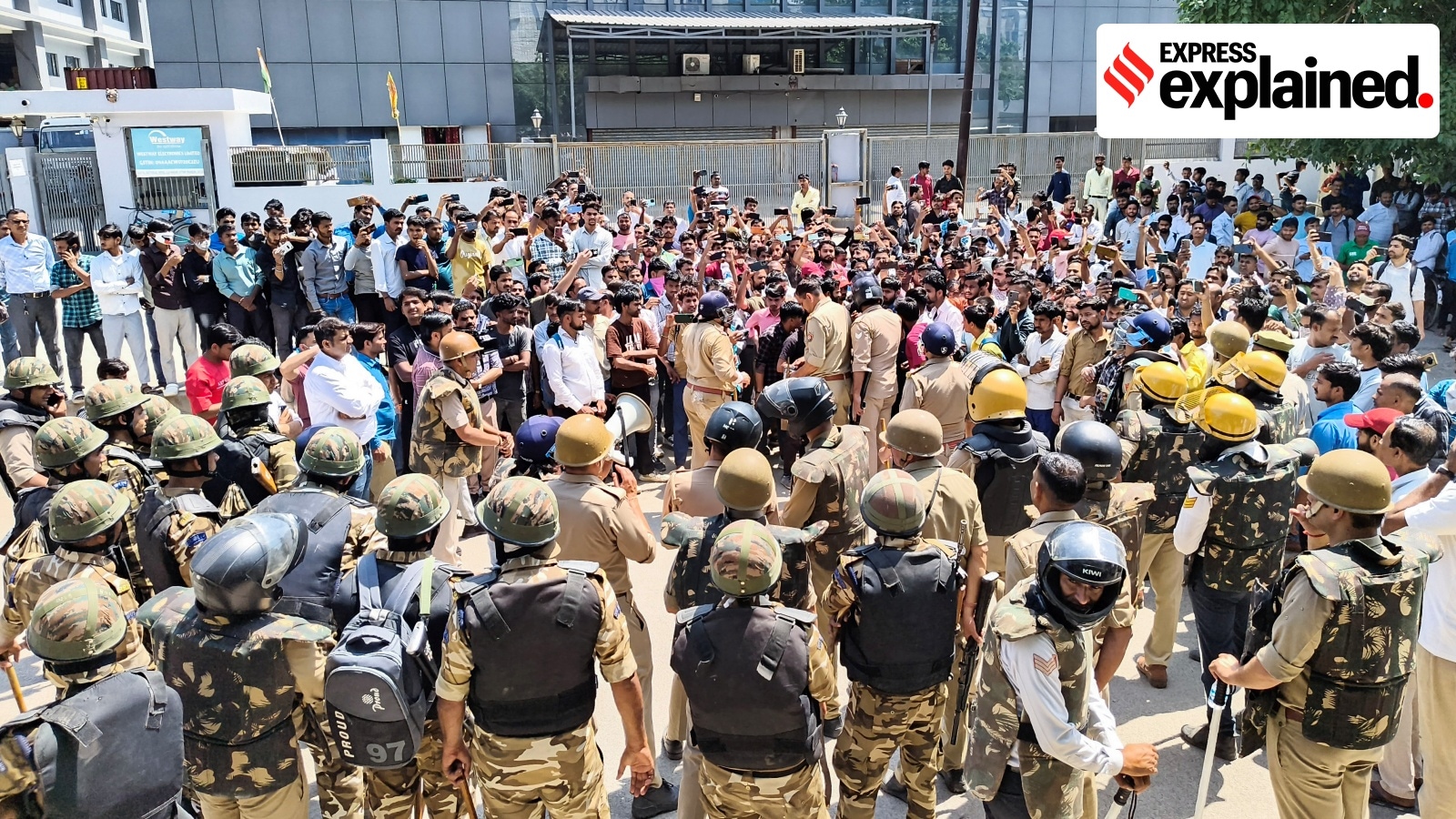
Weather ePaper Today’s Paper Journalism of Courage Home ePaper India Cities UPSC Premium Entertainment Politics Sports World Explained Opinion Business Lifestyle Tech Subscribe Sign In TrendingUPSC OfferIPL 2026US NewsPuzzles & GamesLegal NewsFresh TakeHealthResearch🎙️ Podcast Advertisement function checkAndLoadWindowSizeScript() { if (window.jQuery) { // jQuery is loaded, include your script jQuery(document).ready(function($) { // Your existing script for checking window width if (window.innerWidth) var page_w = window.innerWidth; else if (document.all) var page_w = document.body.clientWidth; if (page_w > 1024) { $(".add-left, .add-right").show(); } else { $(".add-left, .add-right").hide(); } }); } else { // jQuery is not loaded, check again after 0.2 seconds setTimeout(checkAndLoadWindowSizeScript, 200); } } // Initial call to the function checkAndLoadWindowSizeScript(); NewsExplainedRising costs, stagnating wages: Why workers are protesting in India Premium Rising costs, stagnating wages: Why workers are protesting in India Noida and Manesar have seen protests over wages in recent days. At their core are delays in wage hikes and confusion over the new Labour Codes Written by: Aanchal Magazine7 min readNew DelhiUpdated: Apr 15, 2026 07:03 AM IST Factory workers scuffle with security personnel during a protest demanding a hike in wages, in Noida on Monday. (ANI Photo) Make us preferred source on Google Whatsapp twitter Facebook Reddit PRINT The protests by thousands of factory workers in Noida spiralled into violence on Monday, but their agitation seeking a minimum wage hike, better working conditions and overtime payments had begun on April 8 itself. The immediate fuse was the notification of a 35% minimum wage hike in neighbouring Haryana on April 9 following a similar protest in the industrial hub of Manesar. At the core of both protests, and others, is the spike in living expenses amid the West Asia war. This has been compounded by states’ delays in revising the base minimum wage — one of two components that make up overall monthly minimum wage. The revision of the base minimum wage is supposed to take place every five years. But Haryana revised it only after 10 years. Uttar Pradesh, which has now stepped in with an interim hike, had last revised it in 2012. Before the revision, the overall monthly minimum wage of an unskilled worker in Haryana was Rs 11,274.60. It is now Rs 15,220.71, effective April 1. The same for an unskilled worker in Uttar Pradesh was Rs 11,313. It is now Rs 13,690 in Noida (Gautam Buddha Nagar) and Ghaziabad, Rs 13,006 for unskilled workers in municipalities, and Rs 12,356 for other regions, in the interim. This brings us to the second component of the overall monthly minimum wage — cost of living. This variable component is supposed to be revised twice a year, in line with the inflation rate for industrial workers — measured by the Consumer Price Index-Industrial Workers (CPI-IW). While most states carried out these half-yearly revisions, they have missed out on the base minimum wage revisions, especially in the years after Covid-19. According to CPI-IW data, with the latest updated base year of 2016, the all-India inflation rate for industrial workers was 24.8% between February 2021 and February 2026. In Haryana, the inflation rate during this period was 27.9% in Gurugram and 27.2%% in Faridabad. In Uttar Pradesh, this figure was 27.4% in Ghaziabad and Noida. And Delhi saw the inflation rate for industrial workers rise by 27.4% between February 2021 and February 2026. In comparison, the overall minimum wage rate in Haryana increased by just 15% from Rs 9,803.24 in July 2021 to Rs 11,274.60 in July 2025 (before the April 2026 revision). Similarly, for Uttar Pradesh, the minimum wage for unskilled workers increased by 24.6% from Rs 9,078 in April 2021 to Rs 11,313 in April 2026 (before the interim revision announced on Tuesday). For Delhi, the minimum wage rate increased by 20.6% from Rs 15,310 in April 2020 to Rs 18,456 in April 2025. The minimum wage revisions have, therefore, clearly not kept pace with the inflation rate for industrial workers in Delhi-NCR. The impact has worsened in recent times as several industrial units have been reeling under input cost pressures, first owing to the US tariffs and now with the Strait of Hormuz closure. This has resulted in delayed payments to workers and uncertainties regarding their jobs in many cases. The pinch of the West Asia war is being felt by these factory workers, many of whom are migrants. They often have to rely on the black market for LPG cylinders where the price can be as high as Rs 4,000. This, along with a rise in room rents and cooked food prices from outside, has added to their burden. A common thread in the concerns raised by the workers during the protests in Noida and Manesar was that there was a certain expectation of the wages going up after the notification of the four Labour Codes in November 2025, which did not happen. In a statement Tuesday, the Uttar Pradesh government clarified that claims about a uniform minimum wage of Rs 20,000 per month are incorrect. Several social media posts and workers have picked up information from a September 26, 2024 Union government release which stated that the minimum wage rates in ‘area A’ for workers in construction, sweeping, cleaning, loading & unloading for unskilled work will be Rs 783 a day, or Rs 20,358 per month. This rate, however, was only for central sphere establishments. There is also a lack of clarity among factory workers regarding their working hours and rest intervals as the final rules by most states, modelled on the four Labour Codes notified in November 2025, are yet to be notified by the Centre or most states even as draft rules have been put out for public comment. Effective November 21, 2025, the four labour codes — Code on Wages, Code on Social Security, Industrial Relations Code, and Occupational Safety, Health and Working Conditions (OSH) Code — seek to ease regulations and compliance norms for employers, and ensure uniformity in wage structure and social security protection for workers. However, the draft rules were issued by the Centre in December 2025 and final rules are yet to be notified. Unlike the earlier Factories Act, 1948, which specifically provided for the daily and weekly working hours, and ‘spread-over’ hours — the total working hours of an employee inclusive of rest breaks — the new Labour Codes define a workday of eight hours and a weekly working limit of 48 hours, which is in line with International Labour Organization norms. In its draft rules issued in December, the Union government had stated that it would separately notify the period of work in each day, with intervals and spread overs, from time to time. This was intended to provide flexibility to employers who, for instance, may want to give a three-day weekly holiday to their employees with a 12-hour shift for four working days. But this has resulted in confusion among employers as well as employees, often resulting in more work in the name of flexibility, experts said. “The recent labour law reforms have shifted the power to create regulations from Parliament to the executive, enabling state governments to respond to the market needs. Unlike the earlier labour laws that specified the working hour limit, the new codes have kept it flexible and made it a part of rules. But this is being abused by employers in the name of flexibility, with some sectors such as IT even seeing employees work all-year round. The government has not notified the rules for labour codes, which are very important for the implementation part of any law. In the process, there has been an unexpected damage to lawmaking,” said K R Shyam Sundar, labour economist and former professor at XLRI. The new labour codes also leave the recognition of trade unions to states as well as the provision for collective bargaining, due to which no credible process is being followed for the labour law reforms, he added. “If X states notify the new minimum wage rates and working hours and Y states do not, the process will create regional disparities. Centre should have specified the details in the Codes itself,” Shyam said. The Factories Act capped the spread-over hours at 10.5 hours a day, extendable to 12 hours with written permission from Chief Inspector, and the daily working hours at nine hours a day. During the pandemic, many states including Rajasthan, Punjab, Himachal Pradesh and Uttar Pradesh increased the working time to 10-12 hours. As per the draft rules of the new Labour Codes, “no worker shall be required or allowed to work in an establishment for more than 48 hours in any week. The period of work in each day… with intervals and spread overs, shall be as notified by the Central Government.” While these rules would apply to central sphere establishments, it is a final notification by states that would apply to establishments such as factories. Aanchal Magazine is a Deputy Associate Editor with The Indian Express, serving as a leading voice on the macroeconomy and fiscal policy. With 15 years of newsroom experience, she is recognized for her ability to decode complex economic data and government policy for a wider audience. Expertise & Focus Areas: Magazine’s reporting is rooted in "fiscal arithmetic" and economic science. Her work provides critical insights into the financial health of the nation, focusing on: Macroeconomic Policy: Detailed tracking of GDP growth, inflation trends, and central bank policy actions. Fiscal Metrics: Analysis of taxation, revenue collection, and government spending. Labour & Society: Reporting on labour trends and the intersection of economic policy with employment. Her expertise lies in interpreting high-frequency economic indicators to explain the broader trajectory of the Indian economy. Personal Interests: Beyond the world of finance and statistics, Aanchal maintains a deep personal interest in the history of her homeland, Kashmir. In her spare time, she reads extensively about the region's culture and traditions and works to map the complex journeys of displacement associated with it. Find all stories by Aanchal Magazine here ... Read More