Rio fights childhood obesity: No junk food in govt schools, only 2 cooked meals from school farms
•Weather ePaper Today’s Paper Journalism of Courage Home ePaper India Cities UPSC Premium Entertainment Politics Sports World Explained Opinion Business Lifestyle Tech Subscribe Sign In TrendingUPSC Of...
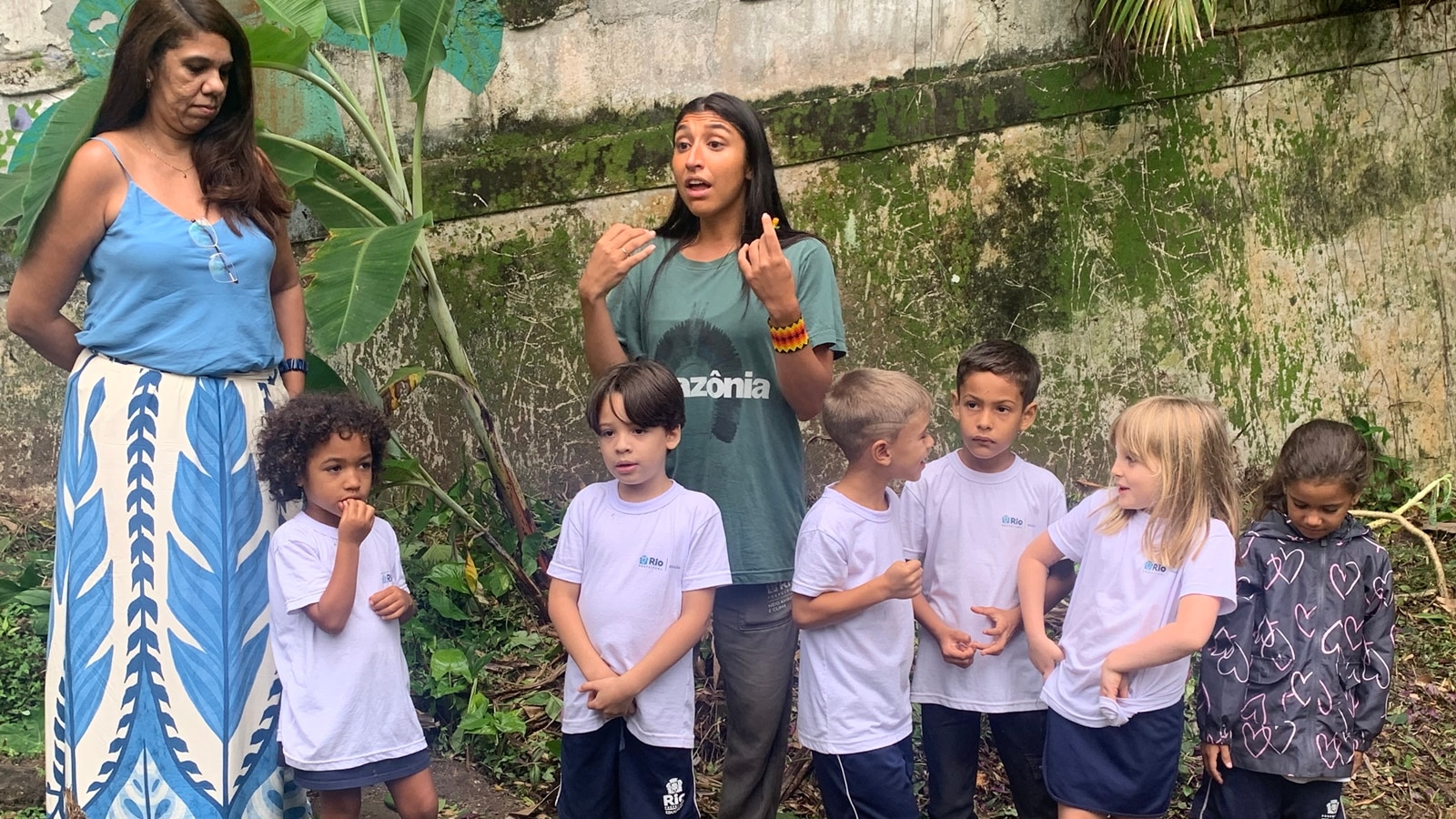
•Written by: Rinku Ghosh7 min readUpdated: Apr 15, 2026 07:40 AM IST Students with a food educator at the farm of a government-run school in Rio de Janeiro, Brazil.
•(Express photo by Rinku Ghosh) Make us preferred source on Google Whatsapp twitter Facebook Reddit PRINT “Banana leaves are like the skin of the soil, they protect it.
هذا الخبر من Indian Express. خبر يقدم أدوات ذكاء اصطناعي للتلخيص والترجمة والاستماع.
Weather ePaper Today’s Paper Journalism of Courage Home ePaper India Cities UPSC Premium Entertainment Politics Sports World Explained Opinion Business Lifestyle Tech Subscribe Sign In TrendingUPSC OfferIPL 2026US NewsPuzzles & GamesLegal NewsFresh TakeHealthResearch🎙️ Podcast Advertisement function checkAndLoadWindowSizeScript() { if (window.jQuery) { // jQuery is loaded, include your script jQuery(document).ready(function($) { // Your existing script for checking window width if (window.innerWidth) var page_w = window.innerWidth; else if (document.all) var page_w = document.body.clientWidth; if (page_w > 1024) { $(".add-left, .add-right").show(); } else { $(".add-left, .add-right").hide(); } }); } else { // jQuery is not loaded, check again after 0.2 seconds setTimeout(checkAndLoadWindowSizeScript, 200); } } // Initial call to the function checkAndLoadWindowSizeScript(); NewsHealth and WellnessRio fights childhood obesity: No junk food in govt schools, only 2 cooked meals from school farms Premium Rio fights childhood obesity: No junk food in govt schools, only 2 cooked meals from school farms The municipal govt of Rio de Janeiro, Brazil, begins a food revolution for child nutrition with fresh meals and a radical food ban that are turning hunger, obesity and neglect into health, strength and hope. Written by: Rinku Ghosh7 min readUpdated: Apr 15, 2026 07:40 AM IST Students with a food educator at the farm of a government-run school in Rio de Janeiro, Brazil. (Express photo by Rinku Ghosh) Make us preferred source on Google Whatsapp twitter Facebook Reddit PRINT “Banana leaves are like the skin of the soil, they protect it. There’s less water in the land, so let’s bury the banana stems in the earth because they hold so much water. The soil can drink it up. Meanwhile you can have the fruit while the beetroot can grow big,” says Laura, a food educator at the government-run EDI Gabriela Mistral Primary School in the south zone of Rio de Janeiro, Brazil. The indigenous teacher is taking her outdoor class among rows of flower and fruit beds in the school’s farm, helping her five-year-old students learn to not just eat their school meals fresh off the land but grow vegetables so that they can run like superheroes. “Hey, look, there’s the pumpkin we grew. But today it is beetroot bread and chickpea spread for lunch,” says a talkative five-year-old, his hands soiled from planting seeds. He leads the way to the school kitchen, which provides free, low-sugar, nutrient-rich meals, and links food consumption to creating an emotional relationship with nature’s produce. “We prevent exposure to intense flavours of processed foods by helping them take pride in eating what they have grown themselves. In fact, we grow edible flowers, so they get educated on what can be seasoning, flavouring and food. All of these are medicinal too,” says Laura as another of her students chews on a cosmos flower, calling it a “chewing gum of the forest” and leaving the pollens beneath a tree “for the bees.” The children from this government school in an abandoned bathhouse have not only improved their health indices, courtesy the Rio school meal programme that takes care of both their breakfast and lunch, they could be future soccer stars like Ronaldo or Olympic athlete Giovanna Pedroso. In a bid to curb malnutrition in the low-income slum clusters or favelas and prevent childhood obesity and diabetes, the municipal government of Rio de Janeiro passed a law in 2023 to ban the sale and distribution of ultra-processed foods (UPFs) in public schools, while disallowing access to foods with high sugar, salt and fat such as cookies, candy and soft drinks. It does not allow fast food vendors outside schools to keep children away from high-calorie, low-nutrient snacks that can build addictive food behaviour in their foundational years. Instead, all government schools now have a kitchen garden for growing ingredients for school meals. “We are teaching children that planting fruits and vegetables is more about our culture than just consumption, eating is just part of the cycle,” says principal Renata Neves. Brazil’s National School Feeding Programme already provides at least 30 per cent of daily nutritional needs of students, ensuring regular access to beans, vegetables and fruit, which has reduced iron deficiency and improved diet quality over the years. Now, according to Daniel Soranz, Municipal Health Secretary, Rio De Janeiro, public schools are also using 30-40 per cent of funds to source supplies from small local producers, who feel incentivized and invested in growing fresh ingredients, easing nutritional access to children. Not only that. There’s drastic monitoring of the children’s health. “We use AI and community health agents to map families in vulnerable situations, proactively connecting them with public services and looking into nutritional needs of children. Unless health systems are universalised, preventive healthcare cannot take off. Enforcement also means penalties. Parents can report violations via calls and an app. Public schools who refuse to comply are name-called by the health department in the media,” says Soranz. Nevez shows the breakfast and lunch menus, the ingredient charts of which are drawn by the children themselves. Breakfast and lunch menus have shifted away from packaged snacks and sugary options toward freshly prepared, traditional foods. “Two meals take care of the bulk of what a child needs. The menus are science-backed, rotated every 15 days and have been developed by the Annes Dias Institute of Nutrition. The cooks are trained by its nutrition scientists. The institute does two health checks a year to ensure children keep to health parameters. More than 91 per cent of school meals now are totally unprocessed and there are 65 diversified healthy meal menus in schools,” says Alina Borges, president of the Municipal Institute of Sanitary Surveillance, who oversees the school meal programme. Such has been the impact that private schools in Rio are also restructuring their school meals. And parents like Pablo and Vivian Henrique are changing their own habits because of their daughter. “No Coca Cola, it’s home-pulped star berry and watermelon juice. She loves avocado salad with lettuce as a snack,” they say. The results are showing. Paula Johns, co-founder and director of ACT Health Promotion, who has been tracking the sharp rise in childhood obesity and diabetes between 2000 and 2025 and the health impact of cheaper processed foods, says food and nutritional security of children has improved. “Overall, 25 per cent of calories in Brazil comes from ultra-processed foods, but in children between 13 and 17, that number was around 39 per cent before the school meal programme. Now it is spiralling down. Their BMI (body mass index) is improving. And it is taking care of the skinny fat syndrome, when children with stunted growth due to malnutrition go through rapid ‘catch-up’ weight gain when food becomes available. This leads to fat accumulation rather than muscle mass, a problem in favela kids,” she says. Street children in favelas, who often look to sports as the big ticket to financial stability and fame, are also being aided by the expansion of family health clinics, which are pleasant, cheerful, safe spaces for the community. Dr Fabio, who calls them examples of the McDonaldisation of healthcare, says that these centres have reduced infant mortality and hospitalisation rates, consistently monitor child development, provide services like prenatal care, vaccinations and nutrition education to mothers. And while open spaces are in short supply in the favelas hugging the mountains, Johns says that resilience is born as they play futsal, a soccer variant, in square enclosures. “This is where competitive athletes are born,” she says of youngsters, who develop high-intensity techniques to handle the ball. Open air beach gyms and beach football grounds are other spaces for physical activity. As the favela kid is poised to be the next sports icon, the Rio experiment shows how a government food policy is crucial for building a child’s foundational health. Robust and future-ready. Rinku Ghosh is the Health Section Lead at The Indian Express, where she oversees the publication’s comprehensive health, wellness, and medical science vertical. With years of experience in high-impact journalism, Rinku specializes in translating complex medical research into actionable insights for the public. Her reporting spans a wide spectrum—from deep-dives into childhood obesity and the effects of urban pollution to the frontiers of medical technology, such as the use of AI and nanobots in cancer treatment. Authoritativeness: As a veteran editor at one of India’s most trusted news organizations, Rinku has interviewed world-renowned experts, including cardiologists from the Mayo Clinic, oncologists from AIIMS, and researchers from the Indian Institute of Science (IISc). Her column often serves as a primary source for "Explained" features, where she breaks down global health trends, vaccine safety, and public health policy. Her work is recognized for bridging the gap between clinical data and the lived experiences of patients. Trustworthiness: Rinku’s editorial approach is rooted in the "Journalism of Courage" philosophy, prioritizing evidence-based science over healthcare myths. In an era of medical misinformation, she ensures that every piece of advice—whether regarding chronic disease management or nutritional supplements—is backed by peer-reviewed studies and verified by leading medical practitioners. ... Read Moreالمصدر: Indian Express | Source: Indian Express
ملاحظة تحريرية | Editorial Note: نُشر هذا المقال في الأصل بواسطة Indian Express. خبر (Khabr) هي منصة إعلامية أردنية مرخّصة تعمل بالذكاء الاصطناعي. نضيف قيمة تحريرية من خلال: تحليل ذكي للأخبار، ملخصات تلقائية، رواية صوتية بالذكاء الاصطناعي، ترجمة متعددة اللغات، وتدقيق الحقائق. هدفنا جعل الأخبار أكثر وضوحاً وسهولةً للقارئ العربي.
This article was originally published by Indian Express. Khabr is a licensed Jordanian AI-powered news platform (Registration #82086). We add editorial value through: AI-powered news analysis, automated summaries, AI audio narration, multi-language translation (Arabic, English, French, Turkish), and AI fact-checking. Our mission is to make news more accessible and understandable for Arabic-speaking audiences worldwide.