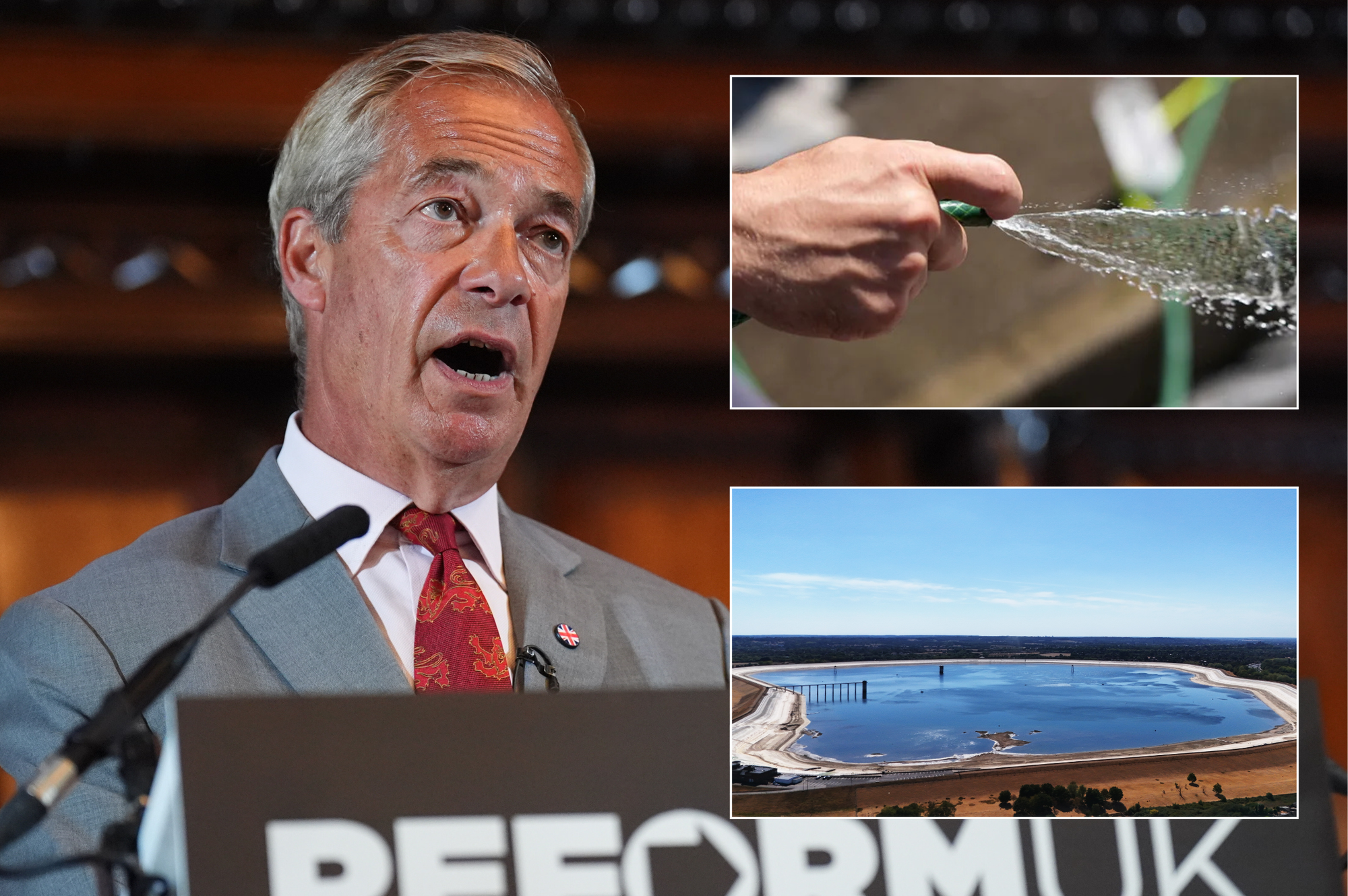
Reform UK has vowed to end hosepipe bans for good and outlined plans to revolutionise Britain's reservoirs.
Nigel Farage's party has pledged to scrap the government's water reduction targets, introduced by the Conservatives and continued by Labour.
Prolonged hot weather and record-low rainfall have forced nine water companies to issue Temporary Use Bans as drought conditions now cover over 71 per cent of England.
More than 26 million people in Britain are currently living under a hosepipe ban as the UK experiences its fifth widespread heatwave of the year.
Under these legal restrictions, households cannot use a hosepipe to water gardens, wash vehicles, clean windows, or fill paddling pools.
Violating the ban carries a potential fine of up to £1,000.
Prolonged hot weather and record-low rainfall have forced nine water companies to issue Temporary Use Bans.
Drought conditions now cover over 71 per cent of England.

The regions and companies enforcing hosepipe bans include:
LATEST DEVELOPMENTS
- Water bills set to rise for MILLIONS despite hosepipe bans amid mass drought
- Britons face ban from swimming pools and car washes for first time in 20 years under rare 'drought order'
- Britons using 12 legal loopholes to dodge hosepipe bans as millions told to cut back usage immediately

England has received just 4mm of rain so far in August, or six per cent of the long-term average for the month, the Environment Agency said on Friday.
It follows the driest July on record for the country, when only 7mm of rain was measured, or 10 per cent of the average.
The ongoing dry weather means that reservoir storage for England now stands at 66 per cent, down from 69 per cent a week ago and nearly 14 percentage points below the long-term average for the time of year, the Environment Agency said.
Storage stood at 85 per cent at the end of June, but has fallen steadily in recent weeks.

Five reservoirs are currently classed as having "exceptionally low" levels: Clatworthy in Somerset (48 per cent full); Clywedog in Powys, which provides water for central and north-west England (56 per cent); the Dove group of reservoirs in Derbyshire (69 per cent); Hanningfield in Essex (56 per cent); and Wimbleball in Somerset (46 per cent).
Reform has also pledged to cut the red tape that is holding back the construction of new reservoirs and to build infrastructure to avoid water shortages.
The last large reservoir in England was built in 1992.
The Environment Agency warned last year of a potential 5 billion litres-per-day shortfall in public water supplies by 2055 without urgent action.

On Wednesday, Andy Burnham chaired an emergency Cobra committee meeting to coordinate the government's response to extreme heat.
The Prime Minister then announced a ban on purchasing disposable barbeques, called in the military in a desperate bid to control the situation, and said firefighting planes will be used to combat the spread.
Describing the country as a "tinderbox", Mr Burnham told reporters in Stourbridge: “Britain is a tinderbox right now, and please just have that in your mind.
“We’re going to go into the rest of the weekend… This is not over by any means. We’ve got 37 fires smouldering around the country, so it could be more. So please bear that in mind at all times.”
Our Standards: The GB News Editorial Charter