Rare identical quadruplets born in Australia
•An Australian woman gave birth to rare identical quadruplets, which are monozygotic and occur in one in 15 million pregnancies.
•The quadruplets were delivered via caesarean section at 28 weeks and four days after a high-risk pregnancy.
•The mother expressed gratitude for a successful outcome, while the newborns were named Emily, Harriet, Catherine, and Alexa.
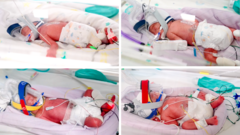
Rare identical quadruplets born in AustraliaImage source, Metro North HealthByAmy WalkerPublishedJust nowAn Australian woman has given birth to very rare, naturally-conceived identical quadruplets after a pregnancy described as "extremely high risk" by the Royal Brisbane and Women's Hospital.The four girls, who were delivered via caesarean section at 28 weeks and four days on 14 July, were monozygotic quadruplets - where a single fertilised egg splits into four embryos.The hospital said the girls' mother, 34-year-old Jenitar Na'amoana, and her husband Jortham, already had four children and were taken by "immense surprise" when told to expect quadruplets.Dr Alexa Bendall, who cared for the mother from the start of her pregnancy, estimated identical quadruplets occur "at one in every 15 million pregnancies" and said "but to share the same placenta - this is unheard of".Dr Bendall, who is a maternal foetal medicine specialist and obstetrician, said such a pregnancy was very high-risk, with the hospital admitting Na'amoana as an inpatient at 25 weeks so she could be monitored."We always said that if we could get her to 28 weeks, we would be doing well," Dr Bendall said."So the fact that we've got four beautiful, healthy babies born at 28 weeks and four days is incredible and we're very happy to be a part of it," she added.Image source, Jenitar Na’amoana/GofundmeImage caption, Jenitar Na'amoana said her and her husband's hearts were "overflowing with gratitude" after the births"Jenitar has taken everything in her stride from day one... she has somehow dodged every complication and risk for both herself and her babies," Dr Bendall said.The newborn girls have been named Emily, Harriet, Catherine, and also Alexa, after Dr Alexa Bendall, who described it as "a beautiful tribute".Image source, Metro North HealthImage caption, One of the girls has b...المصدر: BBC Health | Source: BBC Health
→An Australian woman gave birth to rare identical quadruplets, which are monozygotic and occur in one in 15 million pregnancies.
→The quadruplets were delivered via caesarean section at 28 weeks and four days after a high-risk pregnancy.
ملاحظة تحريرية | Editorial Note: نُشر هذا المقال في الأصل بواسطة BBC Health. خبر (Khabr) هي منصة إعلامية أردنية مرخّصة تعمل بالذكاء الاصطناعي. نضيف قيمة تحريرية من خلال: تحليل ذكي للأخبار، ملخصات تلقائية، رواية صوتية بالذكاء الاصطناعي، ترجمة متعددة اللغات، وتدقيق الحقائق. هدفنا جعل الأخبار أكثر وضوحاً وسهولةً للقارئ العربي.
This article was originally published by BBC Health. Khabr is a licensed Jordanian AI-powered news platform (Registration #82086). We add editorial value through: AI-powered news analysis, automated summaries, AI audio narration, multi-language translation (Arabic, English, French, Turkish), and AI fact-checking. Our mission is to make news more accessible and understandable for Arabic-speaking audiences worldwide.