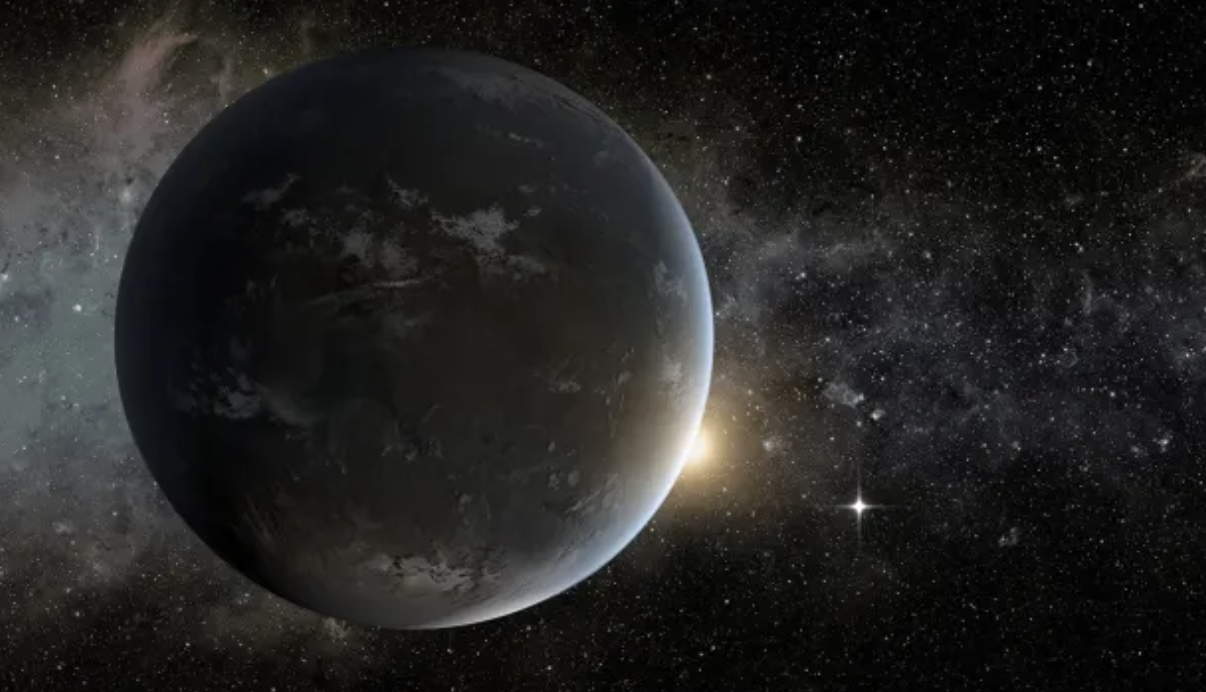
Planet dubbed 'Earth's next-door neighbour' might be able to support life, scientists reveal
•Scientists have revealed a planet dubbed "Earth's next-door neighbour" may be able to support life.Astronomers at the University of California, Irvine, have identified a potentially habitable world or...
•It's one of our closest cosmic neighbours.
•25 light-years sounds like a long way, but the Milky Way is about 100,000 light-years across, so in that respect it's our next-door neighbour." TRENDING Stories Videos Your Say The findings were...
هذا الخبر من GB News. خبر يقدم أدوات ذكاء اصطناعي للتلخيص والترجمة والاستماع.
المصدر: GB News | Source: GB NewsScientists have revealed a planet dubbed "Earth's next-door neighbour" may be able to support life.
Astronomers at the University of California, Irvine, have identified a potentially habitable world orbiting a star just 25 light-years from Earth.
The exoplanet, designated GJ 3378b, occupies what scientists call the "Goldilocks zone", which is a region neither too hot nor too cold where liquid water might exist on the surface.
Paul Robertson, UC Irvine associate professor of astronomy and lead author of the study, said: "This one's exciting. It's one of our closest cosmic neighbours. 25 light-years sounds like a long way, but the Milky Way is about 100,000 light-years across, so in that respect it's our next-door neighbour."
TRENDINGStoriesVideosYour SayThe findings were published in The Astrophysical Journal.
The rocky world is more than twice the size of our planet, classifying it as a super-Earth.
GJ 3378b orbits a red dwarf star considerably dimmer and cooler than our Sun, completing a full year in merely 21.5 days.
Mr Robertson added: "This super-Earth gets about 90% of the radiation from its host star as Earth gets from its sun, so it's right in the sweet spot."
The planet's position is critical: were it located even slightly further from what researchers term the cosmic shoreline, stellar radiation would strip away any atmosphere.
Mars serves as a cautionary example, with scientists believing the red planet once possessed a hospitable atmosphere before solar radiation removed it entirely.
The thickness of a planet's atmosphere proves essential for supporting life as we understand it.
Mr Robertson said: "If you scale the Earth down to the size of an apple, its atmosphere would be about as thick as the skin of the apple. That's just enough to maintain the kinds of surface pressures where you can have liquid water. It's enough that there'll be breathable air and it provides maybe a little bit of protection from the harsh radiation environment of space."
LATEST DEVELOPMENTS
Source of mysterious space balls found washed up on beach revealed after probe by space agency- Nasa launches major rescue mission as telescope plunges towards Earth
- Scientists create world's first synthetic cell as life 'built, not born' in lab
However, Mr Robertson emphasised researchers cannot yet confirm whether GJ 3378b possesses an atmosphere at all, although it remains a promising candidate for harbouring extraterrestrial life.
The discovery was made using the Habitable-zone Planet Finder on the Hobby-Eberly Telescope in Texas alongside Arizona's NEID Spectrometer on the WIYN Telescope.
Earth remains the sole planet in the universe where life has been confirmed, despite astronomers having discovered more than 6,000 exoplanets to date.
Detecting whether distant worlds possess life-supporting atmospheres relies on observing starlight as planets transit their host stars, with atmospheric gases altering the colour of light reaching Earth.
Lisa Kaltenegger, director of the Carl Sagan Institute at Cornell University, said: "Signs of life are written in a planet's light if you know how to read it."
Scientists search for biosignatures, indicators such as oxygen or other gases produced exclusively by living organisms.
Ms Kaltenegger noted extraterrestrial life might differ vastly from terrestrial forms, suggesting researchers should consider alternative solvents beyond water for sustaining organisms.
Our Standards: The GB News Editorial Charter


ملاحظة تحريرية | Editorial Note: نُشر هذا المقال في الأصل بواسطة GB News. خبر (Khabr) هي منصة إعلامية أردنية مرخّصة تعمل بالذكاء الاصطناعي. نضيف قيمة تحريرية من خلال: تحليل ذكي للأخبار، ملخصات تلقائية، رواية صوتية بالذكاء الاصطناعي، ترجمة متعددة اللغات، وتدقيق الحقائق. هدفنا جعل الأخبار أكثر وضوحاً وسهولةً للقارئ العربي.
This article was originally published by GB News. Khabr is a licensed Jordanian AI-powered news platform (Registration #82086). We add editorial value through: AI-powered news analysis, automated summaries, AI audio narration, multi-language translation (Arabic, English, French, Turkish), and AI fact-checking. Our mission is to make news more accessible and understandable for Arabic-speaking audiences worldwide.