Manila: A "hypothetical" 2028 presidential race is already reshaping the political conversation two years ahead of the campaign season.
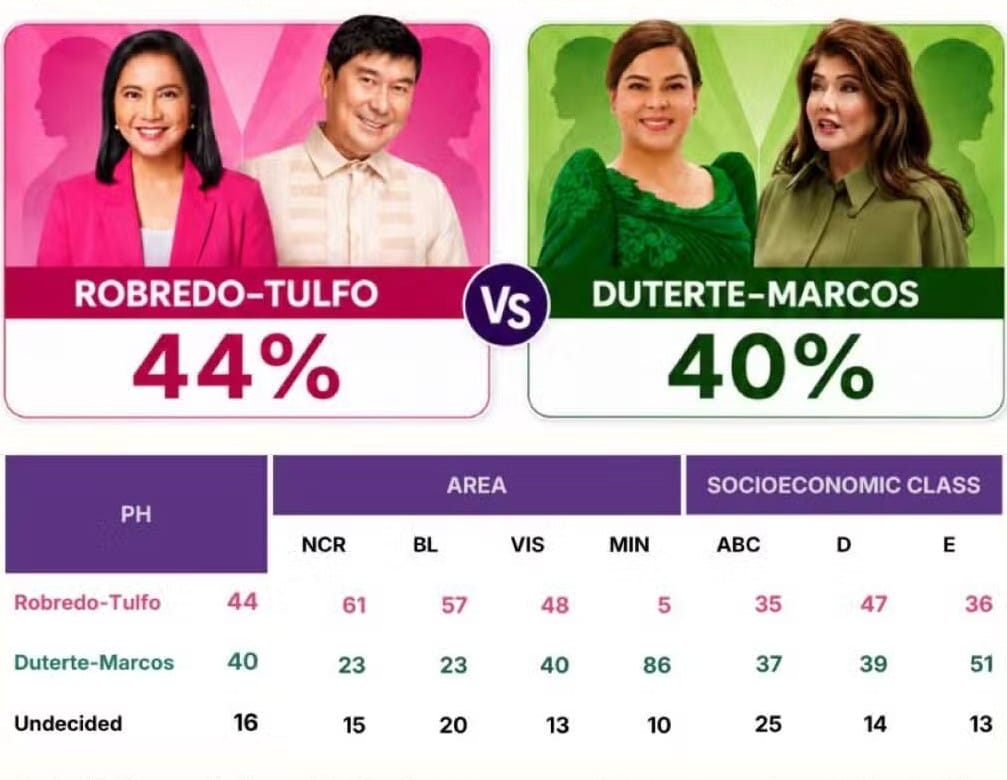
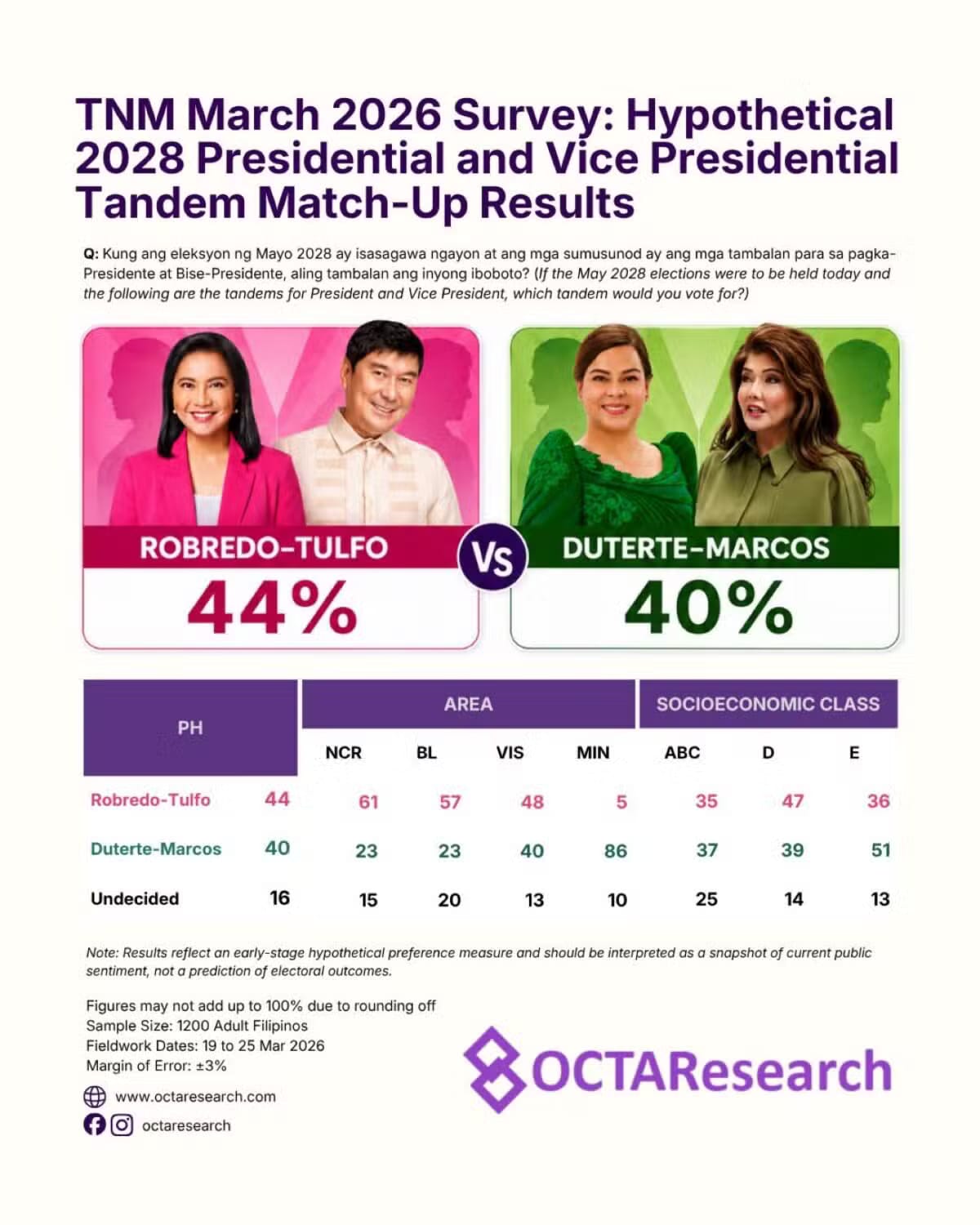
An OCTA Research "Tugon ng Masa" ("People's Response") survey conducted March 19–25 shows a potential tandem of Leni Robredo and Raffy Tulfo drawing 44% voter preference — edging out the 40% received by a pairing of Sara Duterte and Imee Marcos.
Another 16% of respondents said they were undecided.
Survey method
The survey asked: “If the May 2028 elections were to be held today and the following are the tandems for president and vice president, which tandem would you vote for?”
It used face-to-face interviews with 1,200 probability-based respondents aged 18 and above and carries a ±3% margin of error at a 95% confidence level.
OCTA cautioned that the 4-point lead should be interpreted carefully given the margin of error.
Still, the firm noted that this is the first time in its tracking that a Robredo-led pairing has numerically surpassed a Sara Duterte-Imee Marcos alignment in a direct preference test.
Earlier "Tugon ng Masa" soundings over the past year had shown the Duterte-Marcos combination ahead by 15 to 25 percentage points.
Regional fault lines: Emerging battlegrounds
The survey results suggest an evolving electoral map:
Robredo–Tulfo dominated the National Capital Region with 61% support and Balance Luzon with 57%.
Duterte–Marcos retained commanding strength in Mindanao with 86% support.
OCTA flagged the Visayas and Balance Luzon as emerging battlegrounds that could ultimately determine the balance of the race.
This suggests a possible weakening of strict regional or tribal loyalty in vote preference — especially in urban and mixed regions — in favour of:
Candidate image and perceived competence
Media familiarity (Tulfo’s nationwide exposure)
Reformist or governance branding (Robredo’s profile)
Cross-regional appeal rather than hometown identity
It suggests that a growing part of the electorate may be moving from “Where is the candidate from?” to “What does the candidate represent?”
Class divide in preferences
Socioeconomic splits were also pronounced:
Robredo–Tulfo performed strongest among Class D respondents at 47%.
Duterte–Marcos led among Class E respondents with 51%.
Despite the numbers, both figures in the leading tandem have publicly downplayed national ambitions.
Former Vice President Robredo, now mayor of Naga City, said in April she intends to seek a second term as mayor in 2028 rather than return to national politics.
Tulfo has similarly said he does not plan to run in 2028.
By contrast, Duterte has been vocal about her intention to seek the presidency, while Marcos has yet to make any formal declaration.
For OCTA, the takeaway is less about declared candidacies and more about a shifting mood: a once-lopsided hypothetical matchup has tightened into a competitive contest — and a sizable bloc of voters remains open to persuasion.
Tribal patterns haven’t disappeared
Still, tribal voter preferences are strong, and remain powerful in:
Mindanao voting behaviour
Ilocos and northern provincial machinery
Areas dominated by entrenched political clans
Lower-income, rural voting bases where local endorsements matter most
This is why surveys often show sharp regional splits even when national numbers look competitive.
Potential 2028 scenario
The key takeaway is not who leads a hypothetical race, but how:
For the first time in years, a test-pairing appears competitive without relying primarily on a single tribal fortress.
That hints at an electorate — especially in NCR, Luzon’s mixed provinces, and parts of the Visayas — that may be less bound by geographic loyalty and more open to cross-regional figures.
Whether that holds in a real campaign is another matter.
Philippine elections still reward candidates who can combine broad national appeal with at least one deeply loyal regional base.
But the survey suggests that the old map of “North vs South vs Bicol vs NCR” may be loosening at the edges — a subtle but important shift in how Filipinos think about national leadership.