
In 2006, Carl Koch sued his employer for damages after burn injuries during a workplace accident that left him with chronic pain. The employer accused him of malingering, so the judge admitted a neuroscientist as an expert witness, who testified that he could see Koch’s pain on a brain scan. The case was settled for more than ten times the amount the employer initially offered.
This case is not unusual, as chronic pain can be severely debilitating. It can make it impossible to work, exercise and have a social life. It can make you depressed and anxious.
Having pain recognised by insurers, employers and government agencies can mean the difference between receiving benefits and being left without support. So it’s understandable that a judge wants to see objective evidence, such as a brain scan, showing chronic pain.
The problem is that it doesn’t work. However, as Koch’s case shows, it is used anyway. Good for Mr Koch, in this case, but what if the neuroscientist had told the judge that he is faking his pain?
Who is believed?
Chronic pain is invisible, and everyone living with it has stories to tell about the time someone did not believe them: employers, friends, family, partners and doctors. Is it really that bad? Are you sure it’s not just in your head? Have you tried to toughen up a bit?
Who we believe and who faces more scepticism is not random either: women, people of colour, poor people and the less educated are far less likely to be believed that their pain is real. The cruelty is doubled as these are the groups most likely to experience chronic pain in the first place.
With modern brain scanners and AI, it seems tempting to develop what is effectively a pain-lie detector test. The pictures brain scanners show have been too complex to fully understand before, but AI can often solve such problems of complexity. Two studies published in Nature Neuroscience and Nature Medicine seemed to promise to be a first step towards a pain lie detector.
In the US, AI tools are already used to decide who should be prescribed opioids for their pain and who is probably an addict pretending to be in pain. An article in the technology magazine Wired uncovered how flawed the system was, and that it had a tendency to distrust all the groups mentioned above. This is a problem with AI: even when it seems to work, it does not tell you how. This makes it dangerous to put too much confidence in it.
There can be no such thing as a pain lie detector for the same reasons that regular lie detectors do not work. They do not measure if you lie; they measure if you are nervous – but you might be nervous telling the truth in a high-stakes situation.
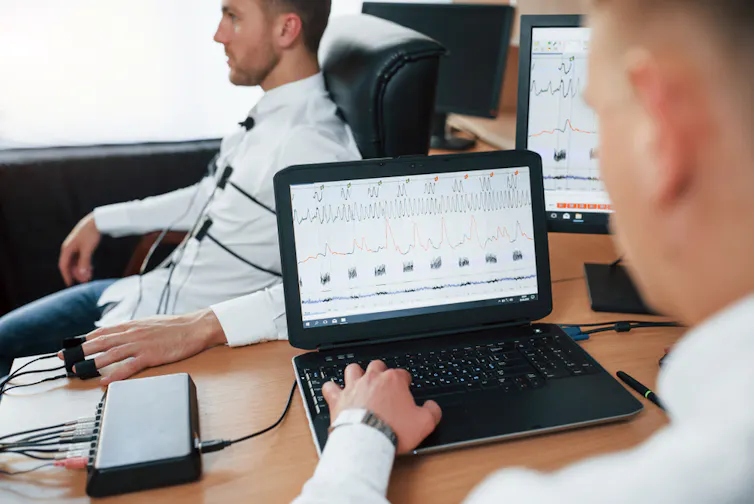
It is similar for measuring pain. Pain causes distress, so any brain pattern of pain will also be a pattern of stress – and often anxiety. We cannot factor that into our pain lie detector: when we develop it, it will be with curious participants volunteering for a scientific study (not very stressful).
When we use it, it will be for the patient who has been disbelieved for years and knows if the scan does not “prove” their pain, no one will ever believe them, and they will not get compensation or benefits (as stressful as it gets). It will always be a catch-22, as explained in The Conversation in 2025.
A private experience
Pain is a personal and very private experience. It depends on your history with it, and on the context, meaning everyone’s pain is different, and your pain today can be different from your pain tomorrow. Some pain can even be pleasurable – spicy food being an obvious everyday example. This means that your brain scan of pain may look very different from mine. Until we have measured both, we cannot know.
It is for these reasons that the International Association for the Study of Pain has stated that pain lie detectors are useless. In a new article in Nature Neuroscience, my colleagues and I discuss technical and fundamental problems with the idea and ask the scientific community to abandon the idea.
So what does this mean for you? If someone tells you about their chronic pain, put all scepticism aside. Remember that most forms of chronic pain are invisible. Back pain, for example, is the biggest cause of disability worldwide, according to the World Health Organization, and a physical cause can rarely be found. Keep in mind that machines make mistakes as well, and that they have the same stereotypes as we do. That is especially true for AI.
A pain scan will not tell us who is suffering and who is lying. But it may tell us something else: how easily we mistake technological confidence for truth. In medicine, insurance and law, that mistake could make already invisible pain even harder to prove – and easier to dismiss.

Jan Vollert receives funding from the UK's National Institute for Health Research including the Exeter Biomedical Research Centre, from the Academy of Medical Sciences, and the pharmaceutical company Viatris. He has received consultancy fees and/or travel funding from the following pharmaceutical companies: Grünenthal, AstraZeneca, Merz Therapeutics. He is affiliated with and/or an officer of the International Association for the Study of Pain, the European Pain Federation EFIC, the British Pain Society, and the German Research Network on Neuropathic Pain.