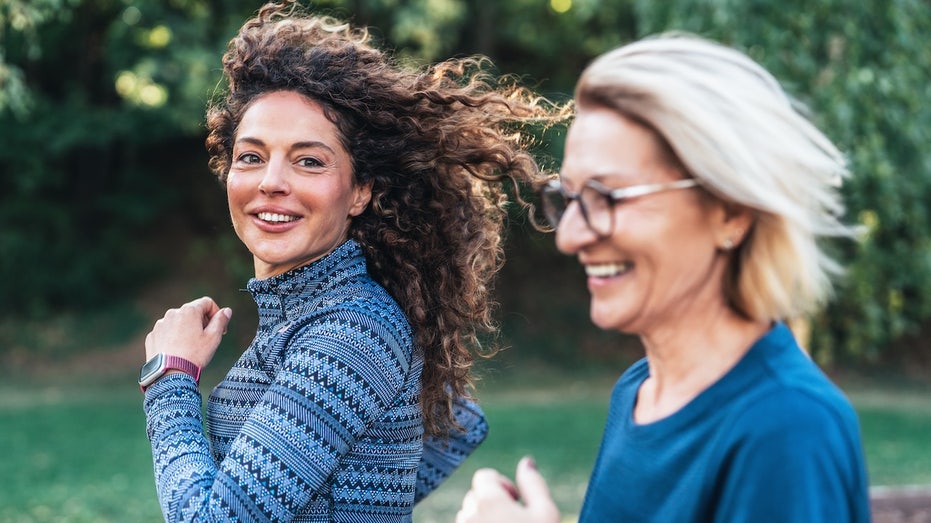
One walking habit could signal a healthier brain after 80, scientists say
•Older adults identified as "super movers" are about half as likely to develop cognitive impairment than their peers.That’s according to a recent study led by Stony Brook Medicine in New York, which ev...
•Joe Verghese, MD, neurologist at Stony Brook Medicine, told Fox News Digital.
•"This suggests that preserving mobility may be an important marker of healthy brain aging and resilience."'LONGEVITY GENE' MAY PROTECT THE BRAIN FROM ALZHEIMER'S BY BOOSTING DNA REPAIR, STUDY FINDSThe...
هذا الخبر من Fox News. خبر يقدم أدوات ذكاء اصطناعي للتلخيص والترجمة والاستماع.
المصدر: Fox News | Source: Fox NewsOlder adults identified as "super movers" are about half as likely to develop cognitive impairment than their peers.
That’s according to a recent study led by Stony Brook Medicine in New York, which evaluated the cognitive function of 4,000 adults 80 and over who participated in multiple aging and longevity studies over several years.
Among this group, 6% to 10% were classified as super movers, which means they walk at a much faster pace than others of the same age and gender — at speeds comparable to people three decades younger.
COMMON VITAMIN MAY INFLUENCE BRAIN AGING IN WAYS SCIENTISTS DIDN'T EXPECT
The super movers were found to have about half the risk of cognitive decline compared to seniors with typical gait speed.
The findings were published in the journal Neurology on June 16.
"The study reinforces that mobility and brain health are closely connected," lead study author Dr. Joe Verghese, MD, neurologist at Stony Brook Medicine, told Fox News Digital. "This suggests that preserving mobility may be an important marker of healthy brain aging and resilience."
'LONGEVITY GENE' MAY PROTECT THE BRAIN FROM ALZHEIMER'S BY BOOSTING DNA REPAIR, STUDY FINDS
The most intriguing finding, according to Verghese, was that super movers maintained cognitive function despite having similar dementia-related brain changes as their peers.
In postmortem brain analysis, there was no difference in dementia-related pathologies between the super movers and the slower walkers, the study stated.
TEST YOURSELF WITH OUR LATEST LIFESTYLE QUIZ
"This suggests they may possess resilience mechanisms that help preserve brain function even in the presence of age-related changes," he said. "Understanding these resilience factors could lead to new strategies for promoting healthy brain aging."
As the study was observational, there were some limitations, and it does not prove that walking faster prevents dementia, the researchers noted.
"Other factors, such as cardiovascular health, physical fitness or genetics, may also contribute to both faster walking and better cognitive outcomes," Verghese said.
CLICK HERE TO SIGN UP FOR OUR HEALTH NEWSLETTER
This study adds to growing evidence that what's good for the heart and muscles also benefits the brain, he noted, adding that "staying physically active remains one of the most effective, evidence-based ways to support healthy aging."
"The broader message is that physical activity is important at any age," Verghese said. "Walking is an easy step-up point because you don't need any special equipment. You can do it inside or outdoors, and you can do it on a regular basis. You can walk with a dog, you can walk with a friend."
Any activity is beneficial if it's done regularly and with the right intensity, he added.
CLICK HERE FOR MORE HEALTH STORIES
Rather than just trying to walk faster, the neurologist recommends that seniors focus on maintaining mobility through regular physical activity, strength training, balance exercises and good cardiovascular health.
"Walking speed is best viewed as a marker of overall health, not a treatment," Verghese noted.
Major public health guidelines from the CDC and U.S. Physical Activity Guidelines recommend at least 150 minutes of moderate-intensity aerobic activity each week, such as brisk walking.
This can be achieved by walking 30 minutes a day, five days a week, or about 20 to 25 minutes most days. Another option is to engage in shorter sessions that add up over the day.
"You have to do it within your health limitations and medical conditions," Verghese advised. "So if there are any medical concerns, I would get your physician to clear you before starting exercise." The good thing about walking, he added, is that you can start at a slow pace and then gradually build up to a brisker pace.
"And then adding on strength and balance training, whatever age you are, I think is also important."
ملاحظة تحريرية | Editorial Note: نُشر هذا المقال في الأصل بواسطة Fox News. خبر (Khabr) هي منصة إعلامية أردنية مرخّصة تعمل بالذكاء الاصطناعي. نضيف قيمة تحريرية من خلال: تحليل ذكي للأخبار، ملخصات تلقائية، رواية صوتية بالذكاء الاصطناعي، ترجمة متعددة اللغات، وتدقيق الحقائق. هدفنا جعل الأخبار أكثر وضوحاً وسهولةً للقارئ العربي.
This article was originally published by Fox News. Khabr is a licensed Jordanian AI-powered news platform (Registration #82086). We add editorial value through: AI-powered news analysis, automated summaries, AI audio narration, multi-language translation (Arabic, English, French, Turkish), and AI fact-checking. Our mission is to make news more accessible and understandable for Arabic-speaking audiences worldwide.