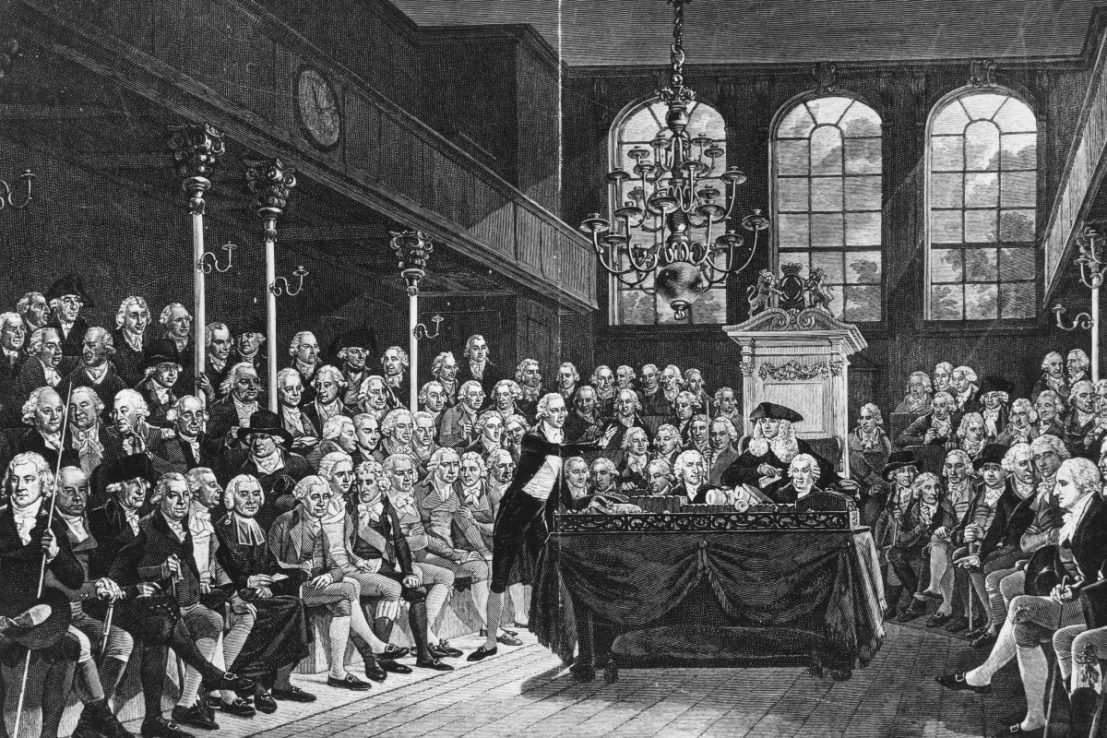
A prodigy and exception, William Pitt the Younger was Britain’s youngest ever Prime Minister. On this day in 1759, he was born, writes Eliot Wilson
In December 1783, the Honourable William Pitt was an outrageous political prodigy. He was not yet 25: three years before, the sickly young Cambridge graduate had been elected MP for Appleby at a by-election, and he had already served eight months as Chancellor of the Exchequer in the Earl of Shelburne’s short-lived government of 1782-83.
When Shelburne had fallen, the Duke of Portland had been appointed to head a government in reality dominated by the eloquent Whig Charles James Fox as foreign secretary and former Tory premier Lord North as Home Secretary. But – imagine it! – prime ministers were proving disposable. Portland was George III’s fourth chief minister in two years: by December 1783 he too was forced out after a defeat in the House of Lords. The King turned to the 24-year-old Pitt and appointed him Prime Minister. He remains the youngest premier in not only British but world history.
What produced this extraordinary figure who fought the Revolutionary and Napoleonic Wars with France when many people today are looking for their first jobs or hoping to find a flat of their own? A contemporary satire described “A sight to make surrounding nations stare; A kingdom trusted to a school-boy’s care”, and few at first thought he would last more than a few weeks in office; but there was very little outright disbelief at his elevation.
The birth of a prodigy
William Pitt was born on this day, 28 May, in 1759 at Hayes Place, his father’s country house in Kent. He was the fourth child and second son of William Pitt the Elder, at that point secretary of state for the Southern Department in the Duke of Newcastle’s government.
In fact, Pitt was virtually co-premier. He and Newcastle had come to power early in the Seven Years’ War (1756-63); Pitt was a brilliant parliamentarian, highly intelligent and erudite, who had demonstrated strategic ability, administrative grip and a noteworthy degree of honesty in nearly a decade as Paymaster of HM Forces. But he had no great body of support in the House of Commons, so an improbable partnership was formed with the Duke of Newcastle, a rich Whig aristocrat who was a mediocre statesman at best but had an unrivalled genius for managing patronage and could deliver the solid parliamentary backing Pitt could not.
The younger Pitt was born into an intensely political family. His father would go on to be Prime Minister in his own right from 1766 to 1768 and was created Earl of Chatham, remembered as one of the best orators of the 18th century. His mother, Hester, was the sister of George Grenville, who would serve as Prime Minister 1763-65; and her uncle was Field Marshal Viscount Cobham, who had been Pitt the Elder’s political mentor in the 1730s.
Pitt’s political devotion
Pitt the Elder’s cercle was not limited to Westminster politicos. The year that the younger William was born, Major General James Wolfe dined at Hayes Place the evening before his departure for North America, where he resumed command of British forces around Quebec and defeated the French at the Plains of Abraham. Benjamin Franklin was a friend and frequent visitor to Hayes Place during his time in London in the 1750s and 1760s.
Family connections and a hothouse atmosphere of politics were hardly remarkable in 18th century high society, however. Henry Pelham had been succeeded as Prime Minister in 1754 by his brother the Duke of Newcastle; the 3d Duke of Portland, twice Prime Minister, was the son-in-law of another premier, the 4th Duke of Devonshire, and had four sons who served in the House of Commons.
Pitt the Younger was a prodigy but a one-off. A sickly child, he was educated at home before matriculating at Pembroke College, Cambridge, aged 14. He worked hard, had a retentive mind and had been coached in oratory by his father. But he was also stiff and remote, even as a young teenager. Shortly after he went up, he suffered an attack of gout for which he was prescribed a bottle of port a day, which may have been clinically disastrous but gave him a taste for drink he would never lose. Henry Addington, a childhood friend who would be Prime Minister in Pitt’s brief 1801-04 spell out of office, remarked that he “liked a glass of port very well, and a bottle better”.
He was destined for politics and he devoted himself to it. Pitt often attended debates in Parliament and was introduced to a constellation of senior figures. He was called to the Bar at Lincoln’s Inn but hardly practiced before he was elected an MP at 21; he remained a Member until his death in 1806.
Pitt’s achievements as Prime Minister
Apart from his name and perhaps his youth, William Pitt the Younger is only hazily remembered now. But he brought order to Britain’s finances, including introducing the first income tax; dominated the Commons and saw the country through the first dozen years of the French Wars; and fought many of the battles which led to the Slave Trade Act 1807, championed by his Cambridge friend William Wilberforce, which prohibited trading in slaves throughout the British Empire.
Pitt was Prime Minister for nearly 19 years (1783-1801, 1804-1806), longer than anyone apart from Walpole. He lived and shaped the office, but it consumed him. He never married, he was always in debt, eventually owing £40,000 (£3m today) and chronic illnesses combined with heavy drinking ruined his health. He died in office on 23 January 1806, exhausted, wracked by abdominal pain, gout and probably cirrhosis, the immediate cause seemingly peptic ulceration. He was 46, and he was done.
But he was a titan who gave his life to governing Britain. Edmund Burke had the measure of him. After Pitt’s maiden speech in the House of Commons in 1781, the great political philosopher, then MP for Malton, said “It is not a chip off the old block which we have, but the old block itself”.
Eliot Wilson is a writer and historian