Oil prices jump as US and Iran trade attacks over Strait of Hormuz
•Oil prices surged over 4% as the US and Iran engaged in hostilities over the Strait of Hormuz.
•The US Central Command conducted multiple strikes on Iranian targets following attacks on commercial vessels.
•Iran retaliated with missile and drone attacks on regional countries while asserting its claim over the waterway.
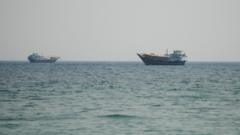
play Live Sign upShow navigation menuNavigation menuNewsShow more news sectionsAfricaAsiaUS & CanadaLatin AmericaEuropeAsia PacificWorld CupMiddle EastExplainedOpinionVideoMoreShow more sectionsFeaturesEconomySportHuman RightsClimate CrisisInvestigationsInteractivesIn PicturesScience & TechnologyPodcastsTravelSponsored Contentplay Live Click here to searchsearchSign upNavigation menucaret-leftUS-Israel war on IranLive updatesStrait of HormuzWhy have strikes resumed?Bodies of Evidencecaret-rightEconomy|US-Israel war on IranOil prices jump as US and Iran trade attacks over Strait of HormuzBrent crude climbs more than 4 percent as Washington and Tehran clash over control of critical waterway. xwhatsapp-strokecopylinkgoogleAdd Al Jazeera on GoogleinfoVessels in the Strait of Hormuz, as seen from Musandam, Oman, on July 9, 2026 [Reuters]By John PowerPublished On 13 Jul 202613 Jul 2026Oil prices have jumped amid the latest outbreak of hostilities between the United States and Iran over the Strait of Hormuz. Brent crude, the main international benchmark, rose more than 4 percent on Monday as Washington and Tehran traded attacks amid their escalating standoff over control of the critical waterway. Brent futures for September delivery stood at $79.29 a barrel as of 02:00 GMT, the highest since June 22. US Central Command (CENTCOM) said on Sunday that it had carried out dozens of strikes on Iran to degrade its ability to attack vessels in the strait, hours after striking hundreds of targets in the country. US forces launched the earlier round of strikes after accusing Iranian forces of “blatantly” attacking a Cyprus-flagged container ship, the MV GFS Galaxy, as it was transiting the strait. “The Strait of Hormuz is a vital maritime corridor for global trade. Iran does not control it,” CENTCOM said in a statement late on Sunday. “US forces are postured and prepared to ensure that freedom of navigation remains available to commercial shipping despite Iran’s continued unwarranted aggression, harassment, threats, and arbitrary declarations.” Iranian forces on Sunday launched a wave of missile and drone attacks against the United Arab Emirates, Qatar, Kuwait, Oman and Bahrain in response to the US strikes. Iran’s Persian Gulf Strait Authority, which claims the right to control traffic through the Strait of Hormuz, earlier reiterated that vessels attempting to cross the waterway without using its preferred route would “not be covered by safe passage guarantees”. “The consequences arising from transit through unauthorized routes shall be the responsibility of the owner, operator, and vessel commander,” the authority said. After ticking up following Washington and Tehran’s signing of a memorandum of understanding on ending the war last month, maritime traffic in the Strait of Hormuz has declined sharply amid the renewed fighting between the sides. Just six vessels were tracked crossing the strait between 18:00 GMT on Thursday and 06:00 GMT on Friday, compared with 18-22 daily crossings earlier this month, according to maritime intelligence platform Windward. Nine vessels were tracked in the waterway between 18:00 GMT on Saturday and 06:00 GMT on Sunday, four of which were flying the Iranian flag, according to Windward. Roughly 130 vessels transited the strait, a conduit for one-fifth of the global oil trade in peacetime, each day before the start of the war. Oil prices, which had returned to pre-conflict levels following the signing of the memorandum on June 17, are now about 9 percent higher than before the US and Israel launched their initial strikes on Iran in late February. Mukesh Sahdev, founder and chief oil analyst at XAnalysts in Sydney, Australia, said he expects the per-barrel price of Brent to remain in the upper $70s during August and September amid the heightened geopolitical uncertainty. “There could be occasional spikes and dips outside that range,” Sahdev said in a note to clients on Saturday. “Long-haul procurement forces refiners to make supply decisions weeks in advance,” Sahdev added. “Those decisions have already reduced immediate reliance on the Middle East, and the latest escalation is likely to reinforce rather than reverse that trend.” Fabien Yip, a market analyst at IG in Sydney, Australia, said prices are unlikely to approach the much higher levels seen earlier in the war despite the latest turmoil. “Oil’s return towards pre-war levels in June reflected markets pricing in a best-case outcome for the fragile US-Iran arrangement; last week’s re-escalation exposes how fragile that assumption was,” Yip said in a note to clients on Monday. “Near-term, the risk premium should keep prices supported, though a repeat of the earlier spike appears unlikely, as demand remains slow to recover while stranded-tanker releases and OPEC+ output quota expansion continue to add barrels to an already oversupplied outlook.” Major Asian stock markets fell on Monday amid the renewed fighting in the Middle East. Japan’s benchmark Nikkei 225 fell more than 1 percent in morning trading, while South Korea’s Kospi plunged more than 5 percent. Hong Kong’s benchmark Hang Seng Index dipped about 0.2 percent. Advertisement AboutAboutShow moreAbout UsCode of EthicsTerms and ConditionsEU/EEA Regulatory NoticePrivacy PolicyCookie PolicyCookie PreferencesAccessibility StatementSitemapWork for usConnectConnectShow moreContact UsUser Accounts HelpAdvertise with usStay ConnectedNewslettersChannel FinderTV SchedulePodcastsSubmit a TipPaid Partner ContentOur ChannelsOur ChannelsShow moreAl Jazeera ArabicAl Jazeera EnglishAl Jazeera Investigative UnitAl Jazeera MubasherAl Jazeera DocumentaryAl Jazeera BalkansAJ+Our NetworkOur NetworkShow moreAl Jazeera Centre for StudiesAl Jazeera Media InstituteLearn ArabicAl Jazeera Centre for Public Liberties & Human RightsAl Jazeera ForumAl Jazeera Hotel PartnersFollow Al Jazeera English:المصدر: Al Jazeera English | Source: Al Jazeera English
→Oil prices surged over 4% as the US and Iran engaged in hostilities over the Strait of Hormuz.
→The US Central Command conducted multiple strikes on Iranian targets following attacks on commercial vessels.
ملاحظة تحريرية | Editorial Note: نُشر هذا المقال في الأصل بواسطة Al Jazeera English. خبر (Khabr) هي منصة إعلامية أردنية مرخّصة تعمل بالذكاء الاصطناعي. نضيف قيمة تحريرية من خلال: تحليل ذكي للأخبار، ملخصات تلقائية، رواية صوتية بالذكاء الاصطناعي، ترجمة متعددة اللغات، وتدقيق الحقائق. هدفنا جعل الأخبار أكثر وضوحاً وسهولةً للقارئ العربي.
This article was originally published by Al Jazeera English. Khabr is a licensed Jordanian AI-powered news platform (Registration #82086). We add editorial value through: AI-powered news analysis, automated summaries, AI audio narration, multi-language translation (Arabic, English, French, Turkish), and AI fact-checking. Our mission is to make news more accessible and understandable for Arabic-speaking audiences worldwide.