Noida workers’ protest: Industry body questions wage hike timing, says, ‘Govt shouldn’t be under pressure’
✨ AI Summary
🔊 جاري الاستماع
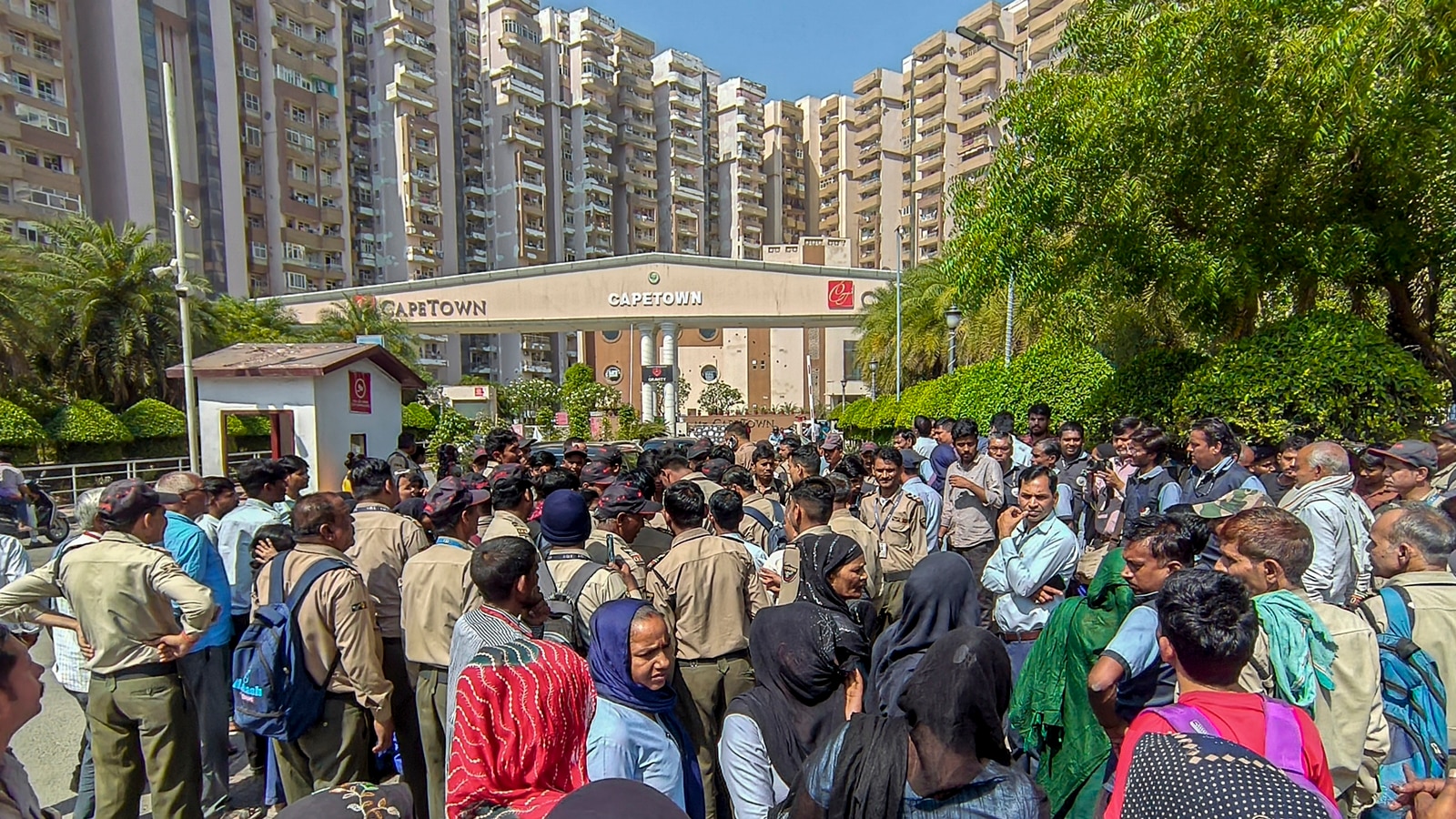
Weather ePaper Today’s Paper Journalism of Courage Home ePaper Politics Explained Opinion India Business Premium Cities UPSC Entertainment Sports World Lifestyle Tech Subscribe Sign In TrendingUPSC OfferIPL 2026US NewsPuzzles & GamesLegal NewsFresh TakeHealthResearch🎙️ Podcast Advertisement function checkAndLoadWindowSizeScript() { if (window.jQuery) { // jQuery is loaded, include your script jQuery(document).ready(function($) { // Your existing script for checking window width if (window.innerWidth) var page_w = window.innerWidth; else if (document.all) var page_w = document.body.clientWidth; if (page_w > 1024) { $(".add-left, .add-right").show(); } else { $(".add-left, .add-right").hide(); } }); } else { // jQuery is not loaded, check again after 0.2 seconds setTimeout(checkAndLoadWindowSizeScript, 200); } } // Initial call to the function checkAndLoadWindowSizeScript(); NewsCitiesLucknowNoida workers' protest: Industry body questions wage hike timing, says, ‘Govt shouldn’t be under pressure’ Noida workers’ protest: Industry body questions wage hike timing, says, ‘Govt shouldn’t be under pressure’ While sources said the government is in the process of forming the new wage board, there are concerns in industry about the timing of the interim hike, which came soon after protests. Written by: Maulshree Seth5 min readLucknowApr 17, 2026 04:17 AM IST Security guards stage a protest over fee hike issues outside a residential society at Sector 74, in Noida, Tuesday, April 14, 2026. (PTI Photo) Make us preferred source on Google Whatsapp twitter Facebook Reddit PRINT The Uttar Pradesh government’s decision to implement revised interim wages soon after labour protests has left industry stakeholders, especially MSMEs, worried about future implications, even as the state prepares to constitute a long-pending wage board after seven years. In a state set to enter election mode in the next few months, the recent Noida protest has put the government in a difficult position. On one hand, it is trying to woo the large workforce and on the other, it has an ambitious one-trillion-dollar economy target to achieve. While sources said the government is in the process of forming the new wage board, there are concerns in industry about the timing of the interim hike, which came soon after protests. “We welcome the move of the hike as it was anyways due but we have our grievances as well. Government should not have done this under pressure, it should have waited,” said Alok Agarwal, senior vice president, of the Indian Industries Association (IIA), who runs a leather footwear business in Kanpur. “Yeh sarkar famous hai ki dabav mein kaam nahi karti hai. (This government is known for not working under pressure.) But this time, without taking industry into confidence, such a decision was taken overnight soon after protests. This has given a message, “hartal kar lo, apni baat manwa lo (stage a strike, get your demands accepted),” said Agarwal. He cited pressure on MSME units already due to the global war situation, rising prices of polymers, fuel and crude oil, and a slow market. “Price hike karen, this was expect but the way it was done, the message has gone in the market contrary to the perceptive image of the Government that “dabav mein kaam nahi karte” Agarwal maintained, adding, “We were expecting the revised rates to come into force soon as Wage Board was last constituted in 2014 and was already due. We were preparing comments for the new wage board for discussions but then this sudden announcement came in.” Vikas Khanna, Chairman of IIA, Lucknow Chapter, who runs his own packaging business said, “For past two-three months, there has been some problem or the other, be it gas, crude oil or rise in the prices of plastic products. There is a proper procedure to be followed for deciding minimum labour wages. A committee is formed, representation is heard from all sides.” He said while a new wage board might come soon, “The fact remains that once the salary increases, it cannot go back. It is to be seen how it is done in the future when actual rates are decided,” adding, “Our main concern is the hurry in which the interim rates were announced. It might set the wrong precedent.” Industry stakeholders fear that even though the hike is termed “interim”, the government cannot roll it back and will have to use it as a base for a permanent formula. “Technically, a wage board is constituted after five years. It was last constituted in 2014, which lapsed in 2019. While it usually takes more than five years to constitute it, this time it went over 12 years because of many possible reasons — COVID in 2019 and also the Wage Code introduced by the Government of India in 2019, as per which the Central Government was to decide a floor rate, while states could make their changes, but with a condition that it would not be lower than floor wage rate decided by the Central Government, but even that could not be implemented for some reasons,” an officer explained. He added that the government was already in the process of constituting a new wage board as per the existing Minimum Wages Act 1948, when suddenly Haryana decided to announce the revised rates simmering the situation in adjoining districts of UP. Meanwhile, sources say, attempts are being made to identify those behind the unrest and send a message that it was done by outsiders, not by actual workers. The government does not want to be on the wrong side of the larger workforce, which it claims is Uttar Pradesh’s USP. Recently, Chief Minister Yogi Adityanath had said UP’s large population and young workforce are its strength. UP has the largest network of MSMEs in the country, the most labour-intensive sector. Additionally, the Noida Police on Thursday identified three main accused in the workers’ protest that turned violent on Monday, and said two X (formerly Twitter) handles operating from Pakistan were also identified for spreading misleading information and disrupting peace. Even as the Government is making attempts to take both workers and the Industry into confidence, the latest protests are likely to make things difficult for the government, with the Opposition also gearing up for the upcoming elections. All eyes are now on how the final minimum wage rate is decided in Uttar Pradesh. Further, with the state trying to attract investment from India and abroad, sources said fresh efforts would be needed to project UP as a safe space for industry. Ministers have recently visited Japan, Germany and the UK, pitching the large labour force and market as key selling points. Maulshree Seth is an Assistant Editor with The Indian Express, based in Lucknow. With over 15 years of experience in mainstream journalism, she has built a formidable reputation for her on-ground reporting across Uttar Pradesh. Her expertise spans a wide array of critical beats, including state politics, governance, the judiciary, and rural development. Authoritativeness Maulshree’s work is characterized by depth and historical context. Her coverage of high-stakes state elections and landmark judicial rulings has established her as an authoritative voice on the intersection of law and politics in Northern India. She is frequently recognized for her ability to gain access to primary sources and for her nuanced understanding of the socio-economic factors that drive the world's most populous sub-national entity. Trustworthiness & Ethical Journalism Her reporting is rooted in rigorous fact-checking and a steadfast dedication to neutral, unbiased storytelling. By prioritizing field-based verification—often traveling to the most remote corners of the state—she ensures that her readers receive a truthful and comprehensive view of events. ... Read More Stay updated with the latest - Click here to follow us on Instagram