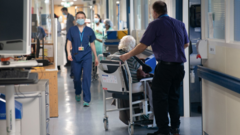
Nearly 3,000 patients a day face corridor care in NHS
•Nearly 3,000 patients a day face corridor care in NHS21 minutes agoShareSaveAdd as preferred on GoogleNick Triggle,Health correspondentandChloe HaywardPA MediaNearly 3,000 patients a day had to be car...
•It is the first time the data has been published and reveals the scale of the challenge facing the NHS in tackling what ministers say is "unsafe" and "unacceptable".
•Corridor care is when patients spend more than 45 minutes waiting for an appropriate place for their care and ministers have pledged to eradicate the practice by 2029.
هذا الخبر من BBC Health. خبر يقدم أدوات ذكاء اصطناعي للتلخيص والترجمة والاستماع.
Nearly 3,000 patients a day face corridor care in NHS21 minutes agoShareSaveAdd as preferred on GoogleNick Triggle,Health correspondentandChloe HaywardPA MediaNearly 3,000 patients a day had to be cared for in hospital corridors or make-shift treatment areas rather in a bed on a ward in England last month, figures show. It is the first time the data has been published and reveals the scale of the challenge facing the NHS in tackling what ministers say is "unsafe" and "unacceptable". Corridor care is when patients spend more than 45 minutes waiting for an appropriate place for their care and ministers have pledged to eradicate the practice by 2029. In A&E this can be in corridors and side-rooms and make-shift treatment areas where there is not the proper equipment to keep them safe and maintain dignity. On the wards, it is when patients have been waiting for a bed for 45 minutes or more. The figures show during May there were 2,241 patients a day, on average, who experience corridor care, while on wards there were 669. NHS analysis found that 20 trusts accounted for more than half of the cases of corridor care in A&E, while 20 trusts also accounted for more than two thirds elsewhere in hospitals. Health Secretary James Murray said: "Corridor care is unacceptable, undignified and has no place in our NHS. "That is why, for the first time, we are publishing this data to shine a spotlight on where the problems are greatest and ensure trusts get the support they need, with the vast majority of corridor care concentrated in a small number of organisations." OtherSuzanne has taken her mother, who is in her 80s, to A&E in the East Midlands five times this yearStaff and patients have told BBC Your Voice of the problems they have experienced with corridor care. Suzanne has taken her mother, in her 80s, to A&E in the East Midlands five times this year. Every visit meant more than 24 hours waiting in a corridor. "Mum was one trolley in a sea of trolleys," Suzanne recalls. Confused and distressed, her mother was only helped to the toilet or given a drink because family were there, she says. "If we hadn't been, I dread to think what might have happened." Kathy's experience was no better. Sent in by her GP one morning earlier this year with a suspected eye infection, she waited 36 hours in a chair, alone, in a hospital in the East of England before being told her blurred vision was caused by a brain tumour. "It was horrendous… I got home and threw up. I was exhausted and broken." Nurses, who asked to remain anonymous, described burnout and impossible conditions. One recalled a shift where the corridor was lined with patients. A body had to be wheeled past them on its way to the mortuary. Later, another patient went into cardiac arrest in the same corridor. "Those frail patients watched chest compressions. There's no dignity in that." Another nurse said her emergency department felt "like a war zone". She described a patient who died unnoticed in the corridor. "He'd started to stiffen because he had been there for so long, dead, with no-one noticing. It's horrific to think someone's loved one died with no one near them." NHSالمصدر: BBC Health | Source: BBC Health
ملاحظة تحريرية | Editorial Note: نُشر هذا المقال في الأصل بواسطة BBC Health. خبر (Khabr) هي منصة إعلامية أردنية مرخّصة تعمل بالذكاء الاصطناعي. نضيف قيمة تحريرية من خلال: تحليل ذكي للأخبار، ملخصات تلقائية، رواية صوتية بالذكاء الاصطناعي، ترجمة متعددة اللغات، وتدقيق الحقائق. هدفنا جعل الأخبار أكثر وضوحاً وسهولةً للقارئ العربي.
This article was originally published by BBC Health. Khabr is a licensed Jordanian AI-powered news platform (Registration #82086). We add editorial value through: AI-powered news analysis, automated summaries, AI audio narration, multi-language translation (Arabic, English, French, Turkish), and AI fact-checking. Our mission is to make news more accessible and understandable for Arabic-speaking audiences worldwide.