NASA launches robotic mission to save space telescope
•Our Privacy Statement & Cookie Policy By continuing to browse our site you agree to our use of cookies, revised Privacy Policy and Terms of Use.
•You can change your cookie settings through your browser.
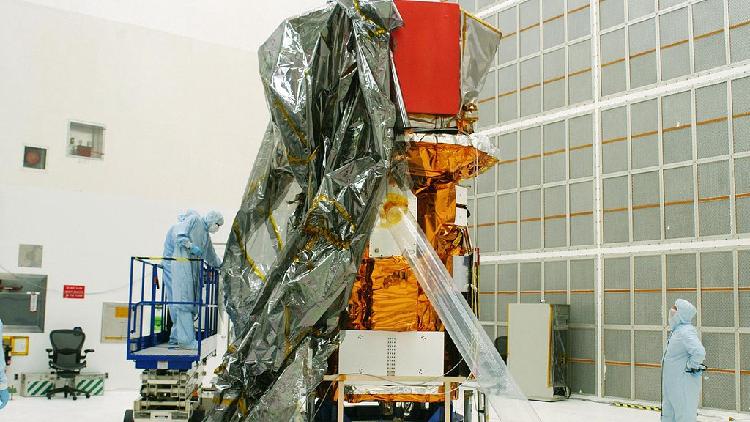
•The Swift space telescope being unwrapped in Hangar AE at Cape Canaveral Air Force Station at Kennedy Space Center, Florida, the US, July 31, 2004.
هذا الخبر من CGTN EN. خبر يقدم أدوات ذكاء اصطناعي للتلخيص والترجمة والاستماع.
Our Privacy Statement & Cookie Policy By continuing to browse our site you agree to our use of cookies, revised Privacy Policy and Terms of Use. You can change your cookie settings through your browser. The Swift space telescope being unwrapped in Hangar AE at Cape Canaveral Air Force Station at Kennedy Space Center, Florida, the US, July 31, 2004. /VCG NASA launched a robotic mission on Friday to try to prevent one of its aging telescopes from burning up in the atmosphere, a complicated operation expected to last several months. The unprecedented $30 million effort involves sending a robot to rescue the Swift space telescope that's currently falling towards Earth. If successful, the mission could pave the way for giving other satellites a second life. Initially scheduled for Tuesday, the robot's launch was postponed due to weather and then technical issues. It finally took place on Friday at 0836 GMT from an atoll in the Pacific Ocean. Developed by American startup Katalyst, the spacecraft was launched by a small rocket named Pegasus, itself launched from an airplane. Once it reaches an orbit close to that of Swift, the robot will deploy its solar panels and perform a series of checks. It will then have to locate the Swift telescope in the vastness of space, circle around it and dock with it using three robotic arms – maneuvers expected to take several weeks. Finally, it will attempt to propel the satellite approximately 300 kilometers higher above the Earth, roughly to its initial orbital position. That operation is expected to last at least a month. The Swift telescope cost $250 million and is used to study gamma-ray bursts, the most powerful explosions in the universe. "This is a lot of firsts stacked on top of each other," Shawn Domagal-Goldman, director of NASA's astrophysics division, told reporters Tuesday. "I'm just deeply thankful that we're even giving this a go."المصدر: CGTN EN | Source: CGTN EN
ملاحظة تحريرية | Editorial Note: نُشر هذا المقال في الأصل بواسطة CGTN EN. خبر (Khabr) هي منصة إعلامية أردنية مرخّصة تعمل بالذكاء الاصطناعي. نضيف قيمة تحريرية من خلال: تحليل ذكي للأخبار، ملخصات تلقائية، رواية صوتية بالذكاء الاصطناعي، ترجمة متعددة اللغات، وتدقيق الحقائق. هدفنا جعل الأخبار أكثر وضوحاً وسهولةً للقارئ العربي.
This article was originally published by CGTN EN. Khabr is a licensed Jordanian AI-powered news platform (Registration #82086). We add editorial value through: AI-powered news analysis, automated summaries, AI audio narration, multi-language translation (Arabic, English, French, Turkish), and AI fact-checking. Our mission is to make news more accessible and understandable for Arabic-speaking audiences worldwide.